


- Home

- Learn
- Healthcare
- Trella Health alternatives for home health and hospice care
HEALTHCARE
Trella Health alternatives for home health and hospice care
Contents

 15 min read
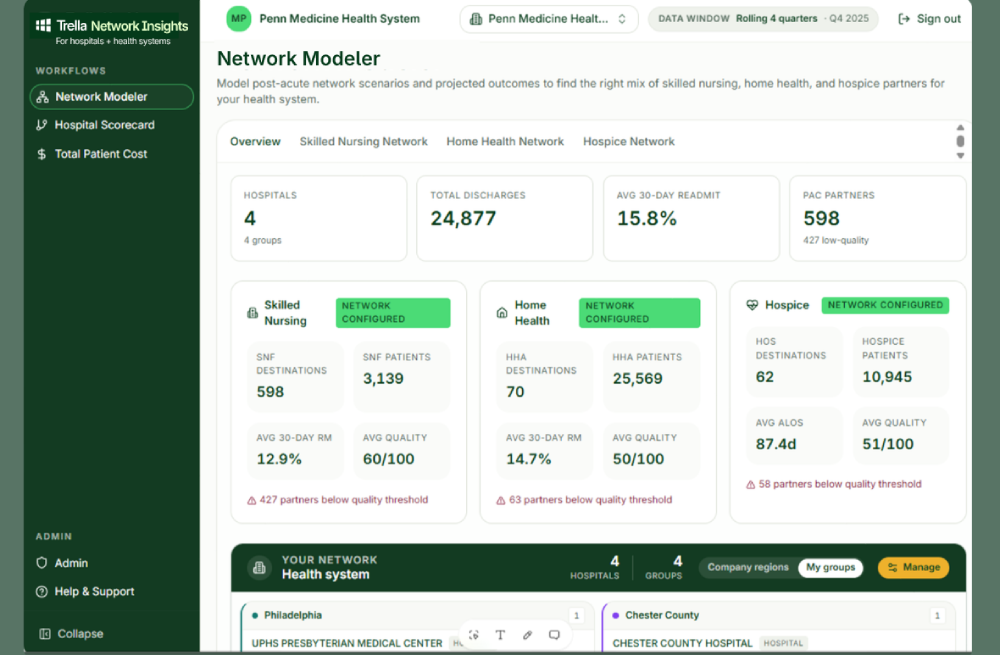


Trella Health offers two products to support referral management across home health and hospice agencies:
Trella CRM helps business development teams manage referral relationships, record sales activities, and track referrals through to admission.
Trella Community, its referral management and intake platform, helps intake teams:
For agencies evaluating Trella, the important consideration is how well these products support the way their teams manage referrals.
For example, agencies with large business development teams may need to distribute incoming referrals according to staff workload and availability. Trella’s standard CRM integration instead assigns referrals based on ownership recorded in the EHR or the owner of the referring facility or physician. This is an important distinction for agencies that need more control over how incoming opportunities are distributed.
Agencies should also note that Trella CRM and Community are sold as separate products, rather than as a single, combined offering.
If Trella’s approach does not align with how your agency manages referrals and admissions, fortunately, other healthcare platforms may offer better ways to coordinate these workflows.
This guide explores why home health and hospice agencies consider switching from Trella Health, reviews four of the best alternatives for referral management and patient intake, and explains how to choose the right platform for your agency.
Trella Health helps agencies understand their markets and manage referral relationships. However, some customer reviews highlight limitations in the data available and how easily agencies can use it to guide business development.
Trella’s market intelligence relies on Medicare claims data, which does not provide a real-time picture of referral activity. Several reviewers report that the information can be three to four quarters old, with some describing delays of around six months. This makes it harder for agencies to identify new competitors, track recent changes in referral patterns, and assess emerging opportunities in their service areas. For example, a hospice agency may not see recent changes in patient utilization at a facility until months after they occur. Agencies that need current market information to guide their outreach may find this reporting lag limiting.
Trella does not provide every level of provider and referral-source detail that agencies need for business development. Reviewers have reported difficulty identifying physicians in private practices, locating assisted living facilities where competitors’ hospice patients reside, and finding certain referral sources in the dataset. Others want to group physicians by their practice or medical group to measure referral performance across their networks. These gaps make it harder for liaisons to identify specific facilities and providers with growth potential and prioritize their outreach accordingly.
Some reviewers find it time-consuming to create reports tailored to their needs. They have requested ready-made report templates, more flexible presentation options, and better ways to organize data for discussions with referral partners. One reviewer noted that some charts contain so much information that they are difficult to print and use in meetings. This can leave business development teams spending extra time preparing market insights before they can share them with hospitals, physicians, and other referral sources.
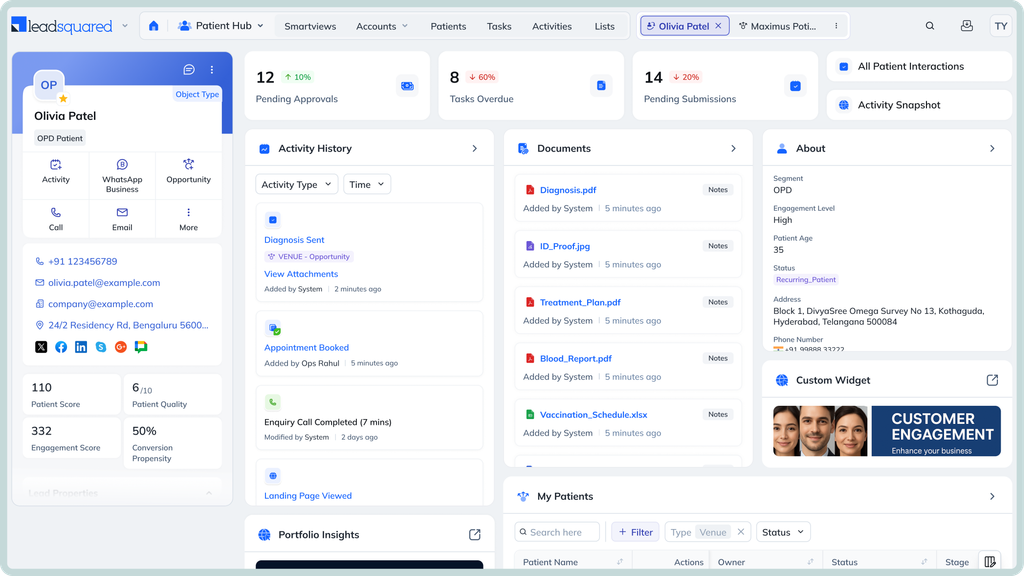
Mid-sized and large home health and hospice agencies with dedicated business development and intake teams, including multi-branch organizations.
LeadSquared’s home care CRM suits agencies that need to coordinate referral acquisition, liaison activity, intake follow-ups, and patient communication across locations.
LeadSquared connects with healthcare systems, including EHR/EMR platforms, through native integrations and third-party connectors
It also offers Universal Data Sync (UDS), a no-code platform for configuring and managing data exchanges with external systems. This gives your team a way to configure integrations beyond LeadSquared’s ready-made connectors. The data available for exchange also depends on the EHR/ tool that LeadSquared integrates with.
LeadSquared is fully HIPAA-compliant and offers a Business Associate Agreement (BAA). Security measures include encryption in transit and at rest, access controls, audit logging, and SOC 2 and ISO 27001 credentials.
LeadSquared uses subscription-based pricing. Your healthcare CRM costs will depend on the number of users and the modules your agency needs. Integrations and implementation requirements also affect the final quote. Contact LeadSquared for pricing based on your workflows and existing technology setup.
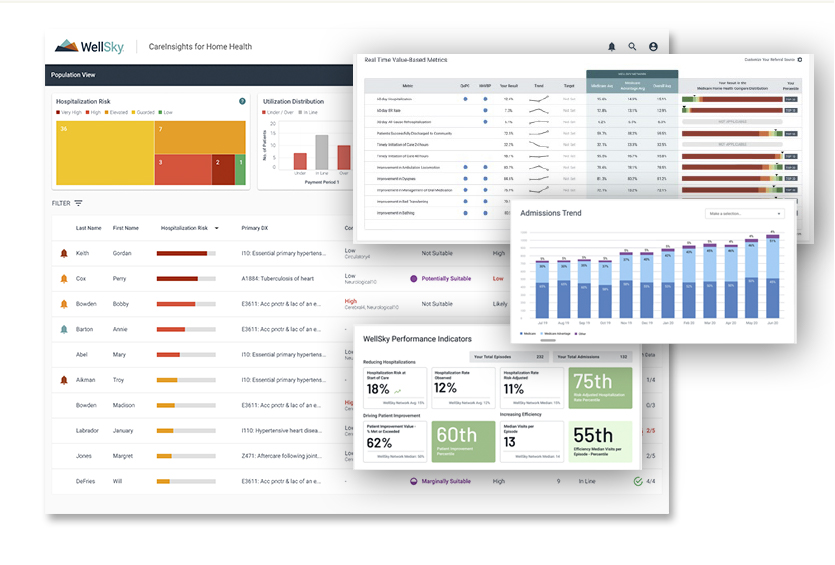
Home health and hospice agencies using WellSky EHR, particularly those managing high referral volumes across multiple teams or locations. It is designed to streamline intake and coordinate referral activity within the WellSky ecosystem.
Connect referrals from CarePort, eFax, Direct Secure Messaging, and other referral networks. Patient and referral information can flow directly into the WellSky EHR. WellSky also describes connections with multiple EHR systems, so confirm compatibility and data exchange scope for your existing setup.
WellSky claims HIPAA compliance and provides a BAA. Its published SOC 3 report describes encryption at rest and in transit and least-privilege access controls. Confirm the applicable security documentation and contractual coverage for your specific deployment.
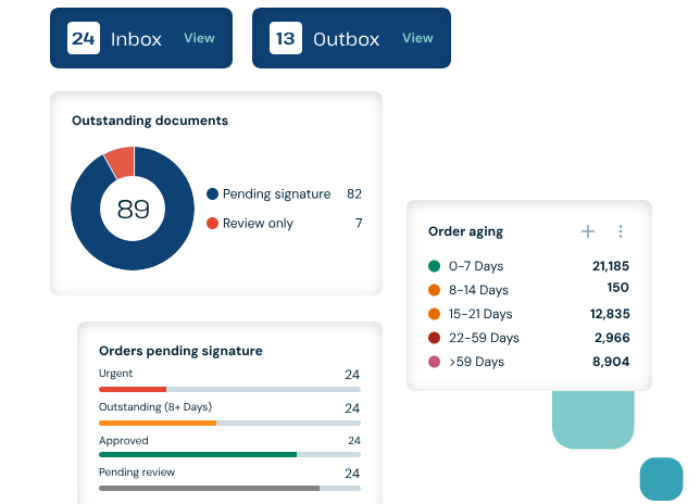
Home health and hospice agencies handling high volumes of referral documents. Particularly relevant to centralized intake teams that need structured document workflows across branches.
Mosai integrates with Homecare Homebase (HCHB), allowing referral documents to be attached directly to patient charts. It also lists integrations with MatrixCare and Axxess. Confirm the available data flows and functionality for your EHR.
Mosai states that its platform aligns with HIPAA, AICPA SOC, and HITRUST security standards.
No public vendor pricing. Request a quote based on your modules, integrations, and agency requirements.
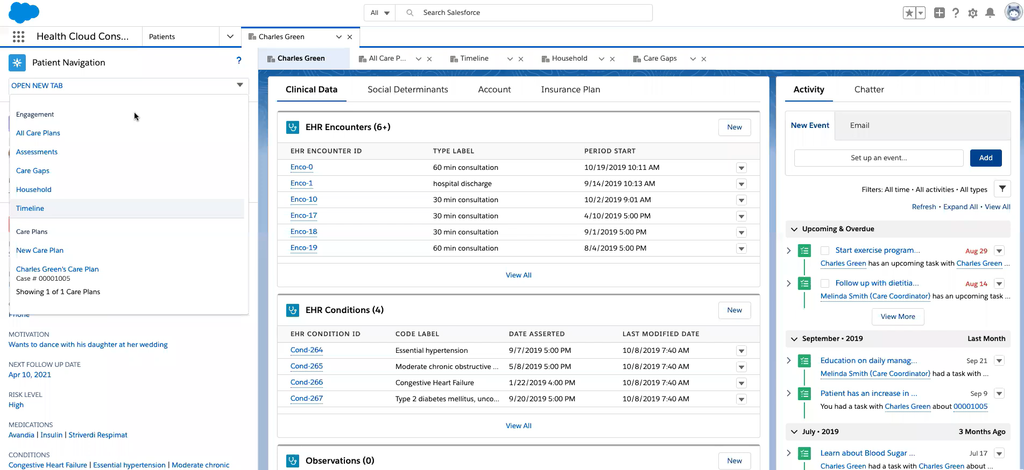
Large home health and hospice organizations with multiple branches, complex referral workflows, and dedicated IT teams. It suits agencies that can invest in configuring and maintaining an enterprise CRM.
Health Cloud uses FHIR-aligned data models and APIs to exchange clinical information with EHRs. You can also use MuleSoft to build Salesforce integrations with external systems.
Salesforce supports HIPAA-compliant deployments and offers a Business Associate Addendum (BAA). Security options include encryption, access controls, and audit monitoring. Only services covered by the BAA should handle PHI.
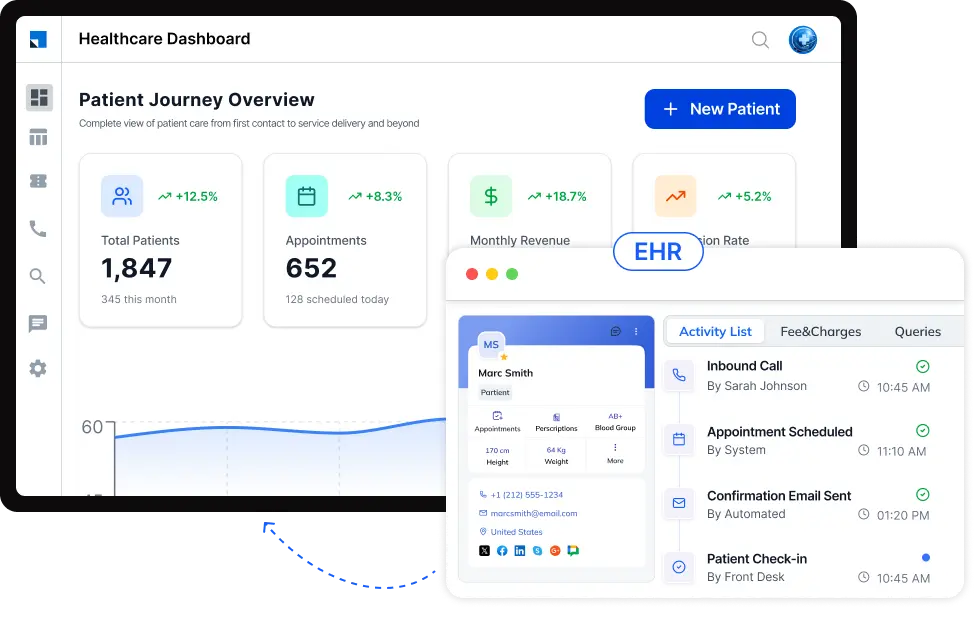
Consider a hospital discharge planner who contacts your agency about a patient who needs home health services. Your team must capture the referral, route it to the right branch or intake coordinator, follow up promptly, and track whether the patient progresses toward admission.
Here’s how LeadSquared’s healthcare CRM and connected tools support this journey.
A hospital case manager or family member might call your agency after business hours to ask about available services or the referral process. LeadSquared’s AI voice agent, Invorto, can answer questions using your agency’s configured knowledge base. It can also collect caller details and other information you configure, then generate a call transcript, summary, and structured insights for your intake team to review.
Once a referral enters LeadSquared, you can route it to the appropriate branch or intake coordinator based on factors such as service area and referral type. The Distribution Engine can also account for staff availability and current workload when assigning records. If a coordinator misses a configured first-response deadline, it can automatically reassign the referral to keep follow-ups moving.
Your liaisons can use LeadSquared’s mobile CRM to access referral partner profiles, review interaction histories, and record the outcome of each visit. They can plan daily routes, navigate between hospitals and physician offices, and log check-ins and follow-up activities from the field. This also gives managers visibility into partner engagement and territory coverage.
When a family or referral partner submits an inquiry through your website, FloStack can use details such as location and service interest to direct them to the appropriate next step. You can guide visitors to a personalized microsite with relevant service information or let them book a meeting with an assigned liaison or coordinator through a configured calendar. This helps your team manage website inquiries without manually sorting every submission.
LeadSquared’s Universal Data Sync (UDS) can connect the CRM with EHR and other healthcare systems through configured data flows and API integrations. Depending on the connected system and mapped fields, you can synchronize relevant referral details and status updates. Your team can then use CRM reports to track referral sources, response times, intake progress, and admissions across branches.
If you’re evaluating Trella Health alternatives, a demo can help you explore how LeadSquared’s healthcare CRM and connected tools support your agency’s referral and intake workflows.
Book a demo to discuss your goals and see how LeadSquared fits into your existing systems.
Look beyond the size of the database. Check which data sources the platform uses, how frequently it updates its records, and how much detail it provides about physicians, hospitals, post-acute providers, and referral patterns. Also ask whether the data covers your agency’s service areas and reflects the payer mix and patient populations you want to reach. Request sample reports for your markets before choosing a platform.
Yes, but check whether the platform supports the distinct workflows and reporting needs of both service lines. Home health agencies may prioritize physician and hospital referrals, payer mix, and service-area coverage. Hospice agencies also need to understand hospice-appropriate patient populations, referral patterns, and quality indicators. If your organization operates both, look for service-specific reporting and workflows rather than assuming one generic setup will cover both.
Compare the full cost of ownership rather than just the subscription price. Ask about per-user fees, separate charges for market intelligence or CRM modules, implementation, data migration, integrations, staff training, and ongoing support. Also clarify contract terms and renewal pricing. These details help you understand what the platform will actually cost as your agency and team grow.
Prioritize referral partner and account records, contact details, liaison activity, interaction notes, referral histories, and relevant performance reports. Ask the outgoing and incoming vendors which records can be exported and imported, whether historical activity remains accessible, and whether relationships between accounts and contacts are preserved. Test a sample migration before switching fully so your team does not lose important relationship history.
Implementation time depends on the platform, number of users and locations, customization, integrations, and amount of historical data to migrate. A straightforward CRM setup will generally involve less work than a deployment requiring custom referral workflows and multiple system integrations. Ask vendors for a written implementation plan covering data migration, configuration, testing, staff training, and go-live support.
Compare platforms based on how well they meet your agency’s referral management and operational needs. Prioritize these criteria:
Referral-to-admission visibility: Look for end-to-end referral tracking with clear visibility into acceptance and admission outcomes.
Liaison productivity: Prioritize mobile access to referral partner records, visit planning, interaction logging, and follow-up management.
EHR integration: Check compatibility with your existing EHR/EMR and the ability to exchange relevant referral and patient data.
Intake automation: Assess how well the platform captures referrals from different channels, extracts key details, and routes them to the right team.
Reporting: Look for reports that connect referral sources and volumes with admission outcomes across branches.
HIPAA compliance and security: Confirm that the vendor will sign a BAA and provide safeguards such as encryption, access controls, and audit logs.
Implementation and scalability: Inquire about the effort involved in setup, data migration, integration, and training. Check whether the platform can accommodate future growth.
Enter your details and we'll send you a quick confirmation email to verify your address.
 17 min read 16 min read 17 min read


