





EDUCATION
Early warning signs an admissions counselor needs performance coaching — before enrollment declines
Contents

 17 min read


Every admissions leader has had that moment: A counselor who seemed fine suddenly shows up in the bottom quartile of your enrollment report.
You trace it back and realize the signals were there weeks ago — dipping CSAT scores, slow follow-ups, call notes that stopped getting filled in. You just didn’t have a system to catch it.
That gap — between when performance starts to slide and when a leader notices — is where enrollments are lost. And in a competitive higher education environment, where every qualified lead is hard-won, that gap is expensive.
This guide gives you a practical, evidence-based system for how to identify counselors who need performance coaching — before outcomes suffer. It covers the early warning signs, the KPIs worth monitoring, the methods for identifying root causes, and how an education CRM ties it all together.
This guide synthesizes widely-used performance management frameworks and contact center benchmarks, adapted here for higher education enrollment contexts.
The cost of a struggling counselor isn’t just missed conversions.
It’s the prospective student who got a rushed, scripted call and chose another institution. It’s the advisor who burned out because no one intervened early enough. It’s the team morale dip when one rep’s workload gets quietly redistributed.
Gallup’s performance management research consistently shows that frequent, timely feedback produces significantly better outcomes than infrequent, backward-looking reviews. Workplace coaching consistently produces measurable performance gains; but only when it’s structured, timely, and tied to specific behaviors. Most admissions teams are still running on lagging indicators: semester-end conversion summaries, annual reviews, or escalation complaints from students. By that point, the window for early intervention has already closed.

The shift from reactive to proactive performance management isn’t about surveillance. It’s about giving your counselors a fair shot. Most underperformance has a fixable cause: a skill gap, a process breakdown, or a motivation issue. And the earlier you find it, the more options you have.
Before getting into signals and metrics, it’s worth being clear on language.
Performance coaching is proactive and developmental. It happens when a counselor is drifting off track, and the goal is to course-correct early with targeted support.
Remediation is reactive. It typically involves formal documentation, HR involvement, and a last-chance framework.
The goal of this article is to keep your counselors in the coaching lane — not the remediation lane. That only happens if you’re watching the right signals, early enough to act.
Also read: 7 Tips To Increase Admissions Counselor Productivity & Enrollments
Performance signals fall into two buckets: leading indicators that predict trouble ahead, and lagging indicators that confirm it’s already here.
The thresholds below draw on established contact center workforce management practice, adapted as calibration starting points for admissions environments. Before setting up alerts, establish your own baseline using 8–12 weeks of team data.
These are the metrics you want your live dashboards to report. They’re forward-looking and give you a two-to-four-week window to intervene before outcomes deteriorate.
Flag counselors whose schedule adherence falls below 92% for two consecutive weeks — the midpoint of the 85–95% range widely used as the industry standard in contact center environments, adapted here for admissions teams. (Source).
Counselors who are consistently missing login times, skipping scheduled call blocks, or showing irregular availability are often struggling with something — workload, disengagement, or personal stress. Adherence isn’t just an operational metric; it’s an early stress signal.
A new counselor taking longer on calls is normal. A mid-tenure counselor suddenly running long may be struggling with objection handling, knowledge gaps, or over-explaining out of anxiety. Context matters, but the delta is worth investigating.
A useful starting flag is 25% above matched peers — adjust based on your own baseline data.
Most admissions QA rubrics cover discovery quality, empathy, information accuracy, compliance language, and follow-up commitment. A counselor consistently scoring below 80 needs a targeted review — not a general pep talk.
Gong’s analysis of over 25,000 sales calls found the average talk-to-listen ratio is closer to 70:30 — meaning most agents spend around 70% of a conversation talking rather than listening — while the ideal ratio for top converters is 43:57. (Source).
In effective enrollment counseling, listening is the job. When a counselor is dominating 70% or more of the conversation, they’re typically script-reading rather than consulting. Conversation intelligence tools embedded in a CRM can surface this automatically.
If a counselor commits to calling a prospective student back within 24 hours and misses that window more than 5% of the time, you have either a capacity issue or a prioritization issue. Either way, it needs attention.
A 5% breach rate is a practical starting flag for most teams — calibrate against your own SLA commitments and lead volume.
This is one of the most reliable early warning signs to identify underperforming counselors. When a rep stops logging the next steps on the CRM, they’ve usually lost track of their pipeline. Prospective students fall through the cracks without anyone realizing it.
15% is a reasonable internal flag — your actual threshold should reflect your CRM workflow and counselor caseload.
Excessive post-call wrap time can indicate difficulty with documentation, cognitive overload, or CRM unfamiliarity — all of which point to trainable gaps.
By the time these surface, you’ve already lost something. But they’re essential for confirming the pattern and scoping the problem.
One bad week can be noise. A sustained conversion drop against matched peers is signal.
Matching by tenure, lead source, and program type is critical here — comparing a first-year counselor to a five-year veteran tells you nothing useful.
A counselor whose Customer Satisfaction Score (CSAT) or Net Promoter Score (NPS) sits in the bottom quartile of your team for three consecutive weeks — not measured against a generic industry benchmark, but against your own program’s performance distribution — is showing a consistent pattern worth investigating.
When counselors can’t answer basic questions or resolve concerns on the first touch, it fragments the student experience and inflates workload for everyone.
A sudden spike in escalated calls or complaints isn’t always the counselor’s fault — but it’s always worth investigating.
In higher education, compliance requirements around financial aid, program outcomes, and accreditation are non-negotiable. Counselors who repeatedly violate these standards should be flagged for immediate coaching, regardless of how their other metrics look.
If you’re wondering how to identify counselors or reps who need performance coaching, know that numbers tell you that something is wrong. Observation tells you why.
A counselor who hasn’t reviewed a prospect’s application history before calling, or who regularly fails to send promised materials, is showing a prioritization or engagement gap.
This is a coachability signal, not just an attitude issue. A rep who consistently deflects, minimizes, or becomes visibly resistant during feedback sessions may be dealing with something deeper — fear of failure, distrust of management, or a motivation problem.
Effective enrollment counselors ask follow-up questions. They probe for the student’s real hesitation. When a counselor is reading from a checklist rather than consulting, the student experience flattens — and so does conversion.
Brief, formulaic notes (“called, left VM, will follow up”) are a red flag. Rich notes reflect genuine engagement with the student’s situation. Thin notes suggest the rep isn’t retaining information or isn’t invested in the relationship.
Some counselors begin over-escalating — passing difficult questions to supervisors or financial aid rather than developing the skills to handle them. Occasional escalation is appropriate. A pattern of avoidance is not.
Spotting these signals requires a combination of structured observation, data review, and direct feedback loops.
Pull three to five calls per counselor per month and score them against a consistent rubric. “Calibration” means two or more reviewers score the same call independently before discussing — this reduces manager bias and ensures the rubric means the same thing to everyone.
Sit in on live calls or chat sessions with a scoring rubric in hand. Don’t just listen for what goes wrong — look for coachable moments and document them specifically.
Ask the counselor to rate themselves on key competencies before you share your own scores.
Research on self-other rating agreement — drawn from Atwater and Yammarino’s foundational work on 360-degree feedback — shows that over–estimators and under–estimators require fundamentally different coaching approaches: over–estimators tend to resist developmental feedback and are less likely to act on it, while under–estimators are often self-critical and fail to recognize genuine strengths that others can clearly see. (Source: Consulting Psychology Journal, “Evidence-Based Answers to 15 Questions About Leveraging 360-Degree Feedback“)
Show counselors their anonymized standing relative to matched peers — not as a ranking exercise, but as a reference point. “Here’s where the top quartile is on follow-up SLA compliance. Here’s where you are. What do you think is driving that gap?” opens a very different conversation than “your numbers are low.”
Having the right metrics is only useful if you’re monitoring them consistently. Here’s how to build a KPI monitoring system that catches issues early without overwhelming your team.
Run eight to twelve weeks of historical data to establish peer benchmarks by tenure cohort, lead source, program type, and shift. This becomes your normalization layer — without it, you’re comparing apples to careers.
Assign every counselor to one of four zones based on their current metric profile.
All key metrics are within the normal range.
One red metric sustained for two or more weeks. Flag for manager awareness and schedule a check-in conversation.
Two or more red metrics, or one severe flag such as compliance, CSAT, or conversion. Trigger a formal coaching conversation within five business days and document a SMART coaching plan.
Four or more weeks of sustained underperformance, or a high-risk compliance pattern. Requires a structured 30-60-90 plan and possible HR involvement.
An education CRM solution is the operational backbone of this entire system.
Without one, you’re manually pulling data from three platforms, spending hours building reports, and almost certainly missing early signals. A purpose-built CRM for higher education should allow you to set threshold alerts on follow-up SLA, pipeline hygiene, and activity metrics — so your managers see a flag before they have to go looking for one.
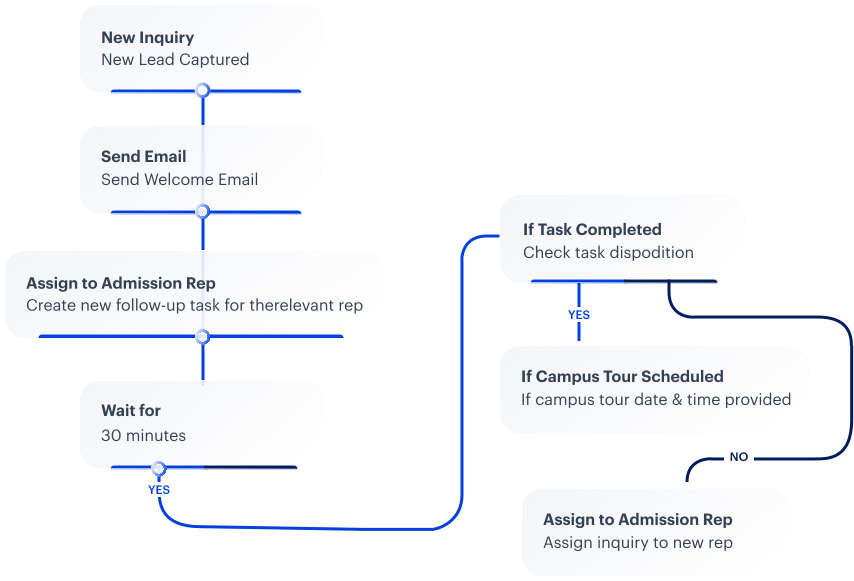
Fifteen minutes per week with your team leads reviewing the Watch and Coach Now lists. Not to micromanage — but to ensure no counselor sits in a red zone for three weeks without a documented touchpoint.
Bring QA reviewers, team leads, and a sample of scored calls into a monthly calibration session. Rubrics drift over time. Teams that don’t recalibrate develop inconsistencies that quietly undermine your coaching program.
Before you design a coaching intervention, you need to understand what’s actually driving the gap. Every performance issue falls into one of three buckets — a diagnostic framework first formalized by Mager & Pipe in their foundational work on performance analysis (Mager, R.F. & Pipe, P., 1997), and widely applied in coaching and HR practice since:
The counselor doesn’t know how — or can’t yet execute — a competency. The fix is targeted training, modeling, and practice with feedback loops.
Skill gap example: A counselor consistently scoring below 80 on discovery quality in QA reviews, but showing strong adherence and CRM hygiene. The gap is a technique issue — they haven’t been trained in needs-based questioning. The fix is targeted role-play and call review focused on discovery, not a conversation about motivation.
The counselor has the capability but isn’t applying it. The conversation shifts from “let me teach you” to “let’s talk about what’s getting in the way”.
Will gap example: A three-year counselor with a strong historical conversion rate who begins missing follow-up SLA commitments and submitting sparse CRM notes after a team restructuring. Metrics point to disengagement, not skill erosion. The coaching conversation centers on what has changed, what support they need, and whether the role still aligns with their professional goals.
The counselor is working against a broken system — outdated scripts, an unworkable CRM, an unrealistic caseload, or unclear policy. Coaching won’t fix a process problem. You need to remove the blocker first.
Process gap example: A cohort of counselors all showing rising after-call work times following a CRM update. When you investigate, the new note-logging workflow requires three additional clicks and doesn’t auto-populate the program field. This is a process issue — coaching individual counselors for a system problem will damage trust and produce no improvement. The fix is a workflow adjustment or CRM configuration change.
A manager who misreads a process issue as a will problem — or a skill issue as a will problem — will damage trust and stall improvement. Taking twenty minutes to ask the right diagnostic questions before launching a coaching plan is almost always worth it.
Also read: 10 Keys To Standardize Student Communication Across Counselors
An education CRM doesn’t just store contact records. When used well, it functions as your performance intelligence layer — surfacing the exact leading indicators discussed above without requiring manual data pulls. At a minimum, the following should all be visible in one place:
Managers should also be able to see, at a glance:
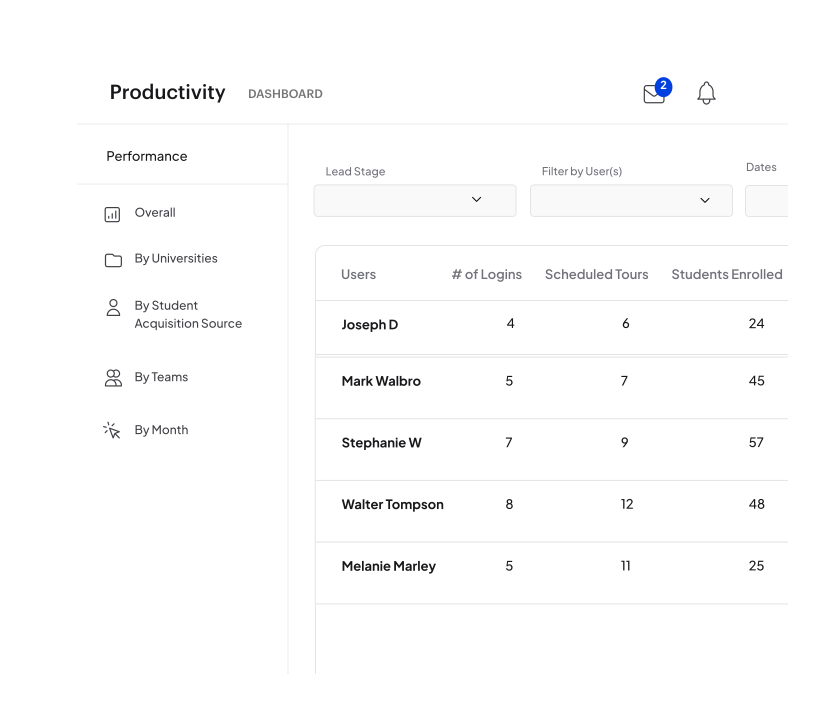
For admissions leaders managing teams of ten, twenty, or fifty counselors, this visibility is what makes early identification possible at scale. Without it, your coaching system is only as good as what your managers can remember — and that’s not a system, it’s a guess.
When CRM data is clean, consistent, and reviewed regularly, the coaching conversation also changes.
Instead of “I feel like your follow-up has been inconsistent,” a manager can say: “Your follow-up SLA breach rate has been at 9% for the last three weeks, compared to a team average of 3%. Let’s look at what’s getting in the way.” That conversation is more credible, more specific, and more actionable — for both people in the room.
Performance data has natural fluctuations. A single off-week is part of the rhythm, not a red flag. Use four-week rolling averages and require at least two consecutive weeks before escalating to a coaching intervention.
A counselor in their first sixty days should never be benchmarked against a three-year veteran. Always normalize for tenure.
A poor-quality lead batch, a system outage, a policy change mid-cycle — these can tank metrics across an entire team. Always check for external shocks before attributing underperformance to individual behavior.
“You need to be more consultative” is not coaching. “In your last three calls, you moved to program details before asking about the student’s timeline or goals — let’s work on discovery questions” is.
Note: The thresholds below are starting-point defaults. Adjust them to reflect your own program benchmarks before use.
Clarify expectations and document the specific gaps. Agree on two to three focus competencies. Schedule weekly, 30-minute coaching sessions. Identify whether the issue is skill, will, or process and address the blocker first.
At least one QA score above 80. Adherence above 92%. All coaching sessions attended and documented.
Move from gap identification to active skill-building. Use call reviews, role-play, and side-by-side observation. Introduce peer benchmarking to give the counselor a reference point. Adjust the plan based on where they’ve improved and where they haven’t.
Conversion trending toward cohort baseline. CSAT above program 25th percentile. Rep can self-identify improvement areas.
Shift responsibility to the counselor. Check-ins move from weekly to bi-weekly. Focus on habit formation and CRM discipline. Document sustained improvement or escalate formally if the pattern has not shifted.
All primary metrics within normal range for four consecutive weeks. Coaching plan closed with documented lift or transitioned to HR process.
The earlier you catch a performance gap, the more options you have to close it before it costs you enrollments, student satisfaction, or team morale.
But none of this works without the right infrastructure. Spreadsheets and gut instinct don’t scale. If your managers are still chasing data across disconnected systems to figure out who needs support, you’re already behind.
About LeadSquared
LeadSquared Higher Education CRM gives admissions leaders real-time visibility into pipeline health, follow-up compliance, counselor-level conversion rates, and team activity — all through configurable dashboards and reports.
See how it works for your team.
Start with your data. Flag counselors who show two or more red metrics sustained over two or more weeks — things like declining conversion rates, low QA scores, rising SLA breaches, or poor CRM hygiene. Layer in behavioral observation: are they avoiding complex cases, struggling to take feedback, or reading from a script instead of consulting? The combination of data signals and observable behaviors gives you a complete picture. Tools like LeadSquared Higher Education CRM make this easier by surfacing activity gaps, pipeline hygiene issues, and counselor-level performance metrics in one place — so you’re identifying needs early, not after enrollments have already slipped.
Start manually pulling a weekly report on the five or six metrics that matter most: follow-up SLA compliance, pipeline hygiene, QA scores, adherence, and conversion vs. cohort.It’s imperfect, but it establishes the review cadence your team needs — and that cadence is what makes coaching proactive rather than reactive.
Start by separating the behavior from the person. Document specific, observed behaviors — not personality traits. Ask open questions about what’s getting in the way before drawing conclusions. If defensiveness persists, it becomes part of the coaching topic itself. A counselor who cannot receive feedback is a risk to the student experience regardless of their other metrics.
No. Share aggregate team trends in group settings. Individual performance data should be shared only in a private, one-on-one coaching context. Publicly ranking counselors typically increases defensiveness and erodes trust.
Most coaching plans should produce measurable movement within 30 days. If a counselor has shown no improvement after 60 days of consistent, documented coaching with clear goals and real support, that’s the decision point for a more formal performance management process.
How long should a coaching intervention run before considering escalation?
Most coaching plans should produce measurable movement within 30 days. If a counselor has shown no improvement after 60 days of consistent, documented coaching with clear goals and real support, that’s the decision point for a more formal performance management process.
 15 min read 29 min read 19 min read



 8 Best home care referral sources: A guide for agencies
