

EDUCATION
GoHighLevel alternatives for career and beauty schools
Contents

 21 min read



If you run a career school; whether trade, massage, or beauty, there’s a good chance GoHighLevel arrived through a marketing agency. It was affordable, it did a bit of everything, and someone else set it up. For a while, that was enough.
Lately, though, the cracks are showing. A workflow fires every email in the sequence at once. Calls from your ads never make it into the CRM. Your agency holds the keys to your own lead data. And when the owner asks which channel actually helped enroll students last quarter, nobody can answer with confidence.
This guide compares the most practical GoHighLevel alternatives for career schools, side by side. We’ll be honest about when GoHighLevel is still the right call, where it falls short for admissions teams, and what to check before you switch, from inquiry capture and revenue reporting to FERPA, data ownership, and the true cost of ownership.
A note on how we wrote this: this comparison is published by an enrollment technology provider whose product appears in it. We used each vendor’s published pricing and documentation, plus third-party reviews, and we flag anything we couldn’t confirm.
GoHighLevel (also called HighLevel) is an all-in-one CRM with built-in marketing tools, designed primarily for agencies. Its plans are priced per agency account at $97, $297, or $497 a month, with phone, texting, email, and AI usage billed on top, according to HighLevel’s pricing page. For a small school, that bundle of funnels, forms, calendars, texting, and automation looks like a bargain.
The trouble is that it was designed to help agencies run many client businesses, not to help an admissions team move a prospective student from first inquiry to enrollment.
Here’s where that gap tends to show up for schools:
GoHighLevel’s workflow builder is powerful, but it depends on careful setup, and even well-built workflows can be thrown off by platform glitches or updates. In a G2 discussion thread, one HighLevel user described automations slowing to a crawl and platform updates triggering odd behavior, leaving them to recheck automations they thought were already solid. For an admissions team, an automation you can’t trust usually means falling back to manual follow-up, which defeats the purpose of having a CRM at all.
That reliance on careful setup is a common sticking point. On G2, the most frequent complaint across HighLevel’s user reviews is a steep learning curve, followed by an interface that doesn’t feel intuitive and inconsistent support, so whoever maintains your workflows has a lot to master and may not get consistent help when something breaks.
A school can buy GoHighLevel directly, but many come to it through an agency. In that case, your school typically runs as a “sub-account” inside the agency’s HighLevel account, and the agency controls access, billing, and often the setup itself. That’s convenient until you want to change agencies, bring marketing in-house, or simply pull a clean export of every inquiry you’ve paid to generate. Then you’re negotiating for access to your own enrollment records.
A beauty school doesn’t sell a one-time service. It moves people through inquiry, tour, application, financial aid conversations, document collection, enrollment, and the first day of class. GoHighLevel can be bent to approximate that, but none of it is native. Program interest, cohort start dates, campus, application status, and enrolled-student outcomes all have to be custom-built and rebuilt when the agency that built them moves on.
Most agency setups measure what agencies are paid on: leads, booked calls, and cost per lead. Schools need to know which channels produced enrolled students, and what those students are worth in tuition. Without that link, you can’t tell a low-cost lead source that fills your calendar with no-shows from a higher-cost one that fills your classrooms.
GoHighLevel can hold up for a very small school: one campus, a single program, a light flow of inquiries, and one person who can follow up on every lead personally. Even then, it tends to work best as a starting point rather than a long-term home for your admissions process.
It stops being enough when:
That’s usually the moment a general-purpose tool becomes more expensive than it looks.
A quick note on terms: we use “inquiry” for someone’s first contact with your school, “applicant” once they apply, and “enrolled student” once they start class. “Lead” means the record your CRM keeps for that person.
Interest in career training remains strong, but growth is cooling. The National Student Clearinghouse reports that enrollment at high-vocational public two-year colleges, the closest public measure of trade-training demand, rose a more modest 2.8% in spring 2026 after two years of strong gains. When the market tightens, every inquiry you lose to slow follow-up or a broken workflow costs more.
So before you compare GoHighLevel alternatives on price, compare them on the things that actually decide enrollments. We used these six criteria for every tool below:
Security and compliance, including FERPA, get their own section further down, because they deserve more than a line in a table.
One more thing:
A generic CRM for small businesses can store contacts, but it won’t understand cohorts, programs, applications, or enrollment status unless someone builds that logic. Ask every vendor to show you that logic working.
LeadSquared is an enrollment CRM and automation platform built for high-volume B2C admissions, with education-specific workflows and AI agents from its LeadEdge AI Lab.
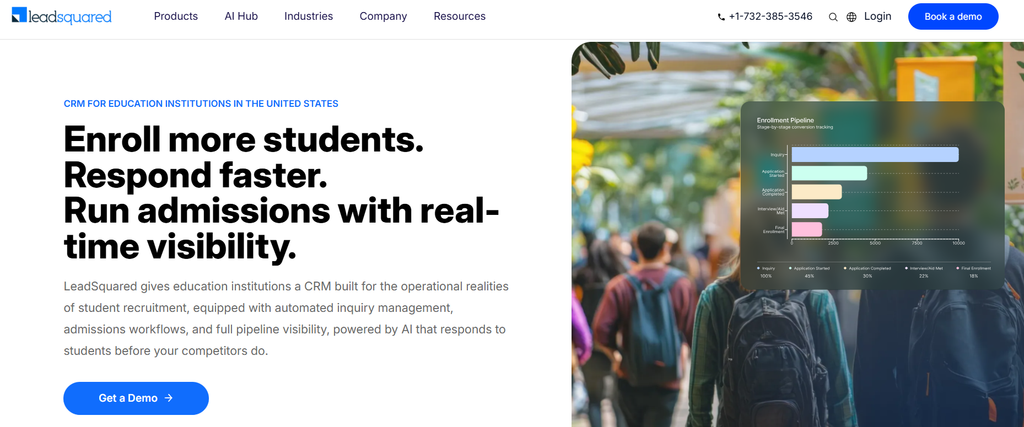
Best for: Schools that want an admissions-ready system without building one from scratch, at almost any size. For a single-campus cosmetology or esthetics school, that means program, cohort, and enrollment stages that already reflect how you work; see how this plays out in LeadSquared’s CRM for cosmetology and beauty schools.
For trade, massage, medical-assisting, and other vocational schools, the career school CRM adds lead distribution, task queues, and follow-up rules for teams juggling several programs. It also scales up: campus-based lead routing and role-based access help multi-campus groups and larger institutions keep inquiries and teams organized as they grow, which is where single-location tools tend to buckle.
LeadSquared is used by universities, community colleges, vocational institutes, and online education providers, so it scales as you add programs and campuses.
Inquiry channels: This is LeadSquared’s biggest difference. Web forms, landing pages, ads, email, SMS, and chat feed one lead record, and telephony integrations add calling, call logging, and recording against that record. For everything else, the Universal Data Sync (UDS) connector (formerly Universal Lead Capture) is the workhorse. UDS is a no-code integration builder: you create an “app” for each source, then set up inbound and outbound data flows with triggers, data mapping, and transformation rules. Data can sync instantly or on a schedule, and UDS logs every sync, so a failed one shows up for your team to fix instead of quietly losing an inquiry.
In practice, that means a social messaging tool, a review platform, an inquiry marketplace, or a third-party lead vendor can push inquiries straight into the CRM, deduplicated and tagged with their source, with no copy-and-paste. Prebuilt sources need no developer; custom API sources need someone comfortable mapping fields and credentials, which LeadSquared’s implementation team can handle. Prebuilt connectors cover common sources, and UDS handles anything with an API or webhook.
Key integration: UDS supports both inbound and outbound data flows, so it can keep LeadSquared in sync with other systems in your stack, and LeadSquared offers SIS integrations as well. As with any vendor, confirm how your specific SIS connects, which direction data flows, and how often it syncs during scoping. LeadSquared’s Hawke agent flags stalled or inconsistent records between your CRM and SIS, so your team can fix mismatches before they cost you an enrollment.
Does it close the loop to revenue? Largely, yes. Because every channel feeds the same record, LeadSquared tracks each student’s journey from first inquiry onward and reports campaign ROI by source, so you can see which channels produce enrollments, not just lead counts. Configurable Lead Score and Engagement Score settings, plus the Flash agent’s instant inquiry response and 0–100 readiness scoring, help teams focus on the inquiries most likely to enroll.
Pricing model: Per user, with pricing published on LeadSquared’s website. FloStack (scheduling and lead engagement), Invorto (Voice AI), and UDS are available as add-ons, and implementation is expert-led rather than left to an agency.
Watch-outs: LeadSquared is a deeper platform than an all-in-one marketing tool, so plan time for setup and staff training. Some capabilities are add-ons, so map your must-haves to a plan before you sign.
What this looks like for an esthetics school: A prospective student fills in an Instagram ad form on a Sunday night. In LeadSquared, that inquiry lands as one record tagged with its source. The Flash agent responds right away and gives the inquiry a 0–100 readiness score, and lead distribution assigns it to the admissions rep covering that program. A task queue prompts the rep to book a campus tour. As the inquiry moves through tour, application, financial aid conversation, and enrollment, each stage updates the same record. Once the student enrolls, their data can pass to your SIS through an API connection, and the campaign ROI report credits the enrollment to the Instagram campaign.
“LeadSquared has literally changed how we are able to interact not only with each other, but also directly with our potential and existing student base. The ability to streamline communication is such a timesaver on a day-to-day basis… From an end-user perspective, some of the other CRM tools can become cumbersome. It’s tough to learn how to navigate and use them once they are initially set up. But, with LeadSquared, once our information was live and we were using it, it was very simple to use and navigate.”
– Katie Sellers, Assistant Dean, Esthetic Institute
Read full case study here.
The flow is the same for a trade, massage, or medical-assisting school; only the programs and start dates on each record change.
HubSpot is a customer platform built for inbound marketing, with marketing, sales, and service hubs sold as separate products.
Best for: Schools with a dedicated marketing person or team that lives on content, SEO, and email, and wants a polished, easy-to-learn interface. It suits larger private schools that value marketing tools first and can tolerate customizing the admissions side themselves.
Inquiry channels: Strong for forms, live chat, email, and social publishing. Calling and texting are available depending on tier, add-ons, or marketplace apps, so check exactly what your plan includes. Review platforms and niche lead vendors usually need an integration or middleware.
Key integration: A large app marketplace and well-documented API. Education-specific SIS connections usually come through third-party apps or custom work. Confirm which app connects your SIS, which direction data flows, and how often it syncs.
Does it close the loop to revenue? Partly. Revenue attribution exists, but multi-touch attribution sits in the Enterprise tier, and tying it to enrollment and tuition requires custom objects and setup.
Pricing model: Seat- and contact-based. Starter is priced per seat, while Marketing Hub Professional starts around $800 a month billed annually with three seats and 2,000 marketing contacts, plus a mandatory one-time onboarding fee of about $3,000, according to HubSpot’s Marketing Hub pricing guide.
Watch-outs: Costs climb as your contact list grows, which hurts schools that keep every past inquiry for re-enrollment campaigns. On G2’s HubSpot Marketing Hub reviews, users frequently describe it as expensive for smaller teams and note limited features on cheaper plans.
Recommended reading: HubSpot For Education: Limits & The LeadSquared Alternative
Agentforce Education is Salesforce’s education CRM, built for the whole student lifecycle.
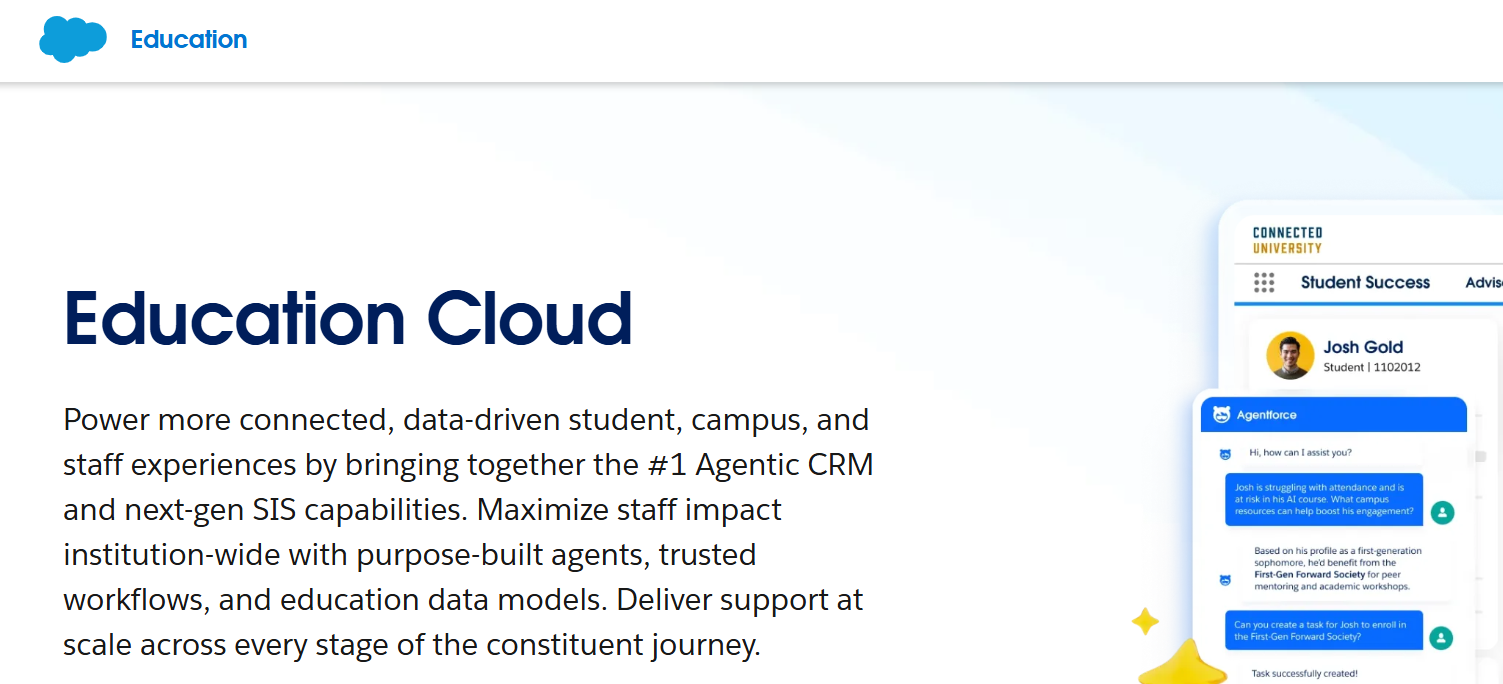
Best for: Large universities and multi-department institutions with in-house Salesforce administrators or an implementation partner, and a budget for both. It’s built to stretch across recruitment, student success, advancement, and alumni relations.
Inquiry channels: Almost anything is possible, but most of it is configured rather than ready to use. Calling, texting, chat, and social typically come from additional Salesforce products or AppExchange apps.
Key integration: APIs, MuleSoft, and the AppExchange ecosystem. Powerful, but usually partner-led and priced accordingly. Confirm who builds and maintains your SIS connection, which direction data flows, and how often it syncs.
Does it close the loop to revenue? With configuration. Revenue-by-channel reporting isn’t ready out of the box. It needs Data Cloud, Tableau, and careful configuration, usually by a Salesforce admin or implementation partner.
Pricing model: Per user, billed annually. Salesforce’s Education Cloud pricing page lists the Enterprise Edition at $87 per user per month and Agentforce 1 for Sales Edition at $375 per user per month. Those are Salesforce’s published education prices. Salesforce also issues a separate commercial pricing guide, so for-profit career and beauty schools should ask for a commercial quote. Implementation partners are an extra cost.
Watch-outs: Complexity. One reviewer on TrustRadius remarked on how complicated it was just to manage how a single program displays on an application. Smaller schools without admin resources often end up paying for capability they can’t use. See more on G2’s Agentforce Education reviews.
Recommended reading: Salesforce Education Cloud Alternatives For Admissions
Element451 is a student engagement CRM built for higher education admissions.
Best for: Colleges and universities with application-heavy admissions funnels.
Inquiry channels: Strong on email, SMS, web forms, and AI chat for prospective students. Calls, social DMs, and review platforms are worth testing in a demo.
Key integration: Offers SIS and higher-ed system integrations; confirm your specific SIS, sync direction, and frequency before you sign.
Does it close the loop to revenue? Partly. It has funnel-level analytics, but tuition ROI by channel isn’t confirmed.
Pricing model: Flat annual pricing starting at $20,000 a year, according to Element451’s pricing page, with quotes above that floor based on submitted applications per year. Some premium AI features use usage credits.
Watch-outs: The price floor can be steep for a small beauty or trade school, and the product is designed around traditional college applications rather than rolling, cohort-based career programs. Its review base is also much smaller than larger CRMs’: seven reviews on Capterra, against nearly 7,000 for Zoho CRM at the time of writing, so there’s less third-party validation to lean on.
Zoho CRM is a general-purpose CRM built for small and mid-sized businesses, sold as part of Zoho’s wider suite of business apps.
Best for: Very small, budget-first schools with someone technical enough to configure a general-purpose CRM.
Inquiry channels: Web forms, email, social, and chat through Zoho’s own apps; telephony and SMS through integrations.
Key integration: Zoho Flow, the wider Zoho suite, and an API. No education-specific objects out of the box. SIS connections typically run through Zoho Flow or the API, so confirm who builds yours, which direction data flows, and how often it syncs.
Does it close the loop to revenue? Not without a custom build.
Pricing model: Per user, with a free plan for up to three users and paid plans from $14 per user per month, per its Capterra listing.
Watch-outs: Like GoHighLevel, it’s a blank canvas, so you still need someone to build admissions logic. On G2’s Zoho CRM reviews, the learning curve and customer support are the most frequent complaints.
| Platform | Best for | All inquiry channels in one record | Built for admissions | Revenue by channel | Pricing model |
| GoHighLevel | Agencies; very small single-campus schools | Mostly, if configured well | No, custom-built | Lead-level by default | Per agency account + usage |
| LeadSquared | Single-campus to multi-campus and enterprise schools | Yes; other API and webhook sources via the UDS add-on | Yes | Yes, campaign ROI by source | Per user (published) + add-ons |
| HubSpot | Marketing-led private schools | Partly; some channels via apps | No, custom-built | Enterprise tier | Per seat + contacts + onboarding |
| Salesforce Agentforce Education | Large universities with admin teams | With add-ons and configuration | Yes, highly configurable | With configuration | Per user + partner fees |
| Element451 | Application-heavy colleges | Mostly | Yes, higher ed focused | Funnel-level | Flat annual, tiered by applications |
| Zoho CRM | Budget-first micro schools | Via integrations | No, custom-built | Custom build | Per user, free tier |
The table reflects each vendor’s public materials and user reviews as of October 2026. Confirm specifics in a demo with your own data.
Security is where a marketing tool and an enrollment system really part ways, so it’s worth checking on its own.
If your school participates in federal student aid programs, FERPA applies to your students’ education records. Inquiry data often turns into those records the moment a prospect enrolls, so your CRM will end up holding more than marketing contacts. The U.S. Department of Education’s Student Privacy Policy Office explains your obligations, including how you can share records with service providers acting on your behalf. Ask every vendor how they support those obligations, in writing.
Most career and beauty schools lean heavily on calls and texts. Make sure your CRM records consent at the point of capture and that your texting is properly registered with US carriers, since unregistered numbers can’t send marketing texts.
This is the question most GoHighLevel schools never think to ask until they need the answer. Before you sign anything, confirm:
With an education CRM you contract for directly, the account is yours. Agencies can still help with campaigns, but they work inside your system rather than owning it.
“Why pay more than $97 a month?” is a fair question. The honest answer is that very few schools actually pay $97.
HighLevel’s own help-centre rate guides list what gets added to the plan fee: carrier registration before you can text US numbers, a 5% markup on phone charges, per-execution fees for premium workflow steps, and AI plans of $50 or $97 a month per sub-account. For a school that texts and calls every day, usage can easily cost more than the plan itself. And if an agency resells GoHighLevel to you, you’re paying their price, not HighLevel’s.
When you compare options, add up these five lines for each one over 12 to 24 months:
Lost enrollments never show up on an invoice, but they’re often the biggest cost of all. If a better system helps you enroll even a few more students a term, it can pay for itself many times over, which is why the tool with the lowest sticker price is rarely the one with the lowest total cost.
GoHighLevel earns its place when you’re small, simple, and well supported by a good agency. But once inquiries outpace your team, workflows become a liability, or leadership wants proof of which channels produce enrolled students, a general-purpose marketing tool starts costing more than it saves.
The strongest GoHighLevel alternatives share three traits: they capture every inquiry channel in one record, they understand admissions out of the box, and they let you own your data outright. HubSpot leans toward marketing, Salesforce toward large institutions with big IT budgets, Element451 toward traditional colleges, and Zoho toward small teams comfortable setting up a general-purpose CRM themselves.
LeadSquared is the one built specifically for high-volume admissions, with Universal Data Sync to pull in every source, campaign ROI reporting and student-level journey tracking, and expert-led implementation, whether you run one beauty school or a multi-campus network.
Not sure what you’re really spending today?
Compare your total cost of ownership with LeadSquared.
Book a demo, bring your current GoHighLevel setup and bills, and we’ll map what it costs you now against an admissions-ready CRM built for your school.
For most growing schools, yes, once you compare total cost rather than the plan fee. GoHighLevel’s $97 plan is priced per agency account, and HighLevel bills phone, texting, AI, and premium workflow steps on top, so few schools actually pay $97. Add the staff time spent on manual follow-up and the enrollments lost when an inquiry goes unlogged or unanswered, and an admissions-ready CRM can cost less overall. A very small school with one program and one person following up every inquiry may not need one yet.
Your contract decides who owns the data, but whoever holds the account controls access to it. When your school runs as a sub-account inside an agency’s GoHighLevel account, the agency typically controls logins, billing, and exports. Before you sign or renew, confirm that the contract names your school as the data owner, that your team has admin access, that you can export every inquiry, activity, and file whenever you want, and what happens to your data if the relationship ends.
It depends less on the software than on what you bring to it: how many inquiry sources you connect, whether you integrate your SIS, how many workflows you rebuild, and how much history you migrate. Starting with inquiry capture and follow-up, then adding integrations and reporting, gets your admissions team working in the new system soonest. One customer mentioned they were up and running in 2-3 weeks. LeadSquared’s implementation is expert-led rather than left to an agency, so bring your current setup and inquiry sources to a demo to get a plan scoped to your school.
Yes. When your school contracts for a CRM directly, the account is yours, and your agency runs campaigns inside it without holding the keys to your inquiry data. If you change agencies later, your data, workflows, and reporting stay where they are.
Bring your current GoHighLevel setup, recent invoices (including usage charges), a list of every inquiry source you use, and the name of your SIS. With those, LeadSquared’s team can map what you spend today against an admissions-ready CRM, and show how each of your inquiry sources would land in one record, including any that need the UDS add-on. Book a personalized demo here.
Enter your details and we'll send you a quick confirmation email to verify your address.
 26 min read 18 min read 22 min read


