




EDUCATION
CRM for cosmetology & beauty schools — What to know in 2026
Contents

 15 min read


The US cosmetology and beauty school industry now generates an estimated $2.4 billion in annual revenue, with more than 1,300 institutions competing for the same pool of prospective students.
Those numbers mask a more competitive reality than they suggest. The margin between a school that fills its cohorts and one that doesn’t often comes down to operational execution — not program quality or tuition pricing.
At the ground level, that execution gap shows up fast. Awareness channels fragment across Instagram, TikTok, Google, school fairs, campus open days, AI-powered search tools, and word-of-mouth referrals — each generating inquiries that arrive through different channels with no unified view. Admissions teams juggle those leads in spreadsheets and email inboxes. Students who ghost a tour never get a timely follow-up. Financial aid handoffs stall. And once a student enrolls, the communication trail often goes cold — until they’re weeks away from completing their required training hours and eligible to sit their State Board licensing exam, and suddenly nobody knows where they stand.
A purpose-built beauty school CRM closes every one of those gaps. This guide explains what it is, how it maps to your actual workflows, what compliance guardrails matter, and how to evaluate vendors without wasting six months on the wrong platform.
This guide is produced by an enrollment technology company. Readers are encouraged to evaluate multiple platforms using the checklist provided.
A general CRM is built for B2B saldes cycles. It handles contacts, pipelines, and emails beautifully. What it doesn’t do is understand clock hours, State Board readiness, clinic floor scheduling, financial aid workflows, or the specific compliance rules around texting prospective students.
A CRM for beauty schools is purpose-built (or heavily configured) for the education-to-career lifecycle of a cosmetology, esthetics, nail, or barbering program. The core difference is that it treats inquiry-to-enrollment as one workflow and enrollment-to-graduation as another, connecting both inside a single platform.
| Feature | General CRM | Beauty School CRM |
| Admissions pipeline | Generic stages | Program-specific; tracks interviews, tours, FAFSA |
| SMS/texting | Basic; no TCPA workflow | Consent capture, quiet hours, opt-out logging |
| Clinic scheduling | None | Appointment slots, service reminders, retail follow-up |
| State Board readiness | None | Clock-hour tracking, readiness alerts |
| Career placement | None | Employer contacts, alumni referrals, placement reporting |
| Financial aid handoff | None or manual | Workflow flag to FA office; document checklists |
Think of a CRM for Cosmetology as the thread running through every stage below. Each stage has a job to do, and each job has metrics that tell you whether it’s working.
Leads come in through web forms, Meta lead ads, organic social, phone calls, and referrals. A properly configured beauty school CRM captures them all into one pipeline, deduplicates contacts, and triggers an automated first-touch interaction within minutes.
Industry benchmark: Speed-to-first-contact is one of the strongest predictors of lead conversion. Institutions that respond within five minutes are significantly more likely to schedule a tour than those who follow up the next day.
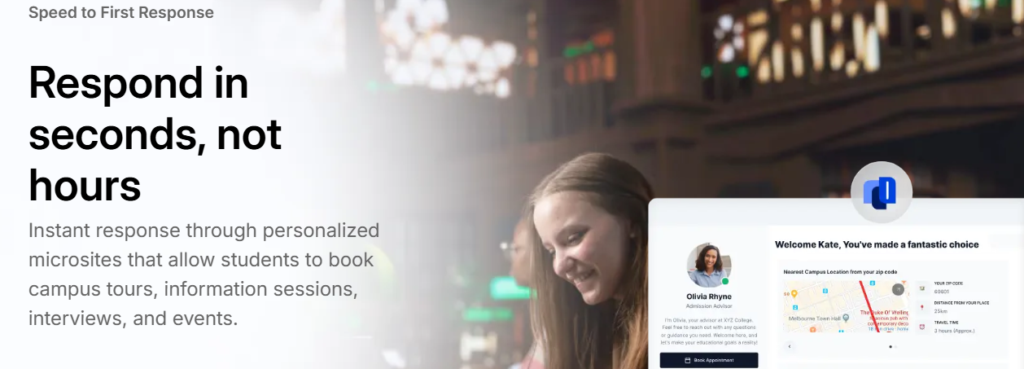
Once a lead is captured, the admissions pipeline takes over. Counselors see each prospect’s status, source, and last touchpoint on a single screen.
Key metrics: Inquiry-to-enrollment rate, show rate, time-to-first-touch, cost per enrollment.
After a student says yes, the CRM triggers a structured onboarding workflow. Document checklists, e-signature requests, and a financial aid handoff flag ensure nothing falls through the cracks between admissions and your FA office.
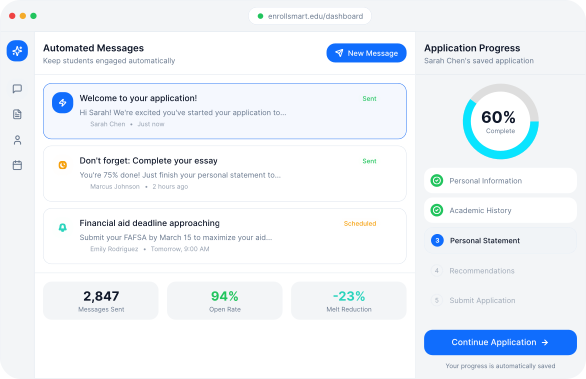
Note: CRM platforms support the workflow and documentation tracking for financial aid; they do not provide financial aid advice or determine aid eligibility.
A CRM for cosmetology colleges that stops at the enrollment stage misses the most operationally complex workflows. Active student management includes:
Key metrics: Clinic rebooking rate, retail attach rate, clock-hour completion pace.
Automation example: Clinic visit logged → CRM sends NPS request 24 hours later → positive responders receive a rebooking offer → rebooking rate improves without any staff effort.
According to the American Association of Cosmetology Schools, member institutions report an average job placement rate above 71% as tracked by their accreditor — a rate that depends directly on career services teams having the tools to track, contact, and confirm placements.
Yet, many schools track placements manually in spreadsheets. A beauty school CRM gives your career services team an employer contact database, outreach sequences, and placement tracking that feeds directly into accreditation reporting.
Key metrics: Placement rate, time-to-placement.
Alumni are your cheapest and most credible lead source. A CRM for beauty career schools can run structured referral campaigns—birthday messages, re-engagement sequences for continuing education, and referral incentive reminders—at scale.
Automation 1 — Meta lead to booked tour in under 10 minutes
Trigger: New Meta/Instagram lead ad submission → CRM creates contact, sends personalized SMS within 5 minutes → if no reply in 2 hours, follow-up email with self-schedule link → tour confirmed via calendar sync.
Automation 2 — No-show rescue
Trigger: Scheduled tour marked as no-show → same-day text offering two reschedule options → if no response in 48 hours, email with an open-ended nurture message. Schools running automated no-show rescue sequences consistently report meaningful recovery rates — contact your CRM vendor for benchmark data from comparable institutions.
Automation 3 — Clinic visit to rebooking
Trigger: Client visit logged on clinic floor → 24-hour NPS text → positive NPS score triggers rebooking offer with a time-limited discount → booking link routes back into clinic scheduling.
A CRM is only as useful as the ecosystem it connects to. Before signing any contract, verify native or API-level integrations with:
All-in-one platforms bundle many of these. Best-of-breed approaches pick the strongest tool for each job. The right answer depends on your team’s bandwidth, your existing technology, and how much you’re willing to manage integrations yourself.
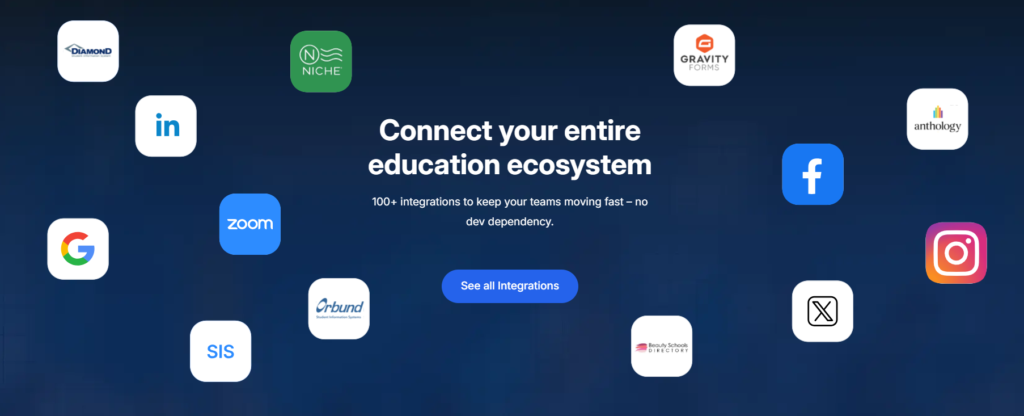
See all of LeadSquared’s integrations here.
Texting and emailing prospective students comes with real legal obligations. Ignore them and you’re exposed to fines, lawsuits, and accreditor scrutiny. Here’s the short version:
Quiet hours matter. TCPA and most platform terms of service prohibit marketing texts before 8 AM or after 9 PM in the recipient’s time zone. Your CRM should enforce this automatically.
Also note: Several states have enacted texting and auto-dialer regulations that impose stricter consent requirements than the federal TCPA baseline. Florida, Oklahoma, and Washington are frequently cited examples. Schools operating in or recruiting from these states should consult legal counsel to confirm their compliance posture before launching SMS campaigns.
Schools that implement a CRM for cosmetology colleges typically report measurable improvements in three areas:
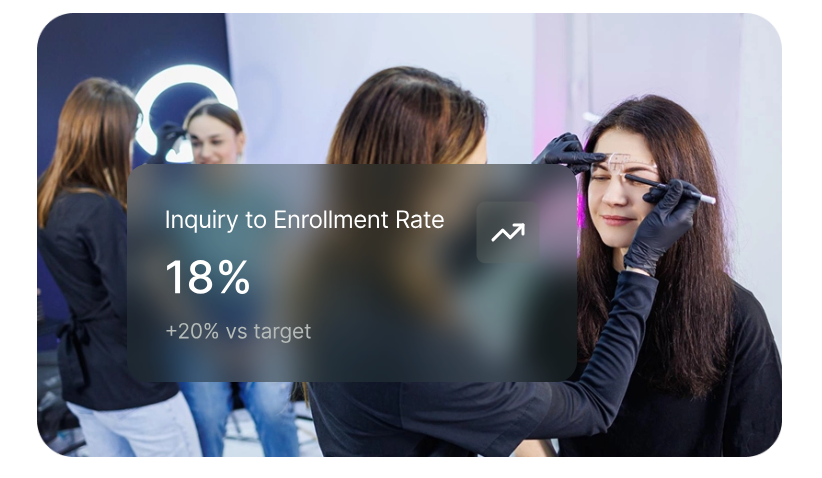
The Bureau of Labor Statistics projects 5% employment growth for barbers, hairstylists, and cosmetologists through 2034 — faster than the national average across all occupations — with roughly 84,200 job openings per year. Schools that can actively track, outreach, and confirm graduate placements are best positioned to capture that demand for their students. A CRM for beauty schools helps with that.
Use these questions before you sign anything:
Established in 1992, Esthetic Institute is a Virginia-based vocational school offering programs in esthetics, cosmetology, and makeup artistry.
The challenge: The team was juggling multiple disconnected tools, losing hours to manual follow-ups, and struggling with internal miscommunication. Most CRMs they evaluated — including Salesforce — were too complex for a small school’s needs.
The solution: LeadSquared’s marketing automation replaced manual workflows almost overnight — going live in just 2–3 weeks. Automated emails, SMS, landing pages for lead capture, and a centralized student database gave every team member a single source of truth.
The results: With 2,000+ automated emails sent at an average of 5 minutes saved each (based on average manual follow-up time logged by the admissions team), Esthetic Institute reclaimed over 10,000 minutes — and gained full visibility into every student interaction along the way.
“LeadSquared has literally changed how we are able to interact not only with each other, but also directly with our potential and existing student base. The ability to streamline communication is such a timesaver on a day-to-day basis.”
– Katie Sellers, Former Assistant Dean, Esthetic Institute
Running a cosmetology or beauty college means managing a student’s entire career trajectory—from the moment they see your Instagram ad to the day they pass their State Board exam and land their first job. That’s not a sales process. It’s a relationship that spans months, touches a dozen different teams, and depends on dozens of small handoffs going right.
A CRM for beauty colleges brings all of those handoffs into one place—so nothing slips, no lead goes cold, no at-risk student falls off the radar, and no graduate disappears before your career services team gets a chance to place them. The schools pulling ahead right now aren’t necessarily the ones with the biggest marketing budgets. They’re the ones that respond faster, follow up smarter, and use data to make better decisions at every stage.
The technology exists. The workflows are proven. The schools that move first move furthest.
Ready to see a beauty school CRM in action?
Take a look at how LeadSquared maps to your admissions, clinic, and career placement workflows.
Yes. An SIS manages enrolled student records—grades, attendance, transcripts, financial aid. It is not designed for prospect management, marketing automation, or career placement outreach. A beauty school CRM sits upstream of your SIS (handling prospects before they enroll) and alongside it (triggering alerts based on SIS data like clock hours). They serve different jobs, and most schools need both. The value comes from connecting them — so clock-hour updates in your SIS automatically surface as alerts in your CRM, without anyone manually moving data between systems.
A well-configured CRM reduces workload—it doesn’t add to it. The goal is to automate the repetitive follow-up that currently eats your team’s time. Start with three automations: lead capture-to-text, no-show rescue, and tour confirmation reminders. Those three alone can recover hours per week per counselor. Most schools can manage a CRM with a part-time admin owner during the first 90 days.
Texting without proper consent is risky. Texting with documented, platform-logged TCPA consent is standard practice across the enrollment management industry and is an effective channel. The key is choosing a CRM that enforces consent capture at the point of form submission, logs it with a timestamp, and blocks sends to contacts who have opted out. Ask vendors to show you specifically how they handle TCPA opt-in before committing.
Most migrations involve three datasets: existing prospect/lead contacts, enrolled student contact records, and employer/alumni contacts. Reputable CRM vendors provide a migration template and dedicated support. Expect 2–4 weeks for a typical single-campus school and 4–8 weeks for multi-campus. Prioritize clean data over fast data—deduplicate and standardize your source files before migration, and your post-launch experience will be significantly smoother.
Four-year higher education CRMs are built for long 12–18-month enrollment cycles, complex committee-based decisions, and large applicant pools. A CRM for cosmetology or CRM for beauty career schools is built for shorter, faster cycles (often 30–90 days from inquiry to start date), high-touch SMS communication, clinic floor operations, and State Board-specific compliance milestones. The workflows, automation logic, and reporting are fundamentally different. Using a four-year platform for a beauty school is like using accounting software to run a scheduling system—technically possible, practically painful.
Pricing varies by vendor and feature set, but most purpose-built beauty school CRMs are priced on a per-seat or flat monthly fee basis, typically ranging from a few hundred to a few thousand dollars per month depending on campus size and modules included. For a single-campus school, the more relevant question is cost relative to what you’re currently losing — one un-recovered no-show per week, multiplied across a program cycle, often represents more revenue than a month’s platform fee. Most vendors offer tiered plans that allow smaller schools to start with core admissions automation and add clinic or career placement features later. Ask any vendor for a cost-per-enrollment calculation based on your current inquiry volume — that number will tell you more than the monthly rate alone.
 29 min read 19 min read 16 min read