





EDUCATION
Why legacy admissions systems are silently killing your enrollment growth—and how to fix it
Contents

 16 min read


It’s 4 PM on a Friday in March. Your admissions team is manually copying application data from one system to another, chasing down missing transcripts in email threads, and explaining to anxious applicants why their status hasn’t updated in 72 hours.
This happens every year. And every year, your VP asks the same question: Why does time-to-decision take 14 days, when competitors deliver decisions in 48 hours?
This isn’t a staffing problem. It’s an architecture problem, with legacy admissions systems.
Legacy systems in admissions operations extract a hidden tax every single day: in manual work, delayed responses, compliance risk, and lost yield. For enrollment leaders wrestling with flat budgets and rising targets, that invisible drag represents the difference between hitting goals and explaining shortfalls.
The good news? A growing number of institutions are escaping this trap.
Some universities report up to 25% faster admissions cycles using modern CRMs. Schools leveraging automation report a 35% reduction in time spent on manual processes. By modernizing their admissions technology stack, they’re cutting cycle times, reducing cost-per-enrollment by 15–30%, and freeing staff to focus on relationship-building instead of data re-entry. And unlike traditional enterprise implementations that drag on for 18-24 months, modern platforms go live in 6-8 weeks with measurable ROI in the first 90 days.
Legacy systems in admission process typically follow a predictable pattern:
In contrast to legacy admissions systems, modern systems in admissions solve these problems:
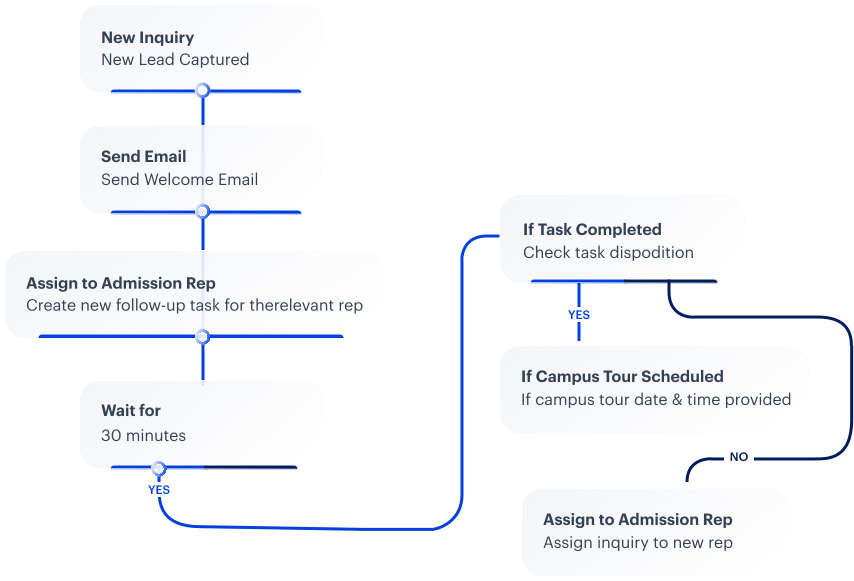

A helpful resource: Admission Challenges Slowing Your Growth? Identify 8 Key Bottlenecks
The architectural difference isn’t academic—it directly determines how fast you can respond to inquiries, how many applications your team can process, and whether you discover problems in hours or weeks.
Let’s quantify what legacy systems in admission management actually cost beyond the line-item license fees:
When data doesn’t flow automatically between systems, humans become the integration layer. Eliminating manual re-entry saves 5–10 minutes per application—which compounds to 80–160 hours per 1,000 applications. At $35/hour fully loaded, that’s $2,800–$5,600 in labor cost alone, not counting the error rate.
Custom integrations built on fragile file transfers break constantly. A routine vendor update can trigger days of troubleshooting. Institutions spend $25,000–$60,000 annually—equivalent to a part-time staff member—just keeping these integrations from breaking. Modern platforms eliminate this entirely with plug-and-play connectors for common systems —deployed in hours, not months.
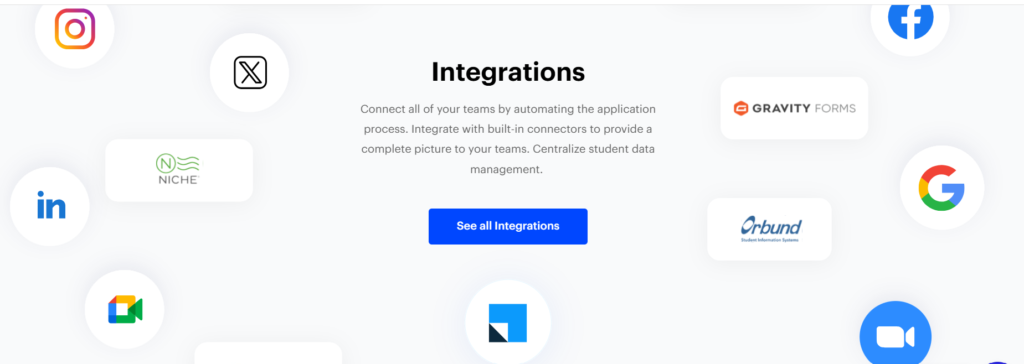
See all of LeadSquared’s integrations and connectors here.
Legacy systems in admission school environments force teams to manage exceptions manually: incomplete applications, missing documents, duplicate records, name mismatches. For every 10,000 applications, institutions need one to two staff members working full-time just to clean up these issues—labor that could be redeployed to yield activities.
When inquiry data lives in your CRM, applications in your SIS, campus tour registrations in a separate events system, and communications scattered across email and texting platforms, no one has a complete view of the student journey. Counselors waste time toggling between screens. Prospects receive duplicate or contradicting messages. Modern systems create a single student record that follows the prospect from first click through enrollment, ensuring every interaction is informed by complete history.
Audits become painful when data is scattered across disconnected systems. Institutions report spending significant time reconstructing data lineage and access logs from legacy platforms with weak audit trails.
Here’s the real cost of weekly reports: by the time you see that inquiry-to-application conversion dropped 15% last week, you’ve already lost another week of prospects. Modern platforms deliver live dashboards showing exactly where students are stuck—right now. When incomplete applications pile up, you know immediately. When a recruitment source stops converting, you see it in real time. This isn’t about prettier charts; it’s about catching problems while you can still fix them.
Complex, undocumented workflows of legacy systems in admission process environments extend onboarding from days to weeks and make you vulnerable when experienced staff leave. Knowledge walks out the door because it exists only in people’s heads, not in transparent, documented automation.
Research consistently shows that time-to-first-response predicts enrollment. Responding in 5 minutes is 21x more effective than slower response times. When your systems require manual intervention to triage inquiries, you bleed enrollment to faster competitors.
When routine work can’t be automated, you’re forced to hire temps or pay overtime during peak season. Modern systems in process automation flatten these spikes, reducing seasonal labor costs by 40–60%.
Let’s model a mid-sized institution processing 25,000 applications annually.
Disclaimer: These figures are illustrative examples based on typical operational costs at $35/hour fully loaded labor rate and the efficiency improvements described above:
| Cost category | Legacy annual cost | Modern annual cost | Savings |
| Manual data entry | $70,000 | $15,000 | $55,000 |
| Integration maintenance | $45,000 | $12,000 | $33,000 |
| Exception handling | $95,000 | $35,000 | $60,000 |
| Reporting/BI labor | $40,000 | $10,000 | $30,000 |
| Seasonal overtime | $50,000 | $20,000 | $30,000 |
| Total operational cost | $300,000 | $92,000 | $208,000 |
That’s a 69% reduction in operational burden—before counting yield improvements, compliance risk reduction, or staff capacity reallocated to strategic work.
This is total cost of ownership (TCO) in action. Legacy systems look cheaper on the license invoice but bleed budget through hidden operational costs. Modern platforms cost more upfront but deliver dramatically lower TCO through automation, pre-built integrations, and staff efficiency gains.
Add a conservative 2% yield lift from faster response times on 5,000 enrolled students at $35,000 net tuition revenue, and you’re looking at $3.5 million in incremental revenue.
A contemporary admissions tech stack typically includes:
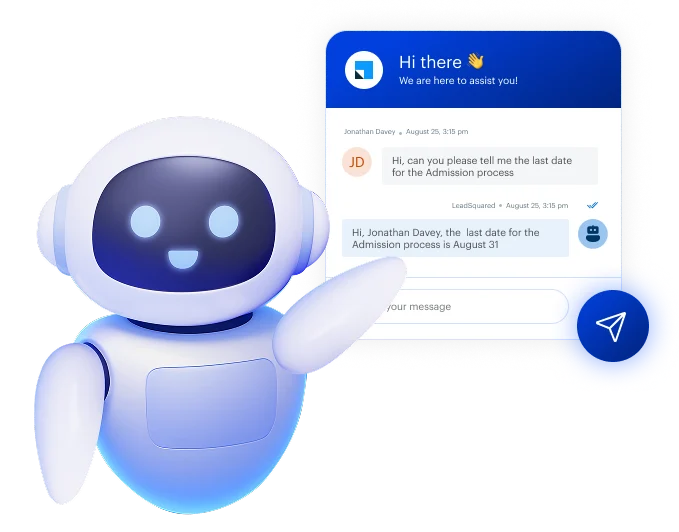

University of the Southwest, a private institution in Hobbs, New Mexico, faced a critical challenge with their enrollment operations. Their admissions team was overwhelmed by manual processes and disconnected systems that made it nearly impossible to track prospective students effectively or respond quickly to inquiries.
The legacy challenge: The university’s legacy systems in admission created several bottlenecks. Staff spent excessive time on manual data entry, inquiry follow-up was inconsistent, and there was no unified view of the student journey from inquiry to enrollment. The lack of automation meant that high-intent prospects could slip through the cracks during critical decision windows.
The modern solution: University of the Southwest implemented LeadSquared’s education CRM to centralize their admissions operations. The platform provided automated lead distribution, intelligent workflow automation, and real-time visibility into the enrollment funnel.
Results:
The transformation allowed the admissions team to shift from administrative work to relationship-building, directly contributing to meaningful enrollment growth.
“LeadSquared’s automation capabilities mean our counsellors spend more time providing a personalized, intimate student experience rather than handling tedious tasks. It’s transformative for both our students and our team.”
– Dr. Ryan Tipton, President and CEO, University of the Southwest
Read more here: University Of The Southwest Transforms Enrollment Efficiency With LeadSquared
ACI Medical and Dental School in Massachusetts faced the complex challenge of managing admissions for multiple healthcare programs while maintaining personalized communication with prospective students—a population that requires careful nurturing and detailed program information.
The legacy challenge: ACI’s previous system represented classic legacy systems in admission management: fragmented data across spreadsheets, manual tracking of application stages, limited ability to segment communications by program interest, and no clear visibility into where prospects were dropping off in the enrollment funnel.
The modern solution: ACI implemented LeadSquared to create an integrated, automated admissions operation. The platform enabled program-specific tracking, automated nurture campaigns, intelligent lead scoring, and complete visibility into student engagement across all touchpoints.
Results:
“I can see everything in LeadSquared so I don’t have to bounce between applications. That saves a lot of time. I also like that it integrates with our text messaging and phone application, RingCentral.”
– Alexandra Galdieri, Admissions Advisor, ACI Medical and Dental School
Read more here: ACI Medical And Dental School Improves Enrollment Processes | LeadSquared
Both institutions demonstrate that the shift from legacy systems in admission school environments to modern systems in admissions delivers measurable outcomes—not just operational improvements, but actual enrollment growth and revenue impact.
Phased rollout mitigates this. Start with inquiry-to-applicant workflows, run dual systems for one cycle with daily reconciliation, then cut over. Use data validation rules and sampling to catch anomalies early.
Calculate the total cost of ownership, not just software licenses. Modern platforms cost more upfront but deliver 15-30% lower TCO through reduced manual work, eliminated integration maintenance, and staff efficiency gains. Use a 90-day pilot to prove ROI, then fund broader rollout from demonstrated savings. (Scroll on for the 90-day pilot roadmap!)
Change fatigue is real, but so is work fatigue from broken processes. Modern platforms with intuitive interfaces require minimal training—most counselors are productive within days, not weeks. And unlike legacy systems that require IT tickets for every workflow change, low-code tools let your team adapt processes themselves.
Also read: 17 Education Workflow Automation Examples)
Not anymore. Legacy enterprise implementations drag on for 18-24 months. Modern platforms go live in 6-8 weeks: two weeks discovery, two weeks configuration, two weeks testing, two weeks training. You’re processing real applications in under two months, not two years.
Days 1–30: Discovery and design
Days 31–60: Build and test
Days 61–90: Launch and measure
Measure what matters:
Legacy systems in admission operations are a silent budget killer. They disguise operational debt as “just how we do things”, when in reality, they’re capping your enrollment growth and burning out your team.
Modern systems in admission management aren’t a luxury—they’re a competitive necessity. Institutions that respond faster, automate exception handling, and give staff real-time visibility consistently outperform those running on batch processes and manual workarounds.
The total cost of inaction—lost yield, operational inefficiency, compliance risk, and staff burnout—far exceeds the investment in modernization. Modern platforms deliver lower total cost of ownership, faster implementation cycles, and AI-powered automation that transforms how you recruit and enroll students.
Your applicants are checking their status in real time. Your competitors are responding in real time. Isn’t it time your systems operated in real time too?
Try LeadSquared.
Modernizing legacy systems means replacing outdated, on-premises or rigid software with cloud-native, API-first platforms that enable real-time data exchange and automation. In admissions, this typically involves moving from batch file transfers and manual processes to event-driven architectures where actions trigger instant updates across connected systems. Modern platforms like LeadSquared use low-code automation, real-time dashboards, and intelligent workflow engines that allow admissions teams to adapt quickly without relying on IT for every change—cutting cycle times by 30–40% while reducing operational costs.
Legacy systems are traditional software platforms built on older architectures with limited automation and manual workflows, while AI refers to intelligent technologies that can learn, predict, and automate decision-making. However, modern admissions platforms like LeadSquared combine both: a cloud-native CRM architecture with embedded AI capabilities such as lead scoring, predictive analytics, and intelligent routing. The key difference is that legacy systems require humans to interpret data and take action, while AI-enabled modern systems can automatically prioritize high-intent prospects, predict enrollment likelihood, and trigger personalized communication workflows—transforming admissions from reactive to proactive.
Most institutions see measurable ROI within 12–18 months, with operational improvements visible much sooner. University of the Southwest achieved a 40% enrollment increase after implementing LeadSquared, while institutions typically report 30–40% cycle time reductions and 15–30% lower cost-per-enrollment within the first year. The key is starting with a phased approach: a 90-day pilot targeting high-pain workflows (like incomplete application follow-up) can demonstrate value quickly, building momentum and funding for broader rollout. Quick wins in the first 30 days—such as eliminating one manual data entry step—help secure staff buy-in.
Absolutely. Modern admissions platforms are designed to work alongside your existing SIS, not replace it. LeadSquared and similar CRMs serve as the orchestration hub for admissions and enrollment management while integrating bidirectionally with your SIS through APIs or iPaaS tools like Workato or MuleSoft. This approach lets you modernize inquiry-to-enrollment workflows—automated communication, real-time tracking, intelligent lead distribution—without a risky SIS replacement project. The SIS remains your system of record for enrolled students, while the modern CRM handles the high-velocity, engagement-heavy admissions funnel where speed and personalization drive yield
The primary risks are data quality issues, staff resistance to change, and workflow disruption during peak season. Mitigate these through phased rollout: start with one workflow (e.g., inquiry follow-up), run dual systems with daily reconciliation for one cycle, and establish clear data deduplication rules upfront. Platforms like LeadSquared offer configurable migration tools and support to ensure clean data transfer. Avoid launching during peak decision periods—aim for summer or early fall. Invest in role-based training and identify internal champions who can demonstrate quick wins. With proper planning, institutions like ACI Medical and Dental School achieved a 3x enrollment increase while simultaneously reducing manual workload.
Build a pilot business case with concrete numbers. Calculate your hidden operational costs: manual data entry hours × hourly rate, integration maintenance FTE, seasonal overtime expense, and yield loss from slow response times. Then model the impact: if eliminating re-entry saves 8 minutes per application across 10,000 applications, that’s 1,333 staff hours or $46,655 annually at $35/hour. Add a conservative 2% yield lift from faster response, and the revenue impact dwarfs the investment. Request a 90-day pilot on one high-pain workflow, measure results, and use proven outcomes to secure funding for full rollout.
 15 min read
  16 min read 18 min read