




- Home

- Learn
- Healthcare
- 6 best home health care and home care marketing ideas
HEALTHCARE
6 best home health care and home care marketing ideas
Contents

 17 min read


In-home care services are expanding as more people choose to receive support where they live rather than in hospitals or long-term facilities. Aging populations, longer life expectancy, and better home-based treatment options have all contributed to this shift. Today, most families begin their search for care providers online, comparing services, reading reviews, and visiting agency websites before making contact.
There are two main types of in-home services, and the difference is important. Home health care involves medical services delivered at home by licensed professionals such as nurses or therapists, often under a physician’s direction. Home care focuses on non-medical assistance with daily activities like bathing, meal preparation, mobility support, and companionship.
Because discovery now happens largely through digital and local search, clear and accurate marketing plays a practical role. It helps agencies explain what they offer, who they serve, and how to get started. Without that visibility and clarity, even qualified providers may be overlooked.
This article explains straightforward, practical marketing ideas that home health and home care agencies can use to build awareness, communicate clearly, and grow in a structured, responsible way.

When families start looking for in-home care, they usually follow a thought process that looks something like this: a need arises, they begin searching online, compare several options, check reviews and testimonials, and then make contact to ask questions or book a consultation.
Most decision makers in this space are adult children, spouses, or caregivers who are balancing many responsibilities while trying to make an important choice for someone they care about. In such situations, being visible where families search and showing up with clear information can make a big difference in whether an agency is considered.
Effective marketing here provides reassurance by addressing common questions and concerns such as cost, qualifications, and service scope. And it builds credibility through elements like professional websites, thoughtful content, reviews, and third-party references.
Care decisions are often thoughtful and emotionally charged because they involve someone’s health, comfort, and quality of life. This means that families are looking for signals of professionalism, trustworthiness, and transparency long before they make contact.
By meeting families earlier in their research with clear, helpful information and consistent messaging, agencies can support better decision-making and be seen as reliable options when care becomes necessary.

Today, most families begin their search for home health care or home care by looking online. When someone types phrases like “home care services near me” into a search engine, the agencies that appear near the top of the results are much more likely to be considered. This makes a strong online presence an important foundation of modern marketing for in-home care.
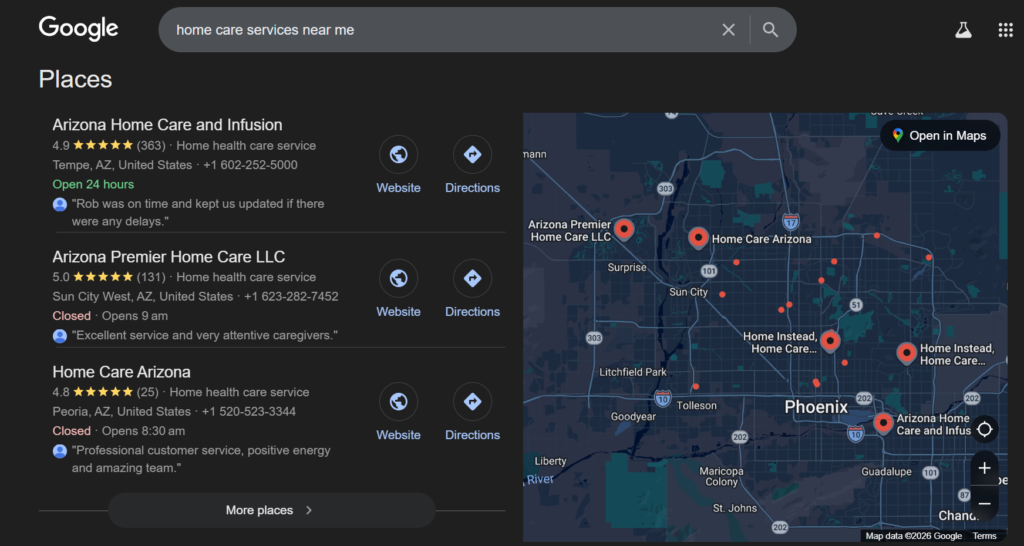
The first place families usually go is your website. This website acts like your digital front door. To make a good first impression, it should clearly explain what you offer and make it easy for visitors to understand their next step. A good agency website should:
Beyond your website, being visible in local search results also matters. When someone searches for home care or home health services in a specific city, local business listings often appear alongside website results. Keeping your business name, address, and phone number consistent across directories and maintaining an updated business profile improves accuracy and visibility.
All these visibility steps fall under what is commonly called search engine optimization, or SEO.
In simple terms, SEO means organizing your website and online listings so search engines can understand your services and show your agency when people search for care in your area
For most home health and home care agencies, the most important parts of SEO are practical rather than technical. They focus on clear service pages, accurate local listings, consistent contact details, and helpful information that answers common questions.
For larger agencies with multiple locations or more complex websites, technical SEO becomes more important because search engines need clearer signals to properly understand and display your content.
At a basic level, this starts with website performance and organization. A faster website not only improves the visitor experience, but also signals to search engines that your site is reliable and user-friendly. Clear site structure is equally important. When pages are logically organized — for example, with separate, well-defined pages for each city you serve — search engines can more easily crawl and index your content. This makes it more likely that the correct page appears when someone searches for services in a specific location.
Beyond structure and speed, technical SEO also involves something called structured data. Structured data is a standardized format added to your website’s code that helps search engines understand exactly what certain pieces of information mean. For home healthcare and home care agencies, this becomes especially valuable when operating across multiple cities or regions.
For example:
Together, a well-structured website and strong local search presence form the digital first impression most families will have of your agency, and getting this right creates a solid base for the other marketing strategies that follow.
Educational content works because it reduces uncertainty. When someone is trying to make an important choice, having straightforward explanations that can ease their doubts and confusion can make a big difference. It also shows that your agency understands the real questions families have.
There are several types of content that work well for home health and home care audiences:
This type of content not only answers questions families have before they contact you, it also improves visibility in search results because search engines show content that matches real questions people type online. Some agencies also offer downloadable guides that visitors can get in exchange for an email address, which helps capture inquiries and feed into follow-up systems like a CRM.
Social media is rarely the first place families make a care decision, but it is often one of the places they check before they make contact. When someone looks up an agency on platforms like Facebook, Instagram, or LinkedIn, they are trying to get a sense of whether the agency is active, professional, and connected to its community. In this way, social media acts as a visibility and familiarity tool, not a hard sales channel.
For home health and home care agencies, social media works best when it helps people get to know you rather than sell services. Content that resonates includes:
The goal is consistency rather than frequency. Posting regularly (even if it’s just once or twice a week) helps families see that your agency is present and responsive. This consistency builds familiarity and trust over time, which supports your other marketing efforts.
While online search plays a major role in how families discover care providers, many final decisions are still shaped by personal interaction and local reputation. Healthcare choices are often relationship-driven, which means offline visibility continues to matter for home health and home care agencies. When people encounter your agency through community education and support activities, familiarity and trust grow more naturally.
Offline outreach works best when it is built around learning and guidance rather than promotion. Agencies can use several education-focused formats to connect with their communities:
Host sessions on practical topics such as home safety, fall prevention, managing chronic conditions at home, or planning in-home care. These workshops give families structured, usable information.
Short talks at senior centers, faith groups, or neighborhood associations allow staff to explain services in simple language and answer questions directly.
Participating in local health events helps agencies stay visible and approachable while meeting families and referral partners face to face.
Simple printed materials give attendees something reliable to take home and review later, reinforcing what they learned.
Community engagement today also includes digital spaces. Many families turn to online discussion platforms to ask questions, compare experiences, and seek recommendations before contacting providers directly.
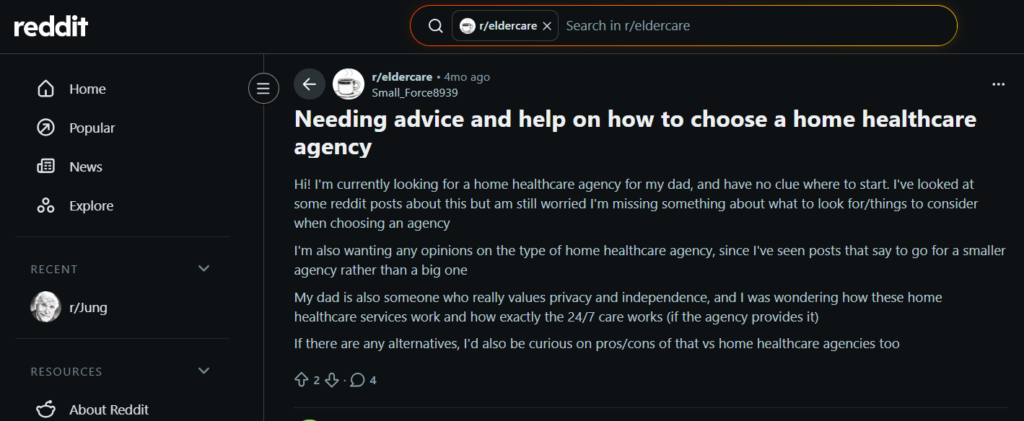
Platforms such as Reddit, local Facebook groups, caregiver forums, and neighborhood networks have become informal support systems where people openly discuss care decisions. In these spaces, agencies should participate as contributors, not marketers.
That means:
When agencies consistently provide helpful, neutral information in online communities, they build familiarity and credibility. Over time, this strengthens reputation in the same way in-person outreach does.
In home health and home care, referrals remain one of the strongest sources of new clients. Unlike broad advertising, referrals come from people or organizations who already understand the needs of someone seeking care and can recommend a specific agency. Because the recommendation comes from a trusted source, families tend to act on it with more confidence.
Referral partners can include a range of professionals and community organizations, such as doctors, hospital discharge planners, rehabilitation centers, social workers, senior living communities, and local nonprofit groups. These partners interact with families early in the care journey and are often asked for recommendations when someone needs support at home.
Building strong referral partnerships is not about networking once and moving on. Successful partnerships develop over time through:
Education: Sharing clear information about your services, how they work, and when they are appropriate helps partners make informed recommendations.
Responsiveness: Returning calls or messages promptly and keeping partners updated shows professionalism and respect for their time.
Consistent follow-up: Regular check-ins help maintain relationships and keep your agency top of mind.
Providing helpful materials: Print or digital guides, service overviews, and resource sheets that partners can share with families make it easier for them to explain your offerings.
In addition to professional referrals, online reviews now play a significant role in influencing care decisions. Many families check platforms such as Google, Facebook, and other directory sites before contacting an agency. Reviews function as public referrals. They offer reassurance that others have had positive experiences.
It is widely observed that people are more likely to leave reviews when they are dissatisfied than when they are satisfied. For that reason, agencies should develop a thoughtful and ethical approach to requesting feedback. When a family expresses appreciation or shares that they had a positive experience, it is appropriate to politely ask whether they would be willing to share that feedback publicly. The key is to avoid pressure or incentives and to make the process simple and respectful.
It’s also important to track where your referrals are coming from, so you know which partnerships are most effective. This sets the stage for better follow-up and outreach — something a CRM system can support by organizing referral sources and helping you monitor which relationships generate the most leads.
Paid advertising means paying to show your agency’s message to a specific audience. There are different types of paid ads, and they serve different purposes.
One common type is search advertising, where your agency appears at the top of search results when someone looks up phrases like “home care services near me.” In this case, the person is actively searching for care, which means their intent is high. Unlike search engine optimization (SEO), which builds visibility gradually over time, search ads provide immediate placement because you are paying for it. This can be especially useful in competitive service areas.
Search ads can also be set up with local targeting, meaning they only appear to people within your service area. This helps control spending and improves relevance. Another effective format within search platforms is call ads, which allow users to tap and call your agency directly from the ad. This works well when families need to speak with someone quickly.
In addition to search ads, agencies can also use social media advertising on platforms such as Facebook, Instagram, or LinkedIn. Unlike search ads, these platforms reach people who may not be actively looking for care but fit certain criteria — such as adult children within a certain age range, people interested in caregiving topics, or healthcare professionals. These ads help build awareness and familiarity by placing helpful content or educational messages in front of a targeted audience.
Because paid advertising involves direct spending, it is best to begin with small test budgets and measure results before increasing investment. Agencies can test different keywords, audience groups, and messages to see what generates real inquiries. Paid advertising works best when it is monitored and adjusted regularly, rather than funded heavily without clear tracking.
A healthcare CRM, or customer relationship management system, is software that helps agencies organize and manage their interactions with families, prospective clients, referral partners, and existing clients in one central place. Think of it as a structured record system for relationships and communication, not just a digital address book. It helps teams keep track of inquiries, conversations, and next steps in an orderly way.
Home health and home care agencies often receive inquiries from many sources such as phone calls, website forms, community events, referrals, and advertising campaigns. When this information is handled manually, details can become scattered across inboxes, spreadsheets, and personal notes. A CRM brings these inquiries into a single system, so staff can clearly see who reached out, when they contacted the agency, and what follow-up has already taken place.
Many healthcare CRM systems can automatically capture leads from websites and intake forms and assign follow-up tasks to staff. This supports timely responses and reduces the chance that an inquiry is overlooked. CRM tools also allow agencies to record referral sources, which makes it easier to understand which professional partners and outreach efforts are generating interest.
Another useful function is visibility into patterns over time. CRM reporting can show how many inquiries convert into assessments, which channels produce qualified leads, and where response delays occur. This supports better marketing decisions based on observed results rather than assumptions.
If you want to explore how a healthcare CRM like LeadSquared works in practice for home health and home care agencies, feel free to book a quick demo to see the workflow and features in a real-world setting.
Marketing results rarely appear instantly, especially for organic channels like content and search visibility. Website improvements and educational content may begin generating inquiries within a few months, while search visibility and reputation building often take longer. Paid ads can produce faster responses, but long-term growth usually comes from consistent visibility, good follow-up, and steady relationship building across multiple channels.
For smaller agencies, the most cost-effective methods are usually local search visibility, educational content, referral partnerships, and consistent follow-up. These approaches rely more on clarity and organization than large budgets. Keeping business listings accurate, publishing helpful guides, and building professional referral relationships often produces reliable results without heavy ad spending.
Yes, in most cases. Families usually search for care providers by city or region. Creating location-specific website pages and listings helps agencies appear in local searches and provide clearer information about service coverage. This is especially important for agencies that serve multiple counties or cities.
Online reviews are often one of the first trust signals families check. Reviews help people understand how an agency communicates, responds, and delivers services. A steady pattern of recent, authentic reviews is generally more helpful than a large number of older ones. Agencies benefit from having a simple, privacy-aware process for requesting feedback after services begin.
Common issues include unclear service descriptions, outdated websites, inconsistent contact details across directories, slow follow-up on inquiries, and irregular communication with referral partners. Another frequent gap is not tracking where inquiries come from, which makes improvement difficult. Many of these problems are operational rather than creative and can be fixed with better systems and processes.
Response time matters. Many families contact more than one provider when searching for care. Responding within the same business day, and ideally within hours, increases the chance of meaningful conversations. Organized intake workflows and CRM task reminders help agencies maintain consistent response times.
Yes. Automation can be used for simple tasks such as appointment reminders, follow-up emails, and educational resources while keeping personal conversations handled by staff. When used carefully, automation supports responsiveness and consistency without replacing human interaction.
Yes. Care marketing must respect privacy, consent, and healthcare communication regulations. Agencies should avoid sharing identifiable client details without permission and should follow applicable healthcare privacy rules when handling inquiries and testimonials. Many healthcare-focused CRM systems include permission tracking and communication controls to support compliant outreach.
 19 min read 17 min read 15 min read



 How AI & workflow automation are transforming home healthcare and agenc...
