

EDUCATION
AI calling agent for admissions: Why the CRM behind it matters more than the voice
Contents

 27 min read



Most admissions teams know a version of the same Monday. The weekend campaigns brought in a fresh batch of inquiries, and by the time the team logs in, forty new names are waiting in the queue.
With two advisors out and another tied up in enrollment paperwork, the first callback doesn’t go out until late morning. By then, many of those prospects have already heard from another school.
This is the gap an AI calling agent is built to close. It dials every new inquiry within minutes of the form submission, at any hour. Then it asks the questions your advisors would ask and books qualified prospects straight onto an advisor’s calendar. Your human team then spends its day talking to people who already said yes to a call.
But here is the part most buying guides skip. Natural-sounding voices are now easy to find, and many platforms run on the same handful of speech and language models. What separates a good result from a disappointing one is what the agent knows before it dials and whether you can trace each call to an enrolled student. Both depend on the CRM the agent lives in.
This guide walks through the questions that come up most before buying one: whether anyone is live on the line, whether it books into the lead owner’s calendar, how it differs from the autodialer you already have, what it costs per minute, and how to pilot it safely. It then compares the main options on the market, with a close look at how each one connects to the rest of your admissions stack.
This guide is published by an enrollment technology provider that sells one of the tools compared below. We checked competitor details against each vendor’s public pricing pages, documentation, and G2 listings in November 2026.
Speed to lead is one of the most talked-about metrics in enrollment, yet most schools are still slow to respond. UPCEA’s 2025 Enrollment Process Review secret shopper study sent 1,000 inquiries to university online and professional education programs. 44% got no response at all, and the average reply took more than 14 hours, up from about 7 hours in 2023.
Career schools weren’t part of that sample, but Lincoln Tech offers a career-school benchmark.
Lincoln Tech, a 22-campus technical training provider aims to contact every inquiry within 2 minutes, across about 30,000 applicants a year. Its Senior Vice President of Admissions, Jay Rasmussen, discussed that target in a 2025 LeadSquared webinar.
A target like that depends on having someone free to call the moment a form comes in. Admissions leaders describe four reasons that rarely happens.
Paid social and search campaigns run around the clock. Working adults research programs after their shift or on weekends. A team that works 9 to 5 on weekdays is offline for roughly three-quarters of the hours in a week. Every inquiry that lands in that window has to wait, and the longer it waits, the colder it gets.
In a LeadSquared webinar on marketing ROI in career education, one enrollment leader shared that, in his team, giving a rep more than 23 new inquiries a week led to diminishing returns. The rep couldn’t get through the new leads while also working older ones and chasing no-shows. More leads without additional capacity simply means more leads go stale.
The same leader noted that, across his schools, the first 14 days after an inquiry carried the highest likelihood of conversion. After roughly a month, his team shifted those leads to a re-nurture track. If the first real conversation happens on day three, a big chunk of that window is already gone.
Another panelist showed what that costs on paid leads. Say each lead costs $150 and it takes 10 leads to get one start. That’s $1,500 per start, and $1,350 of it goes to leads that never enroll. Some of those leads were simply never reached in time.
A large portion of first calls end in voicemail or reach a prospect who doesn’t meet program requirements.
One panelist pointed out that when an admissions team places hundreds of calls a day from the same phone numbers, carriers can flag those numbers as spam. Answer rates then drop even further. Every voicemail and unqualified call is time your advisors could have spent with prospects who are ready to talk.
In our own conversations with education teams, roughly one in four raised this exact problem unprompted. One Canadian career college with 75 reps asked for something very specific: have AI place the first call and book an appointment within a minute of the inquiry, so advisors only ever speak to people who already have a slot on their calendar.
An AI voice agent is software that holds a real phone conversation. It listens, understands what the prospect says, responds in a natural voice, and acts on the answer inside your CRM. In admissions, a well-configured agent follows the same steps your best advisor would take on a first call.
The agent handles the repetitive first call. Your advisors handle the conversation that actually moves someone to enroll, from financing questions to the family discussion that comes before any big commitment.
For a broader look at where agents fit across the funnel, see our guide to AI agents in admissions.
Listen back-to-back to a few vendor demos and they start to sound alike. That is because many of them use the same building blocks. Retell, for example, lets customers choose voices from providers such as ElevenLabs, OpenAI, and Cartesia, and pick from a menu of large language models. The voice is becoming a commodity. The system around it is where admissions results are won or lost.
A stand-alone AI calling agent sees a phone number and whatever fields someone remembered to pass along. A voice agent that runs on your admissions CRM’s lead record sees the whole history. Four things change when that happens.
For a small school, this means fewer tools to wire together and fewer places for a lead to slip through. For a multi-campus enterprise, the gap is much wider. Each extra campus adds programs, calendars, routing rules, compliance reviews, and SIS records. With a bolt-on agent, every one of those becomes an integration to build and monitor.
With an agent that works inside your CRM, each new campus inherits the rules already in place.
Most admissions teams already own a dialer, so this is usually the first question. A predictive or power dialer makes your humans faster at dialing. It still needs a person on the line for every connected call. An AI phone agent holds the conversation on its own and only pulls in a person when there is a reason to.
| Autodialer (power or predictive) | AI phone agent | |
| Who talks on a connected call | An advisor, every time | The AI, with a human on standby |
| After-hours coverage | Only if staff are working | Yes, around the clock |
| Qualification | Advisor asks questions manually | Agent asks your scripted questions and records answers |
| Booking | Advisor books after the call | Agent books during the call |
| Data entry | Advisor types notes and dispositions | Transcript, summary, and disposition logged automatically |
| Scales with volume by | Adding headcount | Adding minutes |
| Typical cost driver | Seats and telephony | Usage (per minute or per call) |
The two can work together. Many schools keep the dialer for advisor-led follow-up cadences and use the AI agent for first contact, off-hours inquiries, re-engagement of old leads, and appointment reminders.
One enrollment leader in the webinar mentioned earlier said he isn’t a fan of predictive dialers because they take the human out of the process. An AI agent addresses that concern directly. It takes on the dialing and the first questions, then hands the prospect to a real advisor for the conversation that counts.
These come straight from conversations with admissions and enrollment teams. They make a good checklist for any vendor demo.
No human is listening by default. The agent runs the conversation on its own, and a human comes in only when the call is warm-transferred or flagged for follow-up. Ask every vendor two things: what triggers a transfer, and what happens if no advisor is free at that moment. The right answer is a fallback, such as booking the next open slot or scheduling a callback, so the prospect always leaves the call with a clear next step.
Adoption is real but still early, and vendor claims vary widely. Ask for references in your segment and size band. A cosmetology school with 3 campuses has very different call patterns from a multi-state allied health group. LeadSquared, for example, is rolling out AI agents across enrollment operations with Lincoln Tech, a 22-campus technical training provider, starting with speed of first response and re-engaging leads who went quiet after 30 days. You can browse more examples in LeadSquared’s education case studies.
It should do both, based on rules you set. A lead that already has an assigned advisor should land on that advisor’s calendar. A brand-new lead might go to the first open slot across a team, a campus, or a program group. Check how the tool handles round-robin and time zones across several campuses. LeadSquared’s FloStack add-on, for instance, manages scheduling across 70+ calendars and multi-location teams.
This case study shows prospects self-booking into staff calendars through FloStack.
It should. Incomplete forms are one of the quiet reasons first calls fail. A good agent sees which fields are blank on the lead record, asks for the info naturally during the call, and writes the answers back. That only works smoothly when the agent reads and writes to your CRM directly.
Usually, yes. Most AI voice platforms bill on usage, either per minute of talk time or per connected call. Telephony (the phone line itself) may be billed separately from the AI layer, or bundled. Ask for both numbers in writing and ask how voicemails and transferred minutes are counted.
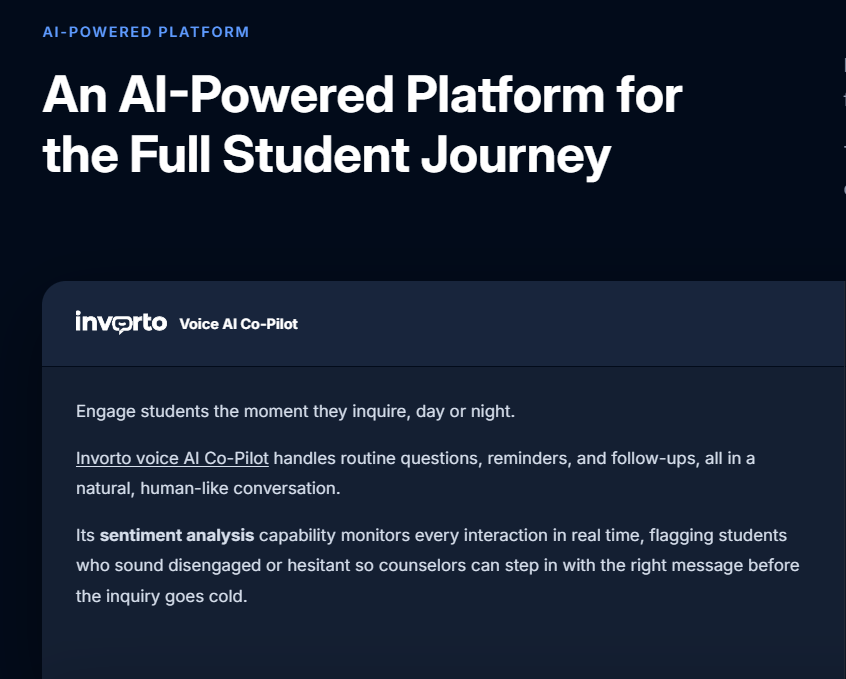
With LeadSquared’s Invorto, minutes are billed on talk time, and calls that are queued but never connect use no minutes. The AI models and voice providers are bundled into the subscription, while you bring your own phone numbers from your telephony provider (see the Invorto feature guide).
Most modern platforms offer several natural-sounding voices and multiple languages. Spanish matters for many US career schools, especially in Texas, Florida, California, and the Southwest. Test it yourself. Ask for a sample call in Spanish, and check that the agent can switch languages mid-call if the prospect does.
LeadSquared’s Invorto voice AI supports 13+ languages, including English and Spanish. It is designed to sound natural across regions, adapting to local accents and everyday phrasing instead of reading from a stiff script. A noise-resistant speech layer also cleans up messy audio, which helps when a prospect picks up in a car or on a busy work floor. Invorto notes that support for mixed-language speech can vary by language and use case, so if your prospects switch between English and Spanish mid-sentence, include that in your test calls. The Invorto page also has sample recordings you can play, including an education call from a beauty school.
The market splits into two camps. Some tools are voice platforms you connect to a CRM. Others put the voice agent inside the admissions CRM itself. That difference decides how much data your agent can see and whether you can tie a phone call to an enrolled student.
If you are shortlisting an AI voice agent for admissions, these are five options teams commonly compare. We judged each one on the questions buyers actually ask. Ratings and pricing were checked in November 2026 and can change, so confirm them during your own evaluation.
| Tool | Type | Pricing model | Best fit |
| LeadSquared with Invorto Voice AI | Voice agent inside an education CRM | CRM subscription plus usage-based voice add-on | Career, trade, allied health, and nursing schools, from single campus to multi-state enterprise |
| Regal | Enterprise voice AI for contact centers | Custom quote | Large, phone-heavy enrollment centers |
| CloudTalk | Cloud call center with AI voice agents | Per-user plans plus AI usage | Teams that want a dialer and AI in one phone system |
| Retell AI | Developer-friendly voice agent platform | Pay as you go per minute; enterprise quotes | Schools with technical staff who want to build their own flows |
| byVoice | No-code voice and chat agent platform | Monthly plans with included minutes | Small schools testing AI calling on a tight budget |
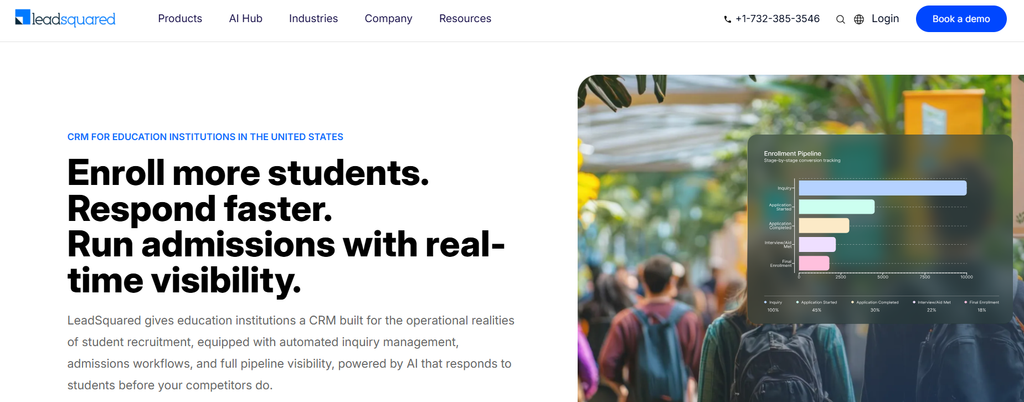
Best for: Career colleges, trade schools, cosmetology and barber academies, allied health, and nursing programs that run counselor-led admissions at volume, along with colleges and universities that want faster first contact.
It fits a single-campus school with a small team and scales to multi-campus groups such as Lincoln Tech. The enterprise case is where the CRM-native design matters most. More campuses mean more programs, more calendars, more routing rules, and more SIS records to keep in sync, and a bolt-on voice tool has to replicate all of that logic outside the CRM.
Invorto Voice AI is a paid add-on to the LeadSquared Education CRM.
Inquiry channels: LeadSquared captures inquiries from websites, landing pages, paid ads, social media, phone calls, chat, SMS, partner portals, and walk-ins into one de-duplicated record. Its Universal Data Sync (UDS) Connector, formerly called Universal Lead Capture, is the part most schools underestimate. It is a no-code integration layer that pulls leads and activities from almost any outside source with an API, a webhook, or an SFTP file drop, on a real-time or scheduled basis. That covers lead aggregators, third-party portals, event apps, and other niche sources that usually end up in a spreadsheet.
UDS matches incoming records on fields like email or phone, so the voice agent doesn’t call the same person twice from two sources. Because every channel lands in the same record, the Invorto agent can call any of them within minutes, with the full history in front of it.
UDS is a paid connector, so include it in your quote.
System of record integration: Invorto writes call outcomes, transcripts, recordings, and booked appointments to the LeadSquared lead record. LeadSquared is the system of record, so no separate sync is needed for lead data. SIS enrollment status flows back through APIs, automated workflows, and webhooks.
Does it close the loop to revenue? Yes. Call outcomes write straight to the lead record, and LeadSquared reports conversion rates by lead source, counselor, and program through application and enrollment. With integrations for SIS platforms such as Anthology Student, Ellucian Colleague, Ellucian Banner, Diamond, Orbund, and FAME Advantage, LeadSquared syncs validated student data into your system of record, and data from the SIS can be pulled back into the CRM. That lets you answer the questions that matter: which channels, and which AI-booked appointments, produced actual starts. To turn those answers into a business case, see our guide on how to measure ROI for AI initiatives in enrollment, which walks through the metrics.
Security and compliance: LeadSquared is SOC 2 Type II and ISO 27001 certified (ISO audited by BSI) and complies with GDPR and TCPA. It supports FERPA obligations through role-based access controls, encrypted student data, and audit trails. Compliance documentation is available to verified procurement contacts. The Lincoln Tech rollout also shows the governance model: each agent works within a defined scope with every action logged in an audit trail, and humans stay in the loop for key decisions.
Pricing model: The education CRM is licensed per user (see education CRM pricing). Invorto Voice AI is an add-on with usage-based pricing, so you pay for the calling you actually use. FloStack scheduling is also an add-on.
Watch-outs: Invorto is sold as an add-on, so ask for the CRM and voice pricing together to see your full cost. You get the most value when LeadSquared is your system of engagement. If your school is locked into another CRM for the long term, discuss the integration path up front. On G2, LeadSquared holds a 4.5 out of 5 rating from about 300 reviews.
Best for: Large enrollment contact centers that live on the phone and have the budget for an enterprise platform. Regal positions itself as a voice AI platform for enterprise contact centers.
Inquiry channels: Primarily voice, with SMS for journeys and reminders. New inquiries typically arrive from your CRM or marketing stack, so channel coverage depends on how well those upstream systems capture leads.
System of record integration: Regal syncs with your CRM through integrations and APIs. Ask which fields sync, in which direction, and whether updates are real time or batched.
Does it close the loop to revenue? Partially. Regal offers strong journey and call analytics, but enrollment outcomes live in your CRM or SIS. Revenue attribution depends on how well you sync those outcomes back.
Security and compliance: Regal sells into regulated industries such as financial services and healthcare. Ask for its SOC 2 report and confirm how it handles FERPA-covered records and consent under your contract.
Pricing model: Custom quotes. According to Regal’s pricing page, you pay for the features you use.
Watch-outs: No public pricing, and the platform is built for enterprise contact centers, which can be more than a small school needs. On G2, Regal scores well from a small review base. Reviewers mention a learning curve and limited reporting depth.
Best for: Schools that want to replace or upgrade their phone system and add AI voice agents to the same purchase. It suits mid-sized teams with an existing call center workflow.
Inquiry channels: Phone calls, SMS, and WhatsApp. Web form and social inquiries arrive through CRM integrations, so capture depends on your CRM.
System of record integration: CloudTalk logs calls and dispositions to connected CRMs through its integrations. Check whether your CRM is on its native list or needs middleware, and whether AI voice agent transcripts sync as well as call logs.
Does it close the loop to revenue? Not on its own. CloudTalk tracks call metrics and logs calls to your CRM, but enrollment and revenue reporting has to happen in the CRM.
Security and compliance: CloudTalk displays SOC 2, ISO 27001, GDPR, and CCPA badges and markets FERPA compliance tools on its enrollment guide. Confirm data residency, since the company operates across Europe and North America.
Pricing model: Per-user plans start at $19 per user per month (Lite, Americas only), billed annually, with AI voice agent usage billed separately.
Watch-outs: It is a phone system first. Education workflows need configuration, and there are no native SIS integrations. On G2, CloudTalk holds 4.4 out of 5 from more than 1,700 reviews; call issues and connection issues are the most frequent complaints.
Best for: Schools and online program management (OPM) companies with in-house technical staff who want full control over call flows.
Inquiry channels: Voice and chat agents. Leads reach Retell through APIs, webhooks, and integrations such as HubSpot, Make, n8n, and Go High Level. There is no built-in lead capture layer.
System of record integration: Retell sends call data wherever you route it through APIs, webhooks, or tools such as Make and n8n. Your team builds and maintains the sync.
Does it close the loop to revenue? No. Retell offers post-call analysis and logs outcomes wherever you send them. Attribution to enrollments depends entirely on your CRM build.
Security and compliance: Retell reports SOC 2 compliance. Note that role-based access control, SSO, and custom data retention are listed on the Enterprise plan only, which matters for FERPA-style access controls.
Pricing model: Pay as you go at roughly $0.07 to $0.31 per minute depending on the AI model, voice, and add-ons, with telephony and phone numbers billed separately. Enterprise pricing is custom.
Watch-outs: Per-minute costs climb as you add premium voices, knowledge bases, and PII redaction. On G2, Retell is highly rated (4.8 out of 5 from more than 2,600 reviews), but reviewers flag missing features, poor understanding in varied conversations, and integration issues.
Best for: Small schools that want to test AI calling with a low monthly commitment and are comfortable with a general-purpose tool.
Inquiry channels: Voice calls, website chat, SMS, WhatsApp, and Telegram, with CRM connections through APIs, webhooks, Zapier, and Make.
System of record integration: byVoice connects to CRMs through APIs, webhooks, Zapier, and Make. Field mapping and sync direction are set up by your team.
Does it close the loop to revenue? No. It reports call outcomes and campaign metrics, and revenue tracking happens in whatever CRM you connect.
Security and compliance: byVoice is based in Krakow, Poland, and publishes a data processing addendum. Its education page does not mention FERPA, so ask directly about US data hosting and student-record handling.
Pricing model: Monthly plans from $29 (150 AI minutes) to $199 (1,500 minutes), with overage per minute and custom plans for higher volume, per its pricing page.
Watch-outs: byVoice has only a handful of reviews on Capterra so far, and the testimonials on its education page don’t name the schools behind them. Ask for references before you rely on the results it advertises.
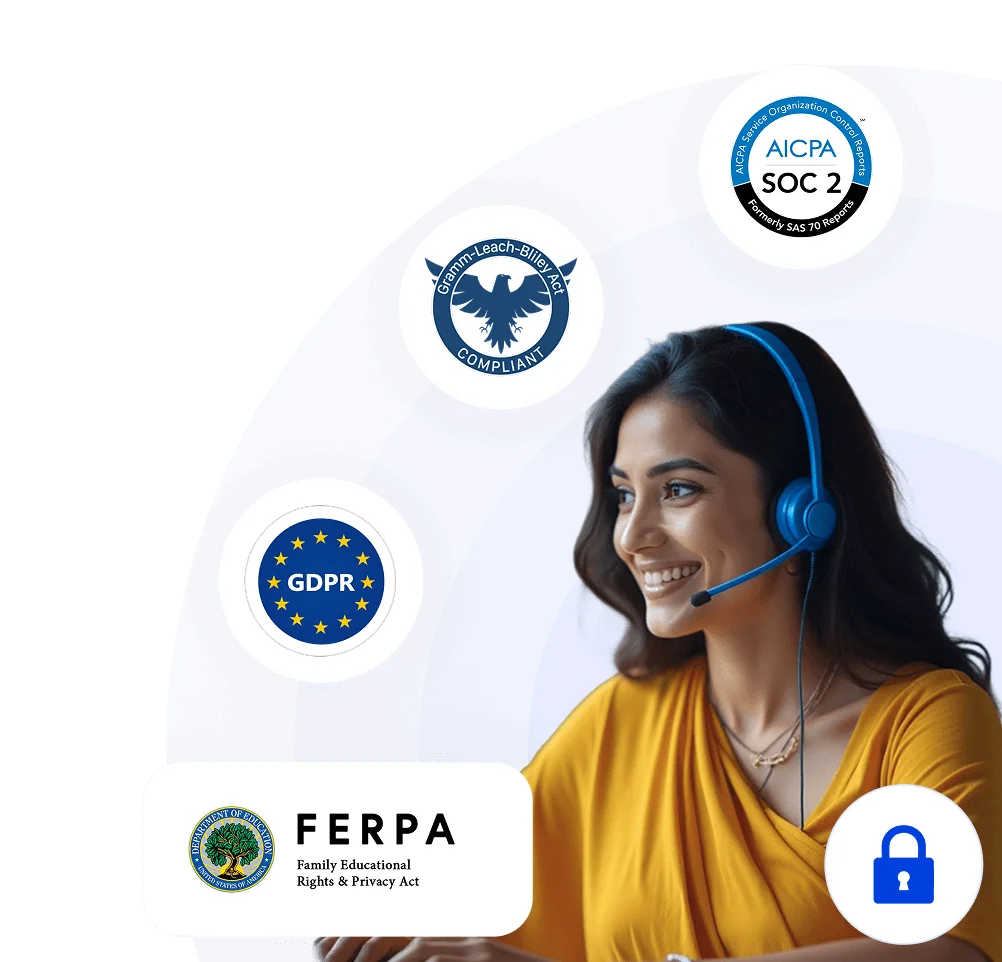
An AI calling agent touches personal data on every call, and it may record and transcribe conversations. That makes compliance a buying criterion, so give it its own line in your evaluation.
FERPA protects the privacy of student education records. Most first calls happen before someone is a student, but a voice agent that also handles applicants, enrolled students, or re-enrollment campaigns will touch records that FERPA covers. Ask every vendor where recordings and transcripts are stored, how long they are kept, who can access them, and whether access is controlled by role. Ask whether audit logs show who viewed or exported a record. A vendor that offers role-based access only on its top plan may not be the right fit for a school with strict access rules.
In February 2024, the FCC confirmed that calls using AI-generated voices count as “artificial” voice calls under the Telephone Consumer Protection Act, which means they require prior consent (Orrick summary of the ruling). In practice, your inquiry forms need clear consent language that covers automated and AI calls, and your agent should identify the school at the start of each call. Opt-outs need to be honored immediately across every channel. State rules, such as calling-hour limits and mini-TCPA laws, can be stricter, so involve your compliance team before you switch on outbound campaigns.
When the voice agent lives inside your CRM, these controls are easier to enforce. Consent, permissions, and audit trails are already part of the record, so the agent inherits them rather than relying on a second system to copy them correctly.
You don’t need to switch everything on at once. A 30- to 60-day pilot on a defined slice of leads gives you real numbers on AI admissions calls and lets your advisors build trust in the agent.
To get a rough sense of the cost, picture a school that receives 1,000 inquiries a month. If the AI agent reaches 60% of them and averages three minutes per connected call, that is about 1,800 minutes a month. At typical market rates, the calling cost typically lands at a few hundred dollars, well below the cost of a single additional advisor. Your numbers will vary, which is why the pilot matters.
Every admissions team already knows that speed wins enrollments. The hard part has always been staffing for it, especially after hours and during campaign spikes. An AI voice agent removes that bottleneck by making the first call within minutes and putting a qualified conversation on an advisor’s calendar.
The voice is the easy part to buy now. The CRM behind it decides how far the results go. A stand-alone voice platform can make the call. A voice agent built into your admissions CRM can also see every channel the lead came from and show you which calls turned into enrolled students, while following your consent and access rules. For a single-campus school, that means less manual work. For a multi-campus group, it means one set of rules across every campus and AI you can actually audit.
If you’re weighing your options, see how an AI voice agent works inside your admissions CRM, from the first call to the enrolled student.
Book a demo of AI calling in LeadSquared
It is software that holds natural phone conversations with prospective students. It calls new inquiries, answers common questions, collects missing details, qualifies the lead against your rules, and books an appointment with an advisor or transfers the call live
No. It takes over the repetitive first call and after-hours coverage. Advisors still handle the conversations that lead to enrollment, such as financing and program fit, and they now spend more of their day on prospects who are ready to talk.
Within a minute or two of the form submission, at any hour, as long as the agent is triggered by your CRM and the prospect has given consent to be called.
Most modern platforms support Spanish and many other languages. Ask the vendor for a sample call in Spanish and check whether the agent can switch languages mid-conversation.
Most vendors charge by usage, either per minute or per connected call, sometimes on top of a platform or per-user fee. Stand-alone platforms list rates from a few cents to around 30 cents per minute before telephony. Ask for an all-in estimate based on your monthly inquiry volume.
It doesn’t have to, but it changes what you get. A stand-alone agent can make calls and log results through an integration. An agent inside the CRM can use the full lead history, follow your existing routing and consent rules, and tie each call to applications and enrollments without extra wiring. The more campuses, programs, and lead sources you run, the bigger that difference becomes.
Enter your details and we'll send you a quick confirmation email to verify your address.
 23 min read 20 min read 26 min read


