





EDUCATION
How to scale AI use in higher education: A solid guide for admissions, academics & student services
Contents

 15 min read


86% of education organizations now use generative AI.
While 54% of students globally use AI weekly, only 42% of undergraduate students (primarily in the UK and US) believe their faculty are well-equipped to provide guidance—a support gap that threatens both learning outcomes and institutional credibility.
The numbers tell a compelling story. The global market for AI in higher education is projected to reach $73.7 billion by 2033. Early adopters are already seeing measurable returns: automating routine tasks with AI can reduce administrative costs in higher education by up to 30%, freeing teacher capacity for high-value student interactions.
But these results don’t come from running just a few isolated projects. Institutions that see real returns are the ones that scale AI across their entire campus—connecting admissions, academics, and student services into a coordinated system. This requires the right infrastructure, clear governance, and teams focused on deploying AI quickly while keeping student data safe.
The cost of waiting is high. Early movers are building the competitive advantages that will be difficult to match.
If you’re looking to scale AI in higher education, it starts with a central AI team that sets standards, provides shared technology, ensures compliance, and trains your staff. This team doesn’t do all the work—it enables your departments to move faster.

Each team should include people who understand the business goal, can work with data and AI tools, and ensure you’re meeting institutional policies. Focus on improving real outcomes—higher enrollment, better retention, faster response times—not just launching new features.
Your higher education AI solutions need six key components working together:
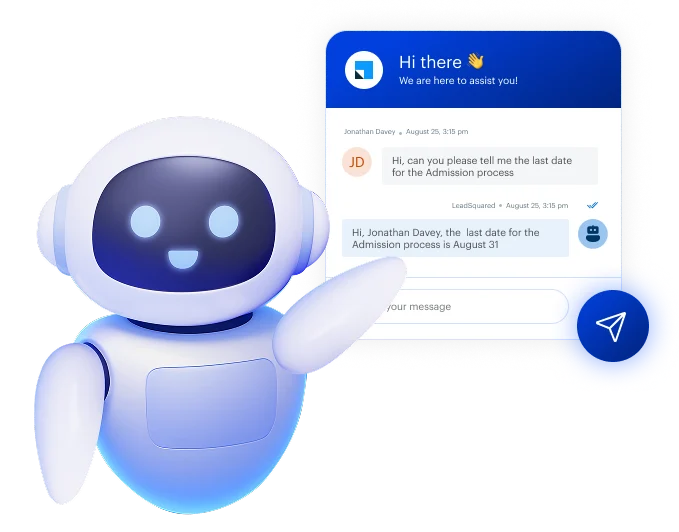
Deploy conversational AI for higher education—AI chatbots that answer prospective student questions 24/7 via your website, text messages, and social media.
Use AI in university admissions to process application documents automatically—reading transcripts, extracting GPAs, and spotting errors or inconsistencies.
AI can also help your counselors prioritize which prospective students to contact. The system analyzes student behavior—like email opens and website visits—and uses predictive models to identify who’s most likely to apply. It tells counselors exactly who to call and what to say.
Also read: How AI Improves Student Counselor Performance: 5 Use Cases
AI course design tools help faculty create materials that work for all learning styles—generating text, audio, and visual versions of content while checking for accessibility issues. Faculty report saving 50-60% of the time they previously spent adapting materials for different learners.
AI-powered tutoring systems can boost student engagement and performance by up to 30%. Integrate AI tutors into your learning management system that answer student questions with detailed explanations, spot where students are struggling, and provide help anytime—day or night. Train these virtual tutors on your actual course materials and set limits to prevent students from simply getting answers without learning.
AI grading assistants can draft feedback based on your rubrics, which faculty can review and edit before students see it. AI grading systems can handle nearly all multiple-choice tests and about half of essay grading. AI accessibility tools can automatically add descriptions to images, create captions for videos, and translate content into other languages—helping you meet legal requirements while serving more students.
AI advising assistants check student progress in real-time, recommend which courses to take next, and catch registration mistakes before they happen. Predictive analytics helps institutions support students proactively by analyzing course engagement, assignment submissions, attendance, and faculty communication.
Early-alert systems spot struggling students before grades drop. AI detects subtle warning signs like reduced campus engagement, social isolation, or changed study patterns that predict retention problems weeks in advance (Source). The system calculates risk scores and automatically routes students to get the right support—tutoring, counseling, or financial aid. This delivers 10-15% better first-year retention and gets help to students 30-40% faster.
Platforms like LeadSquared integrate these AI capabilities for student lifecycle management with your student data, enabling personalized interventions at scale across admissions, academics, and student services—all from a unified system that tracks the entire student journey.
Financial aid chatbots answer routine questions and walk students through document requirements, reducing call volume and helping more students complete verification. Career services AI provides resume feedback, mock interviews, and personalized job recommendations.
AI catches warning signs that slip through the cracks of traditional reporting. AI models detect subtle patterns humans overlook, like how a drop in online course engagement correlates with a higher likelihood of withdrawal. The system notices small changes—students logging in at unusual hours, repeatedly skipping certain materials, or spending less time in each session—that predict bigger problems ahead.
AI detects changes in campus engagement and social isolation by tracking discussion board participation, dining hall visits, library usage, and event attendance. A student who suddenly stops participating socially often faces mental health or personal challenges. By the time grades reflect the problem, it’s harder to help.
AI also connects information across different campus systems that advisors can’t easily see together. When a student simultaneously stops attending class, misses housing payments, and reduces meal plan usage, they’re facing a serious crisis that needs coordinated support—not just academic help.
Beyond grades, AI spots signs of struggle:
AI uncovers hidden issues by analyzing student feedback and discussion posts, detecting declining morale, or growing frustration.
Advanced AI systems achieve 88% accuracy in predicting student performance. (Source). These systems don’t just identify who needs help—they determine the best time and method to reach each student. Some respond better to text messages than emails. Some engage more on Tuesday mornings than Friday afternoons. The AI learns what messaging works for each student.
Educational CRM Platforms like LeadSquared integrate data across your entire student lifecycle—from first inquiry through graduation—enabling these AI insights at scale. The system tracks behavioral patterns, identifies at-risk students, and triggers personalized interventions automatically, ensuring no student falls through the cracks.

AI can predict long-term outcomes from early behaviors. Students with specific combinations of first-year course choices, grade patterns, and engagement levels have a 70%+ chance of changing majors or needing extra time to graduate. Predictive analytics improves student retention rates by up to 25%—a difference that significantly impacts both student success and institutional finances.
Scaling AI responsibly means managing risks systematically. The NIST AI Risk Management Framework was released in January 2023 as a voluntary guide for responsible AI development. It provides four key steps:
The framework emphasizes governance, verifying AI outputs against source documents, thorough pre-launch testing, and transparent incident reporting.
Protect student privacy by getting explicit permission before using student data in AI systems, collecting only the data you actually need, and explaining to students when and how AI influences decisions about them. For high-risk AI systems, document what data you’re using and why.
Make sure AI works for everyone. Test AI-generated content with screen readers and other accessibility tools. Provide phone or email options for students who can’t or won’t use AI chatbots. Check that AI performs consistently across different student demographics to avoid bias. Run bias checks every quarter. If one group of students gets significantly worse results than others (more than 5% difference), fix the AI model or use different approaches for different populations.
Use this roadmap this year, or whenever you have the looming question of “How do I scale AI across admissions, academics, and student services?”:
According to the 2025 EDUCAUSE AI Survey, nearly 40% of institutions report measurable time savings within the first two terms of AI deployment.
Your budget needs will depend on institutional size and how quickly you want to scale. Plan for four main cost categories:
For a customized assessment based on your institution’s specific needs and existing infrastructure, contact vendors for detailed proposals that account for your student population, current systems, and strategic goals.
Return on investment typically comes from three areas: increasing revenue through better enrollment, decreasing costs through efficiency, and making strategic improvements that strengthen your institution long-term. (Source).
Review your metrics monthly to catch problems early. Every quarter, check for bias and hold governance meetings to assess what’s working. Once a year, step back and refresh your overall AI strategy based on what you’ve learned.
Ready to scale AI in higher education?
Start by securing executive sponsorship, establishing governance foundations, and identifying 3-5 use cases delivering maximum value. The institutions that succeed will balance ambition with governance, speed with safety, and technical sophistication with change management. The future of higher education is AI-augmented—will your institution lead or follow?
Get started, with LeadSquared.
AI plays three key roles in higher education: helping students succeed through personalized support and early intervention, assisting faculty with course design and grading, and enabling staff to work more efficiently by automating routine tasks. From 24/7 chatbots answering admissions questions to predictive analytics identifying at-risk students, AI augments human expertise rather than replacing it.
Georgia State University (Atlanta, USA) uses AI to track over 800 risk factors for 40,000+ students daily, enabling 90,000 personalized interventions annually (Source) and improving four-year graduation rates by 7 percentage points. Berry College (Georgia, USA) uses AI for transcript processing and GPA recalculations, saving time while increasing accuracy (Source). The Open University (UK) uses its OU Analyse system to predict at-risk students by analyzing engagement patterns (Source). Platforms like LeadSquared’s Higher Education CRM integrate AI across the entire student lifecycle—from recruitment through graduation—enabling institutions to automate interventions, prioritize outreach, and track student success at scale.
AI delivers measurable benefits across institutions: 40-60% faster response times to student inquiries, up to 30% reduction in administrative costs, 25% improvement in retention rates, and 50-60% time savings for faculty adapting course materials. Beyond efficiency, AI enables personalized learning at scale and can boost student engagement and performance by up to 30%. AI detects struggling students weeks before grades reflect problems and helps advisors support 25-35% more students effectively.
Budget requirements depend on institutional size and scope. Small institutions typically need 2-3 dedicated staff and investment in cloud infrastructure, AI platforms, and training. Mid-size schools require 5-7 staff members, including technical leads and governance coordinators. Large institutions need 10-15 full-time staff members plus embedded specialists.
Responsible AI implementation requires quarterly bias audits measuring whether AI performs equally well across all student demographics. If performance gaps exceed 5%, institutions must retrain models with balanced data or use different approaches for different populations. As mentioned earlier, follow the NIST AI Risk Management Framework: set clear accountability, inventory all AI systems, test regularly for bias and errors, and fix issues quickly. Always provide human oversight for high-stakes decisions and alternative pathways for students who can’t access AI services.
 15 min read 29 min read 19 min read



 How to optimize route planning for healthcare field sales teams