




EDUCATION
Here’s how to reduce counselor dependency in higher education by standardizing admissions
Contents

 15 min read


What happens to your application pipeline when your best admissions counselor takes a two-week vacation?
If the answer involves delays, confused applicants, or a colleague scrambling to decode someone else’s workflow—you have a counselor dependency problem. And you’re not alone.
Across U.S. higher education institutions, admissions operations are quietly running on institutional knowledge that lives inside people’s heads, not documented systems. One counselor handles transfer students one way. Another handles them differently. A third has a spreadsheet no one else knows about. The result is an operation that feels functional on the surface but is one departure away from breaking down.
This post is a practical guide for admissions leaders who want to fix that. Not by removing counselors from the equation, but by building systems around them that make great counseling possible at scale. Read on if you’ve been wondering how to reduce counselor dependency in higher education.
Counselor dependency isn’t just an operational inconvenience—it’s a strategic liability.
When processes live in people rather than systems, you get variability in decision-making. Two applicants with near-identical profiles may receive different timelines, different follow-up communications, and sometimes different outcomes, based solely on which counselor handled their file. That’s an equity problem, and increasingly, it’s a compliance risk.
It also creates fragility. EAB‘s 2025 Benchmarking the Enrollment Office report, based on a survey of more than 180 institutions, found that admissions office workloads continue to increase on a per-staffer basis—while many offices are still operating with unfilled positions.
When a single counselor manages 500+ files during peak cycle, the cognitive load alone leads to errors, slower response times, and burnout—which feeds turnover, which makes the dependency worse.
There’s also the speed problem. According to a 2025 survey by EAB, prospective students now expect responses to admissions inquiries within 24 hours. Institutions where every step requires a counselor to manually intervene can’t reliably hit that bar.
The solution isn’t to automate away the human element. The goal is to standardize the routine so counselors can focus on the complex.
Standardization in admissions doesn’t mean turning your office into a processing factory. It means creating consistent, documented, auditable systems for the decisions and tasks that don’t require individual judgment—and freeing your counselors for the ones that do.
There are six areas where most institutions have room to standardize:
Clear, written eligibility criteria, deadline rules, exception policies, and decision authority levels. If your policy exists only in a PDF on a shared drive that hasn’t been updated since 2019, it doesn’t really exist.
Documented workflows for each application type—first-year, transfer, international, graduate—with defined steps, owners, SLAs, and handoff points. A simple swimlane diagram that maps who does what, when, and where decisions get made is a starting point most offices skip.
A taxonomy that routes applications based on complexity. Straightforward applications that meet all criteria should never require a counselor to open the file manually. Complex cases—appeals, unusual profiles, incomplete documentation—should be escalated through a defined path.
Templated, personalized messaging for every stage of the funnel, triggered by status changes rather than individual counselor initiative. Applicants shouldn’t have to wonder what’s happening because their counselor is traveling.
Also read: 10 Keys To Standardize Student Communication Across Counselors

A connected stack that enforces your process rather than working around it. This is where an education CRM becomes non-negotiable.
A quarterly review cycle, a named owner for each SOP, and a change control process so that when policies update, documentation and automation rules update too—not six months later.
Before any technology can do its job, structural work has to happen first. This is the part most institutions skip—they buy software before they’ve mapped their process, and then they wonder why adoption is low.
Start with a current-state map. Use a SIPOC framework (Suppliers, Inputs, Process, Outputs, Customers) or a simple swimlane diagram to capture every touchpoint in your current admissions process. Count the number of counselor touches per application across each app type.
Admissions teams that have mapped their workflows are often surprised to find that a clean, complete application still involves four to seven manual counselor touches before a decision is issued — most of which are routine and rule-based.
Which applications can be evaluated against objective criteria alone? Which require contextual review? Which need committee involvement? Define the thresholds and document them. Create a RACI matrix that specifies who is Responsible, Accountable, Consulted, and Informed at each decision point.
Not 40-page documents—concise, step-by-step guides with screenshots where needed, stored in a searchable internal knowledge base. Include exception paths: what happens when a document is missing, when an applicant misses a deadline, when a review needs escalation. If your staff members have to ask a senior colleague every time something unusual happens, you don’t have SOPs—you have a dependency on senior colleagues.
Every application type should have a documented target cycle time from submission to decision. Every inquiry should have a response time standard. These become the baseline against which you measure improvement.
Once your structural foundation is in place, technology is what makes it scale. An education CRM is the connective tissue of a standardized admissions operation. Unlike a generic SIS that records what happened, a CRM is designed to manage what’s happening—tracking every applicant interaction, triggering the next action, and surfacing the right information to the right person at the right time.

Here’s what a well-implemented education CRM should enable when you’re working to reduce counselor dependency in higher education:
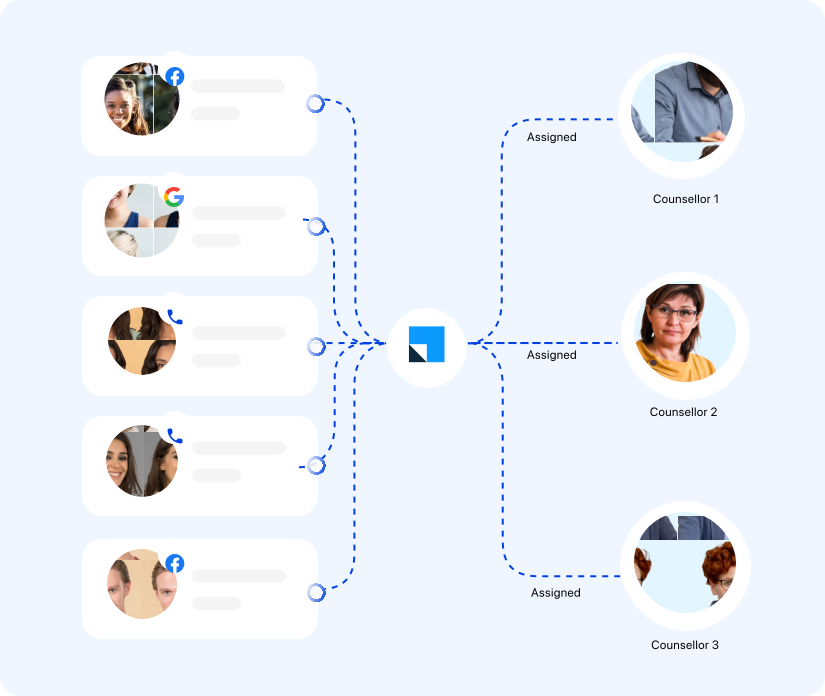
The CRM applies your documented criteria the moment an application is submitted. Applications that meet all thresholds move forward automatically. Applications that need review are flagged and routed to a queue—not a specific counselor’s inbox, but a team queue with defined SLAs. This alone can eliminate a significant portion of manual counselor touches.
Applicants can check their application status, upload missing documents, schedule interviews, and get answers to common questions without emailing a counselor. Every FAQ that gets answered by a portal article or a chatbot is a counselor interaction that never had to happen.
When an application moves from “received” to “under review” to “decision ready,” the CRM fires the appropriate message automatically—personalized by program, applicant profile, and stage—without anyone in the office manually sending an email. Counselors are copied on exceptions, not every routine communication.

Also read: Personalizing Higher Education Marketing Campaigns At Scale
Instead of applications living in counselors’ inboxes, they live in structured queues with priority scoring, SLA timers, and escalation rules. A supervisor can see—at a glance—how many files are in each stage, which are at risk of breaching SLA, and where bottlenecks are forming.
Modern education CRMs increasingly include rules-based or AI-assisted routing that can identify which applications are routine versus complex before a human ever opens the file. Used with a human-in-the-loop design, this doesn’t replace judgment—it directs judgment to where it’s most needed.
Also read: Lead Routing: Rules, Best Practices & AI Automation Tips
Real-time visibility into cycle time, counselor caseload, deflection rates, and yield by segment. Without this, you’re managing blind. With it, you can spot an emerging bottleneck in week two of a cycle and adjust before it becomes a crisis.
The key word here is integration. A CRM sitting disconnected from your SIS, document management system, and communication tools creates data silos—and data silos recreate counselor dependency because people fill the gaps. The CRM should be the single source of truth that the rest of your stack feeds into.
You don’t need a multi-year transformation to start making progress. Here’s a realistic 90-day sprint that any admissions team can execute.
This sprint works best for institutions that already have a CRM or SIS in place, and a team lead who can dedicate 30–40% of their time to process documentation for 90 days. Institutions without a technology foundation should complete Step 1 (map and measure) before committing to the automation phase.
Document your current process for one application type—start with first-year domestic. Count counselor touches. Identify the top five tasks that are repetitive and rule-based. Audit your current SLAs, whether formal or informal.
Write SOPs for the five repetitive tasks. Define your decision taxonomy for this application type. Build a simple RACI. Establish target SLAs.
Pick the highest-volume, most routine interaction—document receipt confirmation, status update emails, or FAQ response—and automate it through your CRM. Measure the deflection rate. Use that win to build internal support for the next phase.
The sprint builds into a broader program: expand automation to additional application types, launch a self-service portal, implement queue-based case management, deploy a governance council to own SOP maintenance, and establish a quarterly PDCA (Plan-Do-Check-Act) review cycle.
If you can’t measure it, you can’t manage it—and you can’t make the case for continued investment. These are the metrics that matter:
Days from application submission to decision, by app type. Baseline it now, track it monthly.
What share of applications can be processed without counselor intervention? Aim to increase this over time without expanding your exception rate.
Average number of manual interactions a counselor has with a file before decision. Lower is better, as long as quality holds.
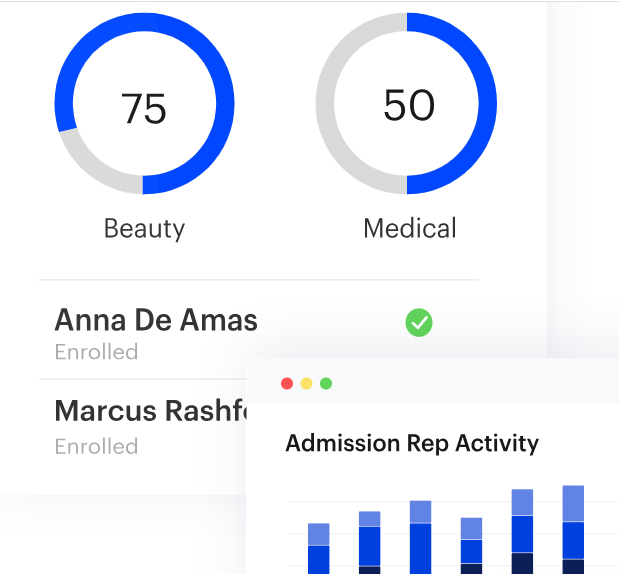
What percentage of applicant inquiries are resolved via self-service—portal, chatbot, knowledge base—without escalating to a counselor?
How often are decisions revised, documents re-requested, or communications corrected after the fact?
Does standardization improve or hurt yield in key segments? Watch this closely, especially for first-generation and underrepresented applicants.
Are cycle times, decision rates, and communication quality consistent across demographic groups? Bias-test your routing rules annually.
The concern that standardization creates inequity is legitimate—but it applies more to poorly designed standardization than to standardization itself. A system where one counselor treats a first-generation applicant’s gap year differently than another counselor does is not equitable by default just because it’s human.
Good standardization actually improves equity by making criteria explicit, documented, and auditable. If your routing rules disadvantage a particular population, a rules-based system makes that visible in a way that informal human judgment does not.
A few non-negotiables to build in from the start:
Three objections come up in almost every conversation about standardizing admissions.
Personalization and standardization aren’t opposites. A counselor who isn’t manually sending status updates to 300 applicants has time for meaningful conversations with the 30 students who need nuanced guidance. The human touch should be reserved for situations where it makes a real difference—not spread thin across routine tasks.
Change resistance is real, and it’s usually not about the technology—it’s about identity and fear of irrelevance. The antidote is to involve counselors in process design, name change champions within the team and be explicit that the goal is to elevate their work, not eliminate it. Counselors who spend less time on data entry and more time on meaningful conversations tend to be more satisfied, not less.
The ROI model for standardization is strong. Fewer errors mean less rework. Faster cycle times mean fewer melt losses. Higher deflection rates mean smaller support staff requirements. Start with a pilot, quantify the impact on one application type, and use that data to justify broader investment.
The following outcomes were reported by institutions using our platform.
University of the Southwest transformed its enrollment efficiency and enhanced personalized student experiences by implementing LeadSquared’s automation. This solution revolutionized their enrollment management, focusing on providing improved student interactions throughout the journey.
“LeadSquared’s automation capabilities mean our counsellors spend more time providing personalized, intimate student experience rather than handling tedious tasks. It’s transformative for both our students and our team.”
– Dr. Ryan Tipton, President and CEO
West Coast Training addressed its challenges with manual lead tracking by utilizing LeadSquared and FloStack. Through this implementation, the institution successfully cut response times by 20%, effectively transforming their lead management into a streamlined, automated system.
“LeadSquared is up all day; it’s our compass that keeps me on task with things… I don’t know how we’d operate without it. It keeps us organized, informed, and our enrollment slots filled. Anyone with access sees real-time lead status and history. It’s top-notch.”
– Thomas Newman, Admissions Representative
Miscio started with 20 students in 2018 and scaled to over 600 across 26 countries — without adding significant headcount. Before LeadSquared, manual spreadsheets and inconsistent processes created constant data loss and operational drag. After implementing standardized workflows and automated communication sequences through LeadSquared, response times improved by 20%, conversion rates rose steadily year over year, and hundreds of staff hours were recovered.
“Hundreds of man-hours, perhaps thousands, have been saved… this system has allowed our team to 10X their own capacity”
– Caleb Hiddleston, Director of Global Operations
Before your next cycle kicks off, run through these:
Admissions offices that learn how to reduce counselor dependency in higher education don’t get there by removing people—they get there by building systems good enough that their people can do their best work. If your current process breaks without two specific people in the building, that’s the starting point. Map it, document it, automate what can be automated, and give your counselors back the time to do the work only they can do.
Start with a 90-day sprint. Audit one workflow. Measure the difference. The institutions pulling ahead in enrollment aren’t the ones with the most counselors—they’re the ones with the clearest processes.
About LeadSquared
LeadSquared is an education CRM built for institutions that need more than a contact database. From automated application workflows and self-service student portals to real-time funnel analytics and counselor queue management, LeadSquared gives enrollment teams the infrastructure to standardize at scale — without losing the personal touch that drives yield.
See how LeadSquared can help your admissions team do more with less.
No. If anything, it improves! Standardizing routine tasks frees counselors to give more time and attention to the applicants who genuinely need a human conversation.
Start with your existing CRM or SIS. Most platforms have automation and self-service capabilities that are underutilized — workflow triggers, document upload portals, and templated communication sequences are common features that many teams never configure. Before requesting a new budget, audit what your current platform can do with proper configuration. If gaps remain after that audit, you have a documented business case for investment. A phased approach — starting with one automated workflow before expanding — makes the budget conversation easier because you can demonstrate measurable ROI from a controlled pilot.
Start with the highest-volume, lowest-complexity workflow in your busiest application type. Pick something where the rules are clear, the volume is significant, and the win is visible. Build from there.
Most institutions see measurable impact within the first 90 days — typically in the form of faster response times and reduced manual touchpoints on a single application type. Broader gains in cycle time, deflection rate, and counselor caseload become visible at the 6–12-month mark, once automation and self-service infrastructure are more fully built out. The key is starting with one high-volume workflow rather than trying to overhaul everything at once.
Not necessarily. Many institutions underutilize the automation and workflow capabilities already built into their existing CRM. A platform like LeadSquared, purpose-built for education, includes queue-based case management, automated communications, applicant self-service portals, and real-time enrollment analytics out of the box — which means less stitching together of separate tools and faster time to value. That said, the most important first step is always structural: map your process, define your decision rules, and document your SOPs before configuring any technology around them.
 12 min read 17 min read 14 min read