




EDUCATION
AI call analysis for admissions teams: Score every call, coach where it counts
Contents

 14 min read



How many calls did your admissions team make last week? Now, how many of those did anyone actually listen to?
For most schools, the second number is small. An admissions director might review four or five calls while her team of counselors makes a few hundred. The other calls never get reviewed, so the mistakes in them never get coached.
One career college with about 10 recruiters described its coaching process to us in four steps: download, listen, take notes, give feedback. All of it manual. Call coaching and call review came up in our conversations with several education teams we spoke to.
Conversation intelligence software is a category of tools built to close this gap. These tools turn every recorded call into a transcript and a short summary, then point managers to the calls that need a closer look.
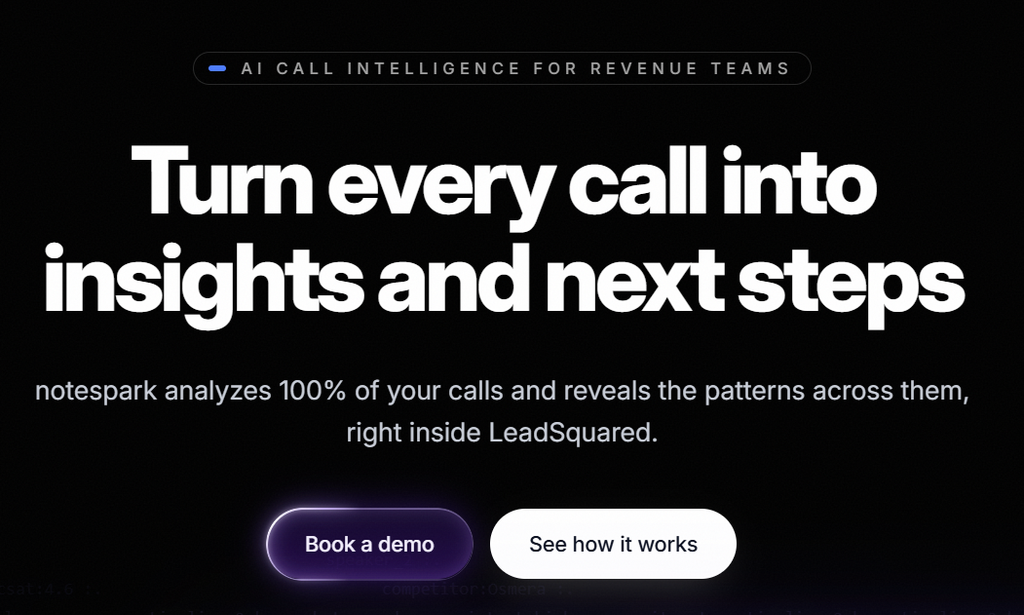
LeadSquared’s notespark is one example. With a tool like this, your team can learn from every admissions call. For admissions, the best setups do two things: your director writes the rubric every call is scored against, and the results land on the lead record in your CRM.
This guide covers how AI call analysis for admissions works in practice, what it can and cannot judge, and the questions admissions leaders asked us most before trying it.
This guide is published by an enrollment technology provider that offers AI call analysis. The evaluation steps in it work for any tool you are considering, including ours.
Most admissions directors know coaching works. Finding the hours for it is harder.
The typical loop looks like this:
Reviewing a 15-minute call this way can take a manager 30 minutes.
That pace works for a few calls a week. Across a team of 10 or more counselors, most calls never get a second listen.
Because review is slow, managers pick calls almost at random. Usually, it is the call a counselor flagged, or the one a prospective student complained about. The quiet patterns go unseen. A counselor who skips the financial aid question on every call may never get help with it, because nobody heard those calls.
If you are trying to spot which counselors need coaching, a sample of four calls a week will not tell you much.
Counselors feel the squeeze from the other side. After every call, they type a summary into the CRM and set up a follow-up task. Many skip it or write two words. Then the next rep who picks up that student starts from zero.
The prospective student has to repeat their program interest and start date, and that repetition can cost you the enrollment.
Prospective students leave voicemails at night and on weekends. Someone has to listen, figure out who called, and log it. On a busy Monday, some of those messages wait until Wednesday. By then they have talked to another school.
AI call analysis listens to recorded calls so your team does not have to listen to all of them. It converts speech to text, works out who said what, and pulls out the parts a counselor or manager needs.
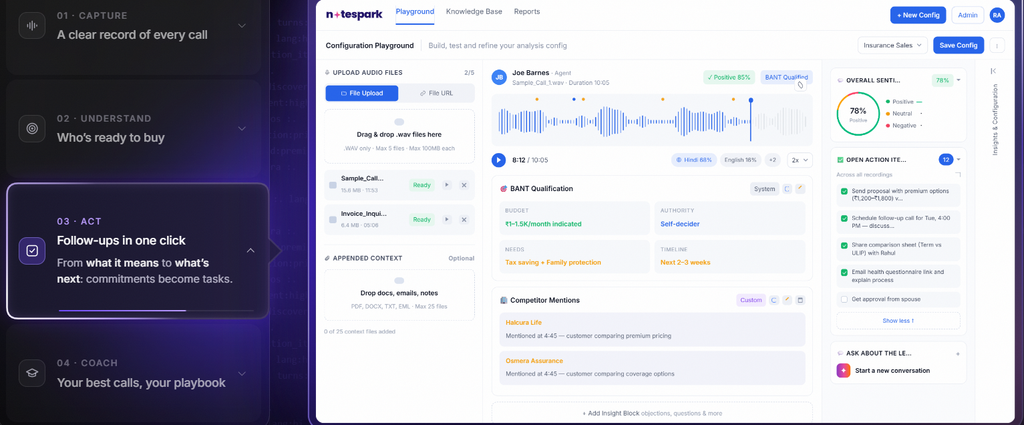
In LeadSquared, notespark runs on calls tied to a lead, so everything it produces lands on that lead record.
| Task | How most teams do it today | With AI call analysis |
| Call notes | Counselor types a summary after each call, if there is time | A summary appears on the lead record, with the commitments and next steps from the call |
| Follow-up tasks | Rep remembers, or forgets, to set them | Follow-ups are pulled from what was said on the call (“send the financial aid checklist”) and can trigger tasks |
| Call review | Manager downloads and listens to a handful of calls | Every call is checked for the criteria the manager defines |
| Keywords and alerts | Managers hear about problems after the fact | Recurring objections and competitor mentions surface across every call |
A good summary works as a handoff note between counselors. It covers the program the prospective student asked about, their target start date, objections they raised, and what was promised next. The next counselor can skim it before dialing and pick up where the last call ended.
Traditional call analytics software tracks activity metrics, such as call volume, talk time, missed calls, and average handle time. Those numbers are useful, but they cannot tell you whether a counselor explained the program well.
Conversation intelligence looks at what was said. It reads the transcript and judges the content of the call against criteria you set. That is the part admissions managers have been doing by hand.
Scoring is where AI admissions call coaching software saves managers the most time. Instead of a manager listening to four calls, the system checks every call against a rubric and shows where each counselor stands.
The best setups let the manager define what a good admissions call looks like. For a nursing program, that might include confirming prerequisites and explaining clinical placement. For a cosmetology school, it might be booking a campus tour and discussing kit costs.
In NoteSpark, your manager decides what gets captured on every call, such as your qualification criteria, and can set different criteria for each team. That keeps coaching tied to your enrollment process. Many standalone call tools are built for B2B sales teams, so their default scorecards look for things like budget and decision-makers. Admissions calls need criteria of their own.
Scores point you to the calls worth your time. Every call gets checked, so the handful you listen to are the ones that matter most. A manager can sort by low scores, open the three calls that missed the financial aid step, and coach on the pattern behind them.
This also makes feedback fairer. Counselors are measured on every call, so one rough conversation does not define their week.
Recommended reading: Spot Counselors Who Need Performance Coaching (2026)
Admissions leaders often ask whether AI can tell when a counselor sounds rushed or dismissive. Most call coaching software scores the transcript, meaning the words spoken. Some tools add signals such as talk ratios or long silences. Tone of voice is harder to score reliably, so test it on real calls. notespark tracks sentiment and talk-to-listen ratio on every call, and managers can compare counselors side by side.
Ask any vendor to show you exactly which signals feed the score. If tone matters to your rubric, test it on real calls during the pilot.
Accuracy was the first worry for many admissions teams we spoke with. A wrong task (“call back Tuesday” when the student said Thursday) could lose a prospective student.
Accuracy depends on a few things you can check:
Bilingual calls are worth testing, too. Many career schools take calls in Spanish. If yours does, include a few Spanish calls in your accuracy checks, along with any calls that switch languages partway through.
During the pilot, have managers spot-check a sample of summaries and tasks each week against the recordings. Track how often they needed a correction. That correction rate is your real accuracy figure.
A call summary sitting in a separate tool helps one person once. A call summary sitting on the lead record helps every counselor who touches that lead afterward.
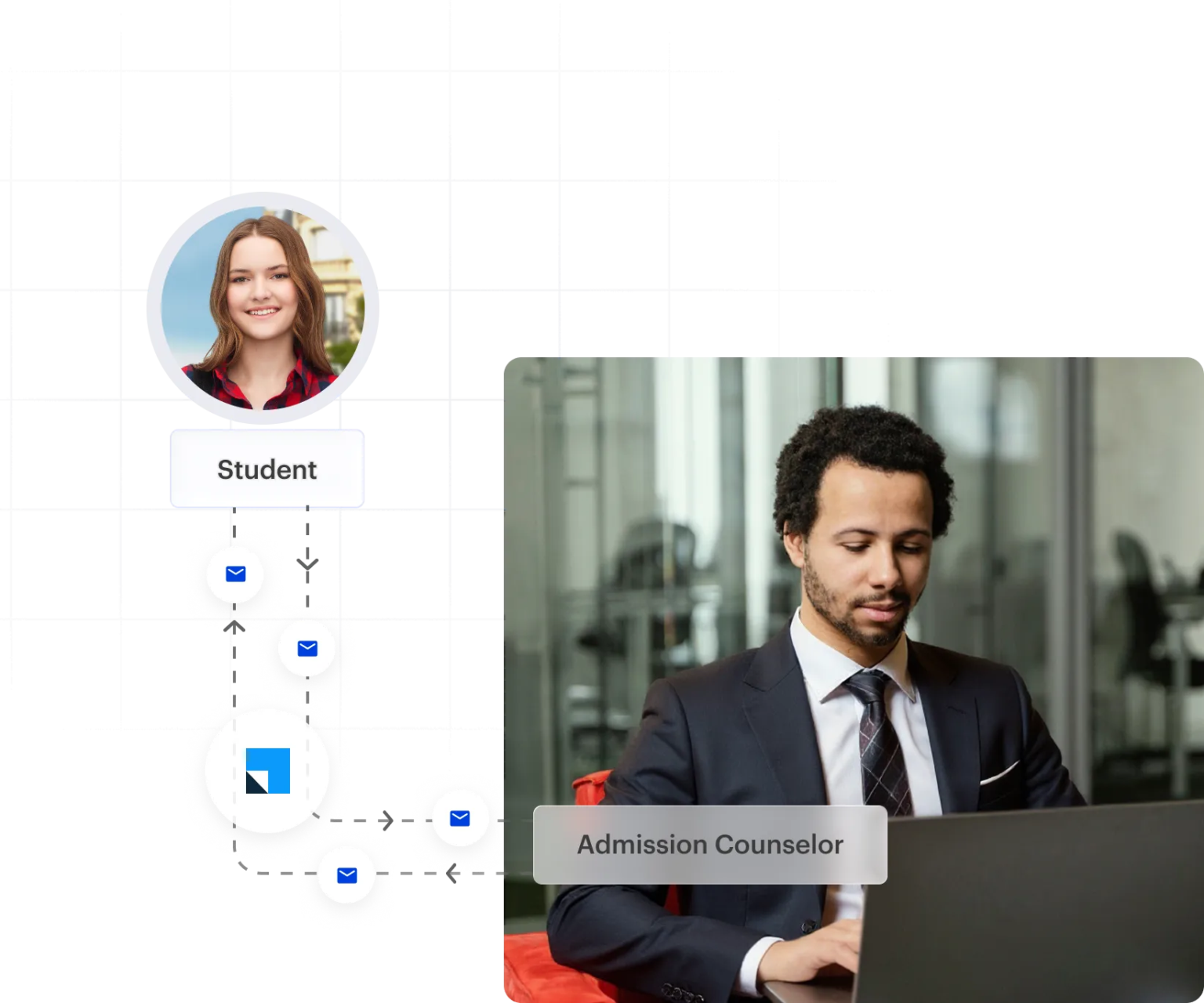
So look for a tool that writes its analysis to the lead record.
In LeadSquared, call insights sit on the same lead record as their web form, texts, emails, and chat history. Schools that pull in leads from many places can route them into that record through the Universal Data Sync (UDS) connector, formerly known as Universal Lead Capture. A counselor opening the record sees the whole story in one place.
It can, when the insights are stored as data on the lead. A call where a prospective student confirms funding and a start date says more about intent than a page visit. Teams can use signals like these to adjust lead scores or move a lead to the next stage, so counselors spend time on the prospective students most ready to enroll.
Recorded calls hold personal details: names, phone numbers, prior schooling, sometimes financial situations. Before any school turns on AI call analysis, compliance and IT will want clear answers to the questions below.
FERPA protects education records, which the U.S. Department of Education defines as records directly related to a student and kept by the school or a party acting for it. Admissions calls often happen before a person is a student. Once they enroll, though, those call notes may sit in the same record as their other files.
The safe approach is to treat call data from prospective students with the same care you give student records from day one. Confirm with your compliance team how your institution classifies it.
Recording rules vary by state. Most states let one party consent, but several require every person on the call to agree. Justia’s 50-state survey of call recording laws is a useful starting point. For calls that cross state lines, both Justia and Kilpatrick Townsend’s 2024 wiretap law summary advise following the stricter state’s rule. A short, recorded disclosure at the start of every call covers most schools.
Not everyone needs to hear every call. Look for role-based permissions so counselors see their own calls and managers see their team’s. In multi-campus groups, campus-level access keeps one location’s data separate from another’s.
This section is general information, not legal advice. Check with your counsel before recording or analyzing calls.
For a single campus with 10 reps, the coaching gap is mostly a time problem. For a school group with 20 campuses and 300 counselors, it becomes a visibility problem too. Leaders can no longer tell which campuses or programs need help until enrollment numbers dip.
One rubric, many campuses. Leadership wants every campus measured the same way, with room for program-specific criteria. A shared rubric with campus-level variations lets you compare fairly without forcing a nursing campus and a barbering campus into one script.
One record per student. Large groups often run separate tools for dialing, recording, analytics, and CRM. Every extra system adds another login and another place where data can drift. When call analysis lives inside the admissions CRM, the summary is on the lead record as soon as the call is processed.
Central control for IT. Roles, permissions, and recording settings managed in one place make audits simpler as new campuses come on board.
Running call analysis inside your admissions CRM, rather than adding standalone conversation intelligence software on top, means fewer handoffs between systems and fewer gaps in the data your leaders rely on.
A focused 30-day pilot with one team shows whether this works for you.
Your counselors already have the conversations that fill your classes. The problem has always been the time it takes to learn from them. When coaching depends on a manager downloading recordings one at a time, most calls go unheard and most patterns go unnoticed.
The right conversation intelligence software lets one manager learn from every call. Every call is checked for the criteria your director defines, and every summary lands on the lead record where the next counselor will see it. The results show managers which calls need their attention, so less of their week goes into searching recordings. The summaries are generated automatically, so counselors spend less time typing notes after each call.
The best way to judge it is on your own calls, measured against your own baseline.
Ready to see it with your team?
Turn calls into revenue with notespark by LeadSquared.
Accuracy depends mostly on audio quality and on whether tasks are auto-created or suggested for a counselor to confirm. Most teams start with suggested tasks and spot-check a weekly sample against recordings. After a few weeks, you will have your own accuracy rate to judge by.
notespark is LeadSquared’s AI call analysis capability. It transcribes calls tied to a lead and writes a short summary on the lead record. It captures the commitments and next steps from each call, which can trigger follow-up tasks. Your manager decides what it looks for, such as qualification criteria, and can set this up by team. It also picks up sentiment and recurring patterns, such as common objections, across all your calls. Because it works inside LeadSquared, everything it produces sits next to the lead’s other touchpoints in the CRM.
Most scoring is based on the transcript. Some tools add signals like talk ratio or long silences. Reading tone of voice is less common and less reliable. Ask the vendor which signals feed each score and test them on your own calls. \
In notepark, managers see sentiment and talk-to-listen ratio alongside each call’s score.
It varies by vendor and plan. Some CRMs bundle call analysis, and others sell it as a separate module or charge per recorded minute. Ask for pricing that covers your full call volume, including voicemails, so there are no surprises as you scale.
notespark is an AI-powered call intelligence solution integrated natively with LeadSquared, available subject to licensing and configuration. Ask us for a quote based on your call volume.
Yes. A team of 10 counselors can still make hundreds of calls a week, far more than one manager can review. The time saved on notes and call review shows up quickly, even on a small scale.
Enter your details and we'll send you a quick confirmation email to verify your address.
 27 min read 23 min read 20 min read


