

EDUCATION
Growing on Campus Cloud? Here’s how to keep admissions from falling behind
Contents

 11 min read



You chose Campus Cloud Services for good reasons. It’s cloud-based, it’s affordable, and it runs the core of your college — admissions, records, financial aid, billing — without a server room or a multi-year implementation.
Then growth happens. You launch your first Google Ads campaign, and inquiries jump. You hire a second admissions counselor, then a third, and soon ten people are working one lead list. Then you open a second campus.
Now the questions get harder. Which campaigns, at which campus, are producing students who actually enroll? Which of your ten counselors converts best on which program, and who is quietly sitting on hundreds of untouched leads? When the same prospect inquires at both campuses, who owns them, and how many times has your team already called? And with the next start date six weeks away, which programs at which campus are falling behind goal? Nobody has the answer in one place.
That’s usually the moment schools start searching for a CRM for Campus Cloud Services colleges. Not to replace the SIS, but to handle recruitment at the pace growth demands, while the SIS keeps doing what it does best.
Connect the two, and every inquiry goes further, especially the ones you paid for. More of them turn into applications, because no prospect waits days for a reply. Your counselors spend less time on admin and more time with the people most likely to enroll. And leadership can finally see which marketing dollars become enrolled students, so every growth decision is easier to make and easier to defend.
Yes. Campus Cloud Services includes recruiting and CRM tools inside its admissions module, along with VOIP calling, real-time admissions dashboards, and automated communication plans. For many schools, that covers the essentials.
But it’s one module inside a full student information system. Once a college is running paid campaigns at scale or recruiting across multiple campuses, most teams pair it with a dedicated enrollment CRM that works alongside the SIS.
Campus Cloud Services, has been building cloud-based student information software for more than a decade.
Its platform covers the student lifecycle from first application to graduate placement:
For a college with a lean staff, it is a real advantage. But running the institution and recruiting new students are two different workloads, and the second one tends to grow much faster.
When a small admissions team handles a steady, modest flow of inquiries, built-in tools usually keep up. The strain shows when volume and complexity rise together:
These problems tend to show up together, and each new campaign or hire makes them a little bigger.
LeadSquared is a higher education CRM built for everything that happens before a prospect becomes a student record. Alongside Campus Cloud Services, it works as your admissions CRM and adds four capabilities on the recruitment side.
Every new inquiry gets an instant, personalized response by email or SMS, at any hour, with WhatsApp available as an add-on. Channel choice matters here. In RNL’s 2025 E-Expectations research, 8% of college-bound high school students said they prefer follow-up by email, and 40% favored text messages. Adult and career-change prospects weren’t part of that survey, so follow up on whichever channel each prospect actually replies on.
From there, nurture sequences react to what the prospect does: viewing a program page, starting an application, missing a scheduled call. Telephony integrations let counselors call, log, and record conversations right from the lead record.
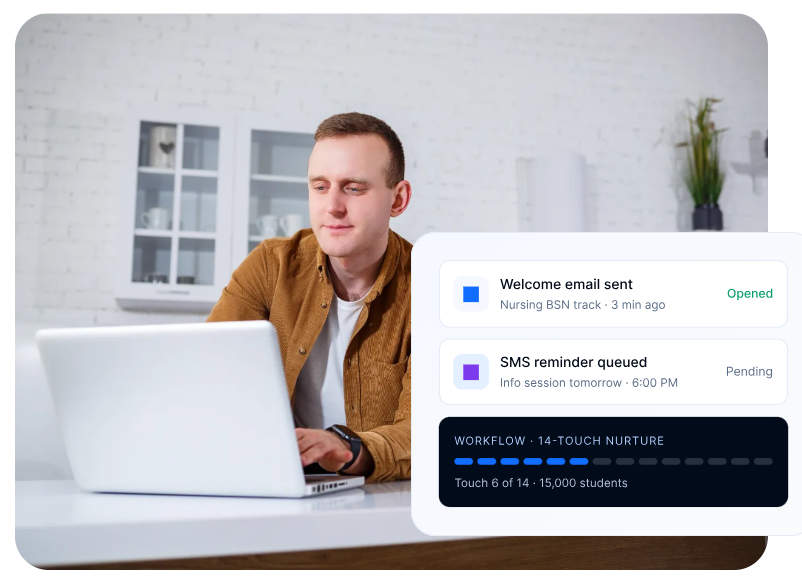
LeadEdge AI Lab’s Flash agent can respond to new inquiries instantly and rate each one’s readiness on a 0–100 scale.
LeadSquared supports TCPA compliance for SMS and calling, though your school still needs each prospect’s consent before texting.
LeadSquared’s configurable Lead Score and Engagement Score rank prospects by fit and activity. You decide what matters, such as program interest, start date, or the number of site visits, and each counselor’s day starts with the most promising names at the top.
Source, campaign, and UTM data are captured at the first touch and stay attached to the record all the way to enrollment. So instead of reporting that Google Ads produced 300 inquiries, you can see which campaigns produced applications and enrolled students, and shift spends accordingly. Offline sources count too. Open houses, high school visits, and alumni referrals can be tagged the same way, so the channels that don’t cost a click still get credit for the students they bring in.
Leads route automatically by campus, program, or counselor. Each location gets its own view of its enrollment funnel, while leadership sees one dashboard across all of them. LeadSquared’s admission software can also collect applications and documents before they move to Campus Cloud for review.
Every school grows differently, but a few milestones come up again and again. Here are three common ones, and how each raises the bar for your admissions process.
Until now, most inquiries came from referrals and walk-ins, warm people who already knew your name. Paid search brings strangers who are comparing you with four other schools, often on the same evening. Winning them takes a fast reply, ideally within minutes. Keeping the campaign running takes proof that the spend is producing applications. Without that proof, the campaign looks expensive, and leadership cuts it before it has a fair chance.
A solo counselor can keep every prospect in their head. Once a second counselor joins, that information has to move into a shared system both of them can use. Now you need clear lead ownership, a shared history of every call and message, and a fair way to split new inquiries. A small college enrollment CRM handles that split automatically, so your new hire can start working real leads from day one.
A second location doubles the moving parts: different programs, start dates, and staff, all competing for the same marketing budget. Leadership needs to compare campuses side by side, and each campus team needs to see only what’s theirs. At this stage, a CRM for Campus Cloud Services colleges becomes central to how you run enrollment.
The LeadSquared Campus Cloud integration draws a clean line between two jobs. LeadSquared runs the prospect journey, from first click to submitted application. Your team then reviews the application and makes the admit decision in Campus Cloud, which goes on to handle records, aid, billing, and more.
In practice, the flow looks like this:
The integration is scoped per school against Campus Cloud’s available interfaces, so which fields move, and in which direction, depends on your setup.
That round trip is Campus Cloud SIS enrollment automation in practice: fewer duplicate data entry issues, and a clear line from marketing reports to actual enrollments. Many schools on smaller SIS platforms split the work the same way: a CRM for recruitment, and the SIS for everything after admission. See how it works for Empower SIS colleges.
Small colleges often have the ambition to grow but not the recruitment infrastructure to match it. Campus Cloud already gives you a solid, affordable foundation for running the institution. Adding a CRM gives you the engine for filling it, with marketing you can measure from first click to enrolled student.

If you’re weighing a small college enrollment CRM, Campus Cloud schools don’t have to start over or switch systems. They just need the right partner for the recruitment side.
Book a demo and we’ll show you exactly how LeadSquared fits alongside Campus Cloud.
It shouldn’t change their day at all. Once the integration is in place, admitted students can arrive in Campus Cloud with their details already filled in. The fields that carry over depend on how the integration is scoped for your school. Registrar, financial aid, and billing staff keep working in the system they know, with less manual entry.
Look for education-specific workflows rather than a generic sales tool reworked for schools. Make sure it connects to your SIS, scales without a dedicated admin, and is simple enough for counselors to pick up quickly. Then ask how it handles student data. FERPA obligations sit with your school, so your CRM vendor should be able to show how its platform supports them. LeadSquared is designed to support institutions in meeting their FERPA obligations for applicant data, is audited to SOC Type II, and is GDPR compliant; with compliance documentation available to verified procurement contacts.
Try a quick test. Can you name, right now, the campaign that produced last term’s most enrolled students? Do you know how many inquiries waited more than a day for a first reply? If either answer is “not sure,” it’s time.
Often, yes. A solo counselor is exactly the person who can’t afford to spend hours on follow-up emails and list sorting. Automation handles the routine outreach, so that one person can focus on conversations that lead to enrollment.
Yes, and it’s often the fastest early win. Most schools sit on years of inquiries from prospects who never applied. Importing that list and running a short, segmented outreach campaign by program or course start term can surface prospects who weren’t ready before but are now. Since those leads are already in your system, the only cost is the outreach itself.
Disclosure: Campus Cloud Services is a trademark of its respective owner. This article is published by the company behind the CRM platform it describes and is not affiliated with or endorsed by Campus Cloud Services. Product details are based on publicly available information as of October 2026 and may change.
Enter your details and we'll send you a quick confirmation email to verify your address.
 11 min read 11 min read 14 min read