




EDUCATION
Ellucian Colleague CRM integration: Modern enrollment tools for community colleges
Contents

 11 min read


Ellucian Colleague runs the back office for hundreds of community colleges, technical colleges, and workforce-focused institutions across the US.
But Colleague was built to manage student records, not to recruit students. And that gap is where most community colleges run into trouble.
This article covers what a CRM for Ellucian Colleague community colleges actually needs to do, how it should divide responsibilities with Colleague, and how the two systems connect in practice.
A CRM for Ellucian Colleague community colleges connects to Colleague through Ellucian’s APIs to manage the parts of enrollment Colleague isn’t built for: inquiry nurture, multi-channel outreach, dual enrollment relationship tracking, and stop-out re-engagement.
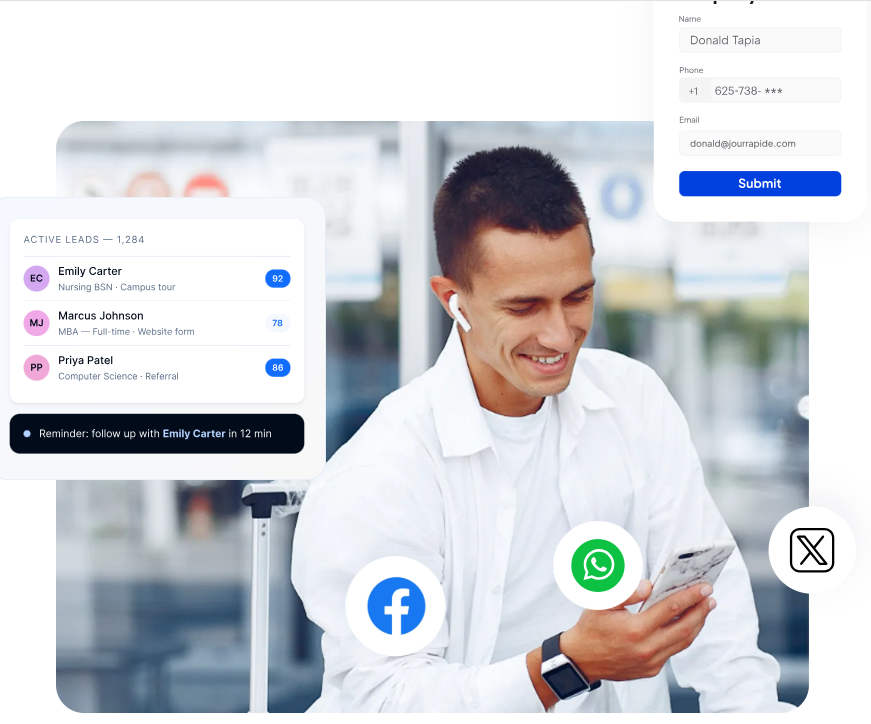
LeadSquared is one option built for exactly this — high-volume inquiry handling, automated nurture, and API-based sync with Colleague so admissions data stays connected without replacing your system of record. Colleague itself is a student information system (SIS), not a CRM, so most community colleges pair it with a dedicated recruitment and enrollment CRM to run the front end of the funnel.
If you’re evaluating a CRM alongside Ellucian Colleague, this article covers how the two systems divide responsibilities, which enrollment workflows matter most for community colleges specifically, and how the integration actually works.
Disclosure: Published by an enrollment technology provider that offers a CRM in this category. We’ve aimed to keep the guidance vendor-neutral; weigh the recommendation accordingly.
Ellucian sells two separate SIS platforms, and it’s easy to conflate them.
Banner is generally deployed at four-year universities with selective or moderately selective admissions. Colleague is more common at community colleges, technical colleges, and smaller institutions — schools with open-door admissions, part-time and returning adult learners, and a much broader mix of credential types (certificates, workforce training, transfer-track associate degrees).
That difference matters for CRM strategy. What a university needs from a Colleague SIS admissions CRM looks nothing like what a community college admissions office actually deals with day to day. A university CRM strategy built around selective-admissions funnels — application review, yield management, waitlists — doesn’t map well onto open enrollment, rolling admissions, and the sheer inquiry volume a community college handles. Nationally, community colleges number in the hundreds and enroll several million students a year, and that volume runs through admissions offices that are often a fraction of the size of a university’s.
If your institution runs Colleague, you’re almost certainly dealing with community-college-style enrollment challenges, not university-style ones, and your CRM evaluation should start there. Given the challenges you face, a good CRM for Ellucian Colleague community colleges is what you need.
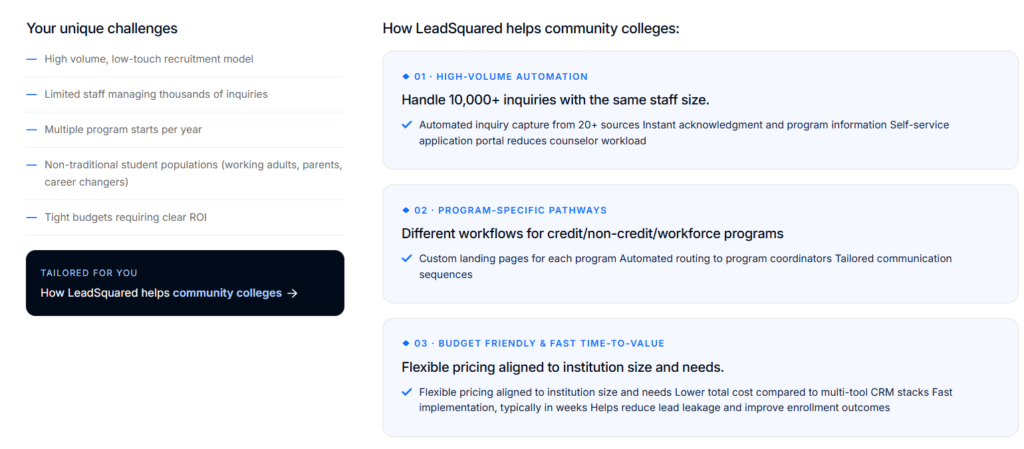
Colleague manages records once a student is admitted and enrolled. It’s not designed to run the recruitment and nurture motion that gets prospects to that point — and community colleges have a distinct set of pressures that four-year institutions generally don’t.
Layered on top of all four of these is a staffing reality specific to community colleges: admissions and enrollment teams are often smaller relative to inquiry volume than at four-year institutions, because open enrollment naturally produces more top-of-funnel activity per staff member. A university admissions office reviewing 3,000 applications a year and a community college fielding 15,000 inquiries a year may have comparably sized teams — which means the case for automation isn’t a “nice to have” efficiency play, it’s closer to a structural necessity.
Once you’ve mapped the challenges above to actual system capabilities, the workflow list is fairly specific to how community colleges operate.
Ellucian doesn’t publish a certified, native, plug-and-play connector between Colleague and most third-party recruitment CRMs. What’s realistic — and what most institutions actually run — is an Ellucian Colleague CRM integration built through Colleague’s web APIs (Colleague Web API / Ethos Integration), which allow data like applicant records, program interest, and enrollment status to sync between systems.
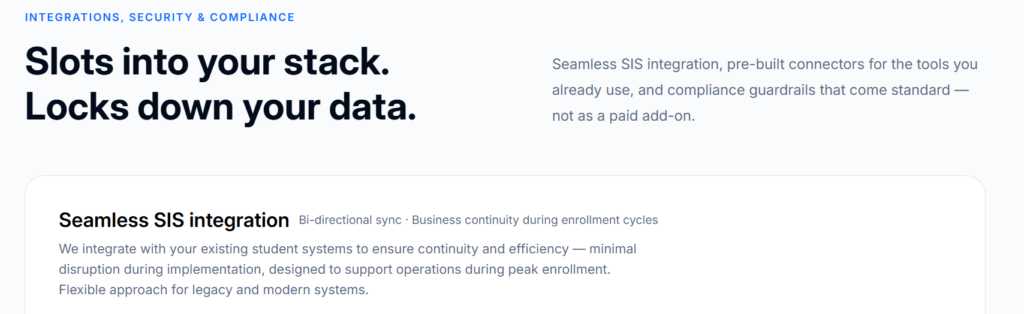
In practice, that means:
If a vendor tells you they have a native, zero-configuration Colleague connector, ask for specifics — in most cases what’s being described is a well-documented API integration pattern, not a certified plug-in. That’s not a dealbreaker; it’s simply the accurate framing, and it’s worth knowing going into a vendor conversation.
A few practical questions are worth asking any CRM vendor before you commit to a Colleague integration project:
None of these have a universally correct answer, but the answers should be concrete, not vague reassurances that “integration is included.”
Consider a mid-sized urban community college running Colleague, fielding roughly 15,000 inquiries a year across credit programs, workforce training, and dual enrollment, with an admissions staff of five. Manually sorting that volume isn’t feasible — even at a rough average, that’s dozens of new inquiries per staff member per week before any follow-up work begins.
With inquiry routing and lead scoring automated, the team can prioritize hand-offs based on program interest and likelihood to enroll rather than reviewing every inquiry in the order it arrives. Automated FAFSA and deadline reminders handle a large share of the top-of-funnel nurture without staff intervention. Dual enrollment communications with partner high schools run on a separate, counselor-facing track so they don’t compete for attention with individual student inquiries. And a standing stop-out segment gets its own recurring re-engagement campaign instead of relying on staff to remember to look at inactive records.
The net effect is the same five-person team handling the existing volume without proportional headcount growth, because routing, scoring, and nurture are no longer manual steps.
Colleague and a CRM software aren’t competing systems — they’re solving two different problems. Colleague is the system of record: it manages the student once they’re admitted, registered, and enrolled. A CRM handles everything before that point, and everything that happens when a student’s relationship with the institution pauses rather than ends — the inquiry, the nurture, the employer conversation, the counselor relationship, the win-back campaign.
For Colleague institutions specifically, that means the CRM conversation should center on the four things that actually drive enrollment at a community college: absorbing open enrollment volume without losing prospects to slow follow-up, running workforce development as its own pipeline rather than squeezing it into a student funnel, treating dual enrollment as an ongoing relationship with high schools rather than a batch of applications, and giving stop-out students a real, systematic reason to come back. None of these require replacing Colleague — they require an API-connected CRM sitting alongside it, doing the work Colleague was never designed to do.
Want to see how this looks in practice? Consider LeadSquared.
Walk through an open enrollment journey and stop-out re-engagement campaign built for a Colleague institution.
No. Colleague is a student information system (SIS) built for records management, registration, financial aid processing, and academic administration — not for recruitment, lead nurture, or multi-channel outreach. Community colleges running Colleague typically pair it with a separate CRM to manage the front end of enrollment.
There’s no single standard; it varies by the institution’s size and budget. Options range from higher-ed-specific platforms to general-purpose CRMs configured for admissions. Community colleges generally look for CRMs that can handle high inquiry volume, workforce development outreach, dual enrollment relationship management, and stop-out re-engagement — the workflows covered above.
Most rely on automated lead scoring and routing to sort high volumes of inquiries by program interest and enrollment likelihood, paired with segmented nurture campaigns so prospects aren’t left waiting for a manual follow-up during peak enrollment periods.
Effective programs start by segmenting stop-out students by how recently they left and why, since recently stopped-out students are more likely to return than those who’ve been gone for years. From there, targeted outreach — often including simplified re-enrollment steps, financial aid support, and academic advising — is run as an ongoing campaign rather than a one-time push.
Look for a CRM that can manage employer accounts and training coordinator contacts as a distinct pipeline from individual student inquiries, since workforce development sales cycles involve a B2B-style buyer rather than a prospective student applying directly.
Enter your details and we'll send you a quick confirmation email to verify your address.
 11 min read 14 min read 11 min read



 CRM for Skyward SIS schools: Automating career and CTE program enrollment
