





EDUCATION
Populi and CRM integration: Enrollment automation for small colleges and seminaries
Contents

 11 min read


Small colleges and seminaries choose Populi because it handles academics, billing, financial aid, library and donations — in one system they can afford.
What it wasn’t built to do is capture, nurture, and convert prospects into enrolled students before they ever touch the academic system.
That’s the gap a Populi CRM integration for small colleges is designed to close. For small admissions teams recruiting from church networks, Christian high schools, and faith community networks, that gap is where enrollments are won or lost.
Populi is a cloud-based student information system built specifically for small colleges, Bible colleges, and seminaries. Its appeal is straightforward: one platform that handles academics, student billing, financial aid, online learning, library management, and donations — all at a price point that works for institutions running on tight budgets.
But Populi does include admissions-side functionality — inquiry forms, lead tracking, applicant pipeline reporting, and basic automation. These tools are designed for record-keeping and basic workflow management. What they don’t provide is the kind of automated multi-channel inquiry capture, behavioral follow-up sequences, real-time visibility into the enrollment funnel that a dedicated CRM delivers.
A CRM for Populi small colleges doesn’t replace your SIS — it handles everything that happens before a prospect becomes a student, then hands off a clean record to Populi at the point of enrollment.
Populi has built a lasting niche among the smallest US higher education institutions, particularly faith-based colleges, Bible institutes, and theological seminaries. According to a January 2025 ListEdTech market analysis, Populi continues to grow its share among smaller institutions even as the overall SIS market consolidates around larger vendors.
Disclosure: This article is published by an enrollment technology provider.
At most Populi institutions, the admissions team is one to three people. The same team handles inquiry follow-up, application review, campus visit coordination, scholarship communication, financial aid questions, and enrollment paperwork: often simultaneously.
Leads may not fall through the cracks intentionally — but with manual processes, it’s almost inevitable at any meaningful inquiry volume.
A dedicated small college admissions CRM automates the repetitive parts of that workflow — initial response, follow-up cadences, event reminders — so your admissions counselors can spend their time on the high-touch conversations that actually move prospects toward enrollment.
The same affordability that makes Populi attractive to small colleges creates a problem when evaluating CRM options. Enterprise platforms built for large universities come with price tags and implementation timelines that simply don’t fit a 300-student institution with two admissions staff.
A Populi compatible CRM should be affordable, fast to implement, and usable without a dedicated IT team. This is a real constraint, not a secondary consideration.
Small-school experience is often the primary competitive differentiator for faith-based colleges and seminaries. Prospective students and their families choose these institutions precisely because they expect personal relationships. The right CRM handles the logistics — reminders, follow-up timing, document tracking — so your admissions counselors are free to focus on the conversations that actually matter.
Faith-based institutions don’t recruit from the general population the way large public universities do. Their pipelines run through specific church networks, Christian high school college fairs, denominational youth programs, pastor referrals, and mission networks. Managing those relationship-based inquiry sources — and tracking which churches and feeder schools are producing enrolled students — requires a CRM that can capture source data and segment accordingly.
Every inquiry source matters for a small college: a church youth group visit, a pastor referral, a denominational college fair, an Instagram ad targeting Christian high schoolers. Whichever channel a prospect comes through, a Populi enrollment automation setup captures that first touchpoint — and every one after it — into a single, unified lead record, tracks the source, and routes the inquiry to the right admissions counselor automatically.
For seminaries and Bible colleges, this also means tracking denomination-specific data — which church a prospective student attends, which pastor referred them, whether they’re associated with a specific ministry network — so that admissions counselors can tailor their outreach accordingly.
Campus visits are a high-converting touchpoint for small colleges, where the community atmosphere and personal relationships are the product. A CRM automates the entire visit lifecycle: invitation sequences to interested prospects, pre-visit reminders, post-visit follow-up workflows, and re-engagement sequences for no-shows. For a two-person admissions team, this automation is the difference between a systematic visit program and an ad hoc one.
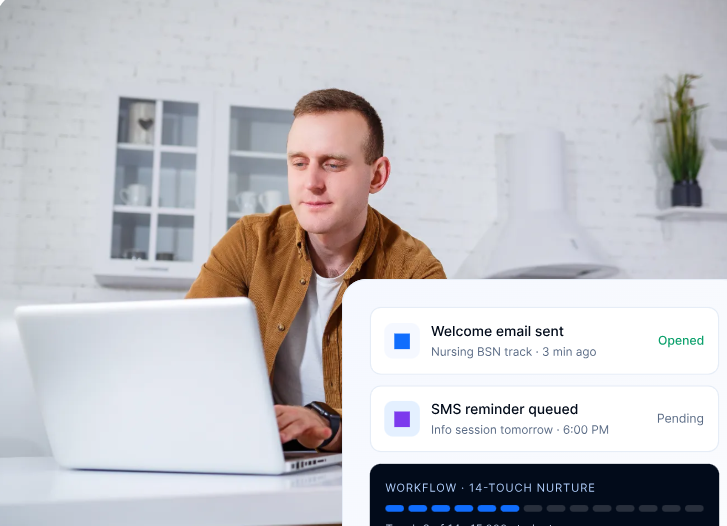
Scholarship availability is often a primary enrollment driver for small college prospects, particularly at faith-based institutions where many students are first-generation or from lower-income households. A CRM tracks which prospects have been offered scholarships, sends automated reminders for acceptance deadlines, and triggers follow-up sequences for students who haven’t responded — without requiring manual tracking in a spreadsheet.
FAFSA submission, aid verification, and award letter follow-up are consistent drop-off points in the small college enrollment funnel. A seminary CRM-Populi integration allows admissions teams to track financial aid status as a pipeline stage, trigger automated reminders for outstanding documents, and flag prospects who are stalled at the financial aid step before they disengage entirely.
Transfer students represent a growing opportunity for small colleges. Their decision timeline is often shorter than traditional freshmen, and their questions center on credit transfer and program fit. A CRM can segment transfer inquiries into a dedicated pipeline with workflows tailored to their specific questions and timeline, rather than running them through the same sequence as a 17-year-old deciding on their first college.
Using Populi’s open API and LeadSquared’s integration capabilities, institutions can automate the flow of student data between admissions and the Student Information System (SIS). LeadSquared helps admissions teams capture, engage, and convert prospective students through every stage of the enrollment journey, while Populi serves as the system of record for enrolled students. Together, they create a seamless admissions-to-enrollment workflow that reduces manual effort and improves data consistency.
A typical integration synchronizes key student information, including contact details, program of interest, application status, enrollment milestones, document completion, and other institution-specific fields configured during implementation. By eliminating duplicate data entry and ensuring information flows automatically between systems, admissions teams can spend less time on administrative tasks and more time engaging prospective students.
The Populi CRM integration can be tailored to each institution’s admissions workflow, allowing LeadSquared to manage recruitment, communications, and application progress while Populi maintains the official student record. This connected approach improves operational efficiency, supports a better student experience, and provides staff with accurate, up-to-date information across both platforms.
For more on how LeadSquared serves the broader higher education market, see its pages on higher education CRM and admission software for colleges.
Charlotte Christian College is a small faith-based institution that faced many of the same challenges described in this article: a lean admissions team, a relationship-driven recruiting model, and the need to automate enrollment without sacrificing the personalized experience prospective students expect. The institution also wanted a solution that would integrate with Populi, its Student Information System, while streamlining the admissions journey.
After implementing LeadSquared, Charlotte Christian College increased enrollments by 20% while giving its admissions team complete visibility into the enrollment funnel. The team automated follow-up across phone, email, and SMS, reduced manual administrative work, and created a smoother handoff of student information into its existing systems. The result was a more efficient admissions process that allowed counselors to spend more time building relationships with prospective students instead of managing spreadsheets and repetitive tasks.
“The best part about LeadSquared? The people. The team took the time to figure out exactly what we required, asked a lot of questions, and ensured everything was put in place. We’ve been using LeadSquared for over two years now, and we couldn’t be happier about the decision.”
– George Shears III, Director of Admissions, Charlotte Christian College.
Read the full story here.
Small colleges are operating in a genuinely difficult environment.
Undergraduate enrollment has faced sustained pressure over the last few years, with at least 16 nonprofit colleges — five of them religiously affiliated — closing in 2025 alone, and private-college tuition discount rates reaching a new record high of 57.1% for incoming students in 2025-26.
For Populi institutions, the response to that pressure has to come from the enrollment pipeline. Populi manages your enrolled students well. But converting inquiries into applicants and applicants into enrolled students — particularly from the church networks, Christian high schools, and denominational connections that faith-based colleges depend on — requires tools built for that specific job.
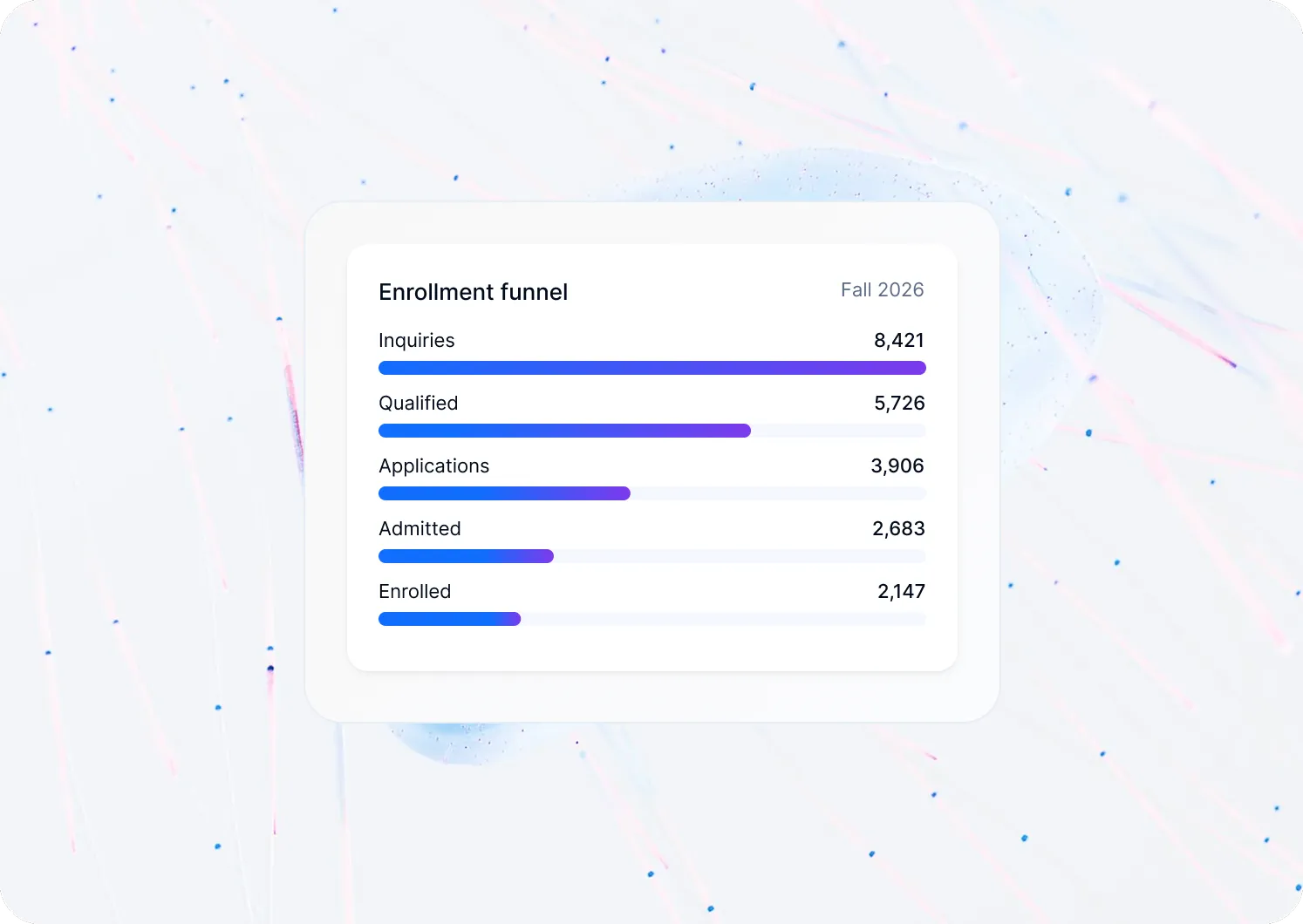
A purpose-built CRM for Populi small colleges handles multi-channel inquiry capture, automated follow-up, scholarship and financial aid tracking, visit management, and denomination-specific source tracking. Once a student enrolls, that record moves cleanly into Populi, where your academic and operational team takes over.
Book a demo with LeadSquared to see how small college enrollment automation and denomination network tracking work in practice.
Populi includes some built-in admissions CRM functionalities. However, these tools are designed around record-keeping and manual workflows rather than active pipeline acceleration. Populi does not offer the multi-channel inquiry capture, behavioral nurture sequences, automated speed-to-lead routing, or real-time enrollment funnel visibility that a dedicated CRM provides. Most small colleges using Populi pair it with a separate CRM to manage the pre-enrollment acquisition pipeline more effectively.
Small colleges typically look for CRM platforms that are affordable, quick to implement without dedicated IT support, and flexible enough to handle the relationship-based recruiting that characterizes smaller institutions. LeadSquared is purpose-built for enrollment-intensive education institutions and offers the workflow flexibility, source tracking, and financial aid pipeline management that small colleges need — at a price point that doesn’t require an enterprise budget.
Seminaries and Bible colleges typically recruit through denominational and faith community networks, church relationships, pastoral referrals, and faith-based high school pipelines rather than the broad digital channels that large universities use. Effective enrollment management for these institutions means capturing inquiry sources accurately, tracking denomination-specific data, automating follow-up from initial inquiry through financial aid, and maintaining the personal-touch communication that prospective students expect from a faith community. A CRM that integrates with Populi via API handles the automation layer while preserving the relationship-driven character of the admissions process.
For small colleges with limited budgets, the key criteria are per-student or per-user pricing that scales with enrollment, fast implementation without large IT overhead, and integration capability with existing SIS platforms like Populi. LeadSquared’s education-focused CRM is designed for enrollment-intensive institutions and offers configurable pricing for smaller schools. The most cost-effective approach is a CRM that eliminates manual processes — reducing the staff time spent on follow-up, scheduling, and data entry — so that a small admissions team can manage a larger inquiry volume without adding headcount.
LeadSquared and Populi connect via API integration. The integration can be configured to synchronize contact information, application progress, enrollment status, document completion, and other institution-specific data collected during the admissions process. This ensures admissions teams don’t have to re-enter information after a student enrolls, while maintaining a single, consistent record across both systems.
LeadSquared manages the admissions journey from inquiry capture through enrollment confirmation, while Populi serves as the Student Information System (SIS) for enrolled students. Together, they eliminate duplicate data entry and provide a seamless flow of information between admissions and student records.
LeadSquared allows admissions teams to capture and tag inquiry sources at the lead level — so every prospect is recorded against the church, ministry network, Christian high school, or referral source that generated them. Over time, this gives enrollment directors a clear picture of which feeder relationships are producing enrolled students and which aren’t, making it easier to prioritize recruiting visits, pastor outreach, and partnership development where they’ll have the most impact.
Yes — in fact, a small admissions team is often where CRM ROI is most immediate. When one or two people are managing the entire funnel, automation handles the follow-up volume that would otherwise require additional headcount. Fewer leads fall through the cracks, visit attendance improves, and financial aid drop-off decreases — all without hiring. For small colleges where each enrolled student represents meaningful tuition revenue, even a modest improvement in inquiry-to-enrollment conversion can justify the investment quickly.
Enter your details and we'll send you a quick confirmation email to verify your address.
 11 min read 14 min read 11 min read



 Ellucian Colleague CRM integration: Modern enrollment tools for community c...
