




EDUCATION
AI agents in admissions: Why chatbots are yesterday’s news (and what’s replacing them)
Contents

 16 min read


Fifty-three percent of college faculty and staff have considered quitting due to burnout, increased workload, and severe stress. These numbers are usually expected in Investment Banking or Consulting, but not in admissions.
Let that sink in. More than half of the people running your institution have thought about walking out the door.
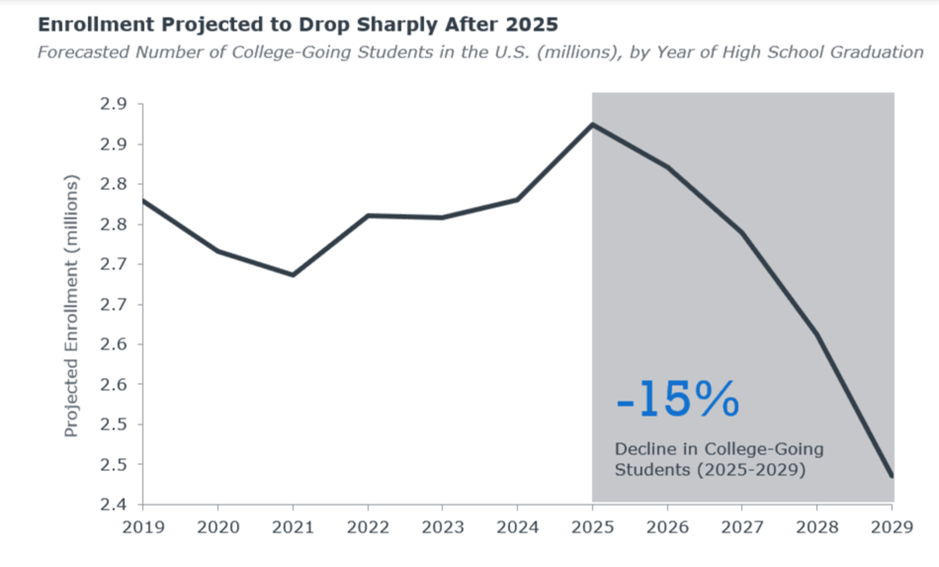
And it’s not hard to see why. The demographic cliff has officially arrived. According to the Western Interstate Commission for Higher Education (WICHE), 2025 marked the peak of high school graduates at 3.9 million, followed by 15 years of steady decline. By 2041, traditional-age incoming college students will drop by 13%, nearly half a million fewer potential enrollees.
Meanwhile, your admissions team is stretched impossibly thin. CUPA-HR data reveals that 71% of admissions coordinators and counselors have been in their jobs for just three years or less. That’s less a staffing strategy and more a revolving door.
Here’s the uncomfortable math: fewer students to recruit, fewer staff to recruit them, and higher expectations from everyone involved. Something has to give or something has to change.
Enter AI agents in admissions. Not the clunky chatbots that frustrate students with “I’m sorry, I didn’t understand that.” We’re talking autonomous digital teammates that can think, decide, and act.
This article breaks down what AI agents in admissions really are, how they differ from traditional chatbots, and why they’re quickly becoming essential infrastructure for enrollment teams that want to survive in the years ahead.
Before we talk solutions, let’s be honest about the problem. Higher ed is facing a convergence of pressures that would stress-test any industry.
The numbers are stark. WICHE’s December 2024 report projects that the number of 18-year-old high school graduates will begin a 15-year decline starting now. By 2041, that population will be down 13%, roughly 500,000 fewer traditional college-age students nationwide.
The impact is already visible. More than 120 colleges have closed or merged since 2016, with New York, California, Pennsylvania, Massachusetts, and Illinois hit especially hard. Analysts project an 8.1% increase in annual college closures as enrollment pressures intensify. Between 2025 and 2032, there will be an estimated six million fewer U.S. workers than jobs needing to be filled, partly because fewer students are completing degrees.
Even if the demographic cliff weren’t happening, higher ed would still have an admissions problem: the people doing the work keep leaving.
That 71% turnover figure for admissions coordinators and counselors isn’t a pandemic blip. CUPA-HR found similar numbers in 2017, long before COVID. This is structural.
Three in 10 higher education staff members are aged 55 and older, approaching retirement. And the pipeline to replace them? It’s not exactly overflowing. Burnout is a business risk. When experienced counselors leave, institutional knowledge walks out with them. New hires take months to get up to speed, and in admissions, timing is everything.
Also read: 7 Tips To Increase Admissions Counselor Productivity & Enrollments
Here’s the painful irony: while institutions are struggling to maintain service levels, student expectations are rising.
The gap between what students expect and what understaffed teams can provide is widening. And in a competitive market where students have more choices than ever, that gap translates directly to lost enrollments.
If you’ve implemented a chatbot in the last few years, you might be thinking: “We’ve already addressed this.” However these are fundamentally different technologies.
Most chatbots in higher education today are essentially sophisticated FAQ machines. They’re programmed with decision trees: if a student types “application deadline,” the bot returns a pre-written response about deadlines. If someone asks “how do I apply,” they get the application link.
This works fine for simple, predictable questions. But real student journeys aren’t simple or predictable.
Traditional chatbots struggle when students phrase questions unexpectedly, ask follow-up questions that require context, or need help with multi-step processes. They can’t remember previous conversations, can’t access student records to give personalized answers, and can’t actually do anything beyond providing information.
An AI agent is like giving your admissions office a tireless team member who works 24/7, never forgets a conversation, can access all your systems simultaneously, and handles routine tasks autonomously. And when they can’t they know when to get a human involved.
Here’s what that looks like in practice:
They understand intent, not just keywords. When a student asks “I submitted my stuff last week but haven’t heard anything,” an AI agent understands they’re asking about application status, even though they didn’t use those words. It can then check the student’s record and provide a specific, personalized update.
They complete multi-step tasks. Instead of just telling a student how to schedule a campus visit, an AI agent can actually schedule it. They can check availability, confirm the appointment, sending calendar invites, and follow up with directions and preparation materials.
They remember context. If a student chatted last month about financial aid and returns today asking about housing, the AI agent knows who they are, what they’ve discussed, and can connect the dots without making them start over.
They learn and improve. Every interaction makes AI agents smarter. They identify patterns in student questions, flag gaps in your knowledge base, and continuously refine their responses based on what works.
They know their limits. Good AI agents recognize when a situation requires human judgment and seamlessly hands off to the right staff member with full conversation context.
Also read:
How AI Improves Student Counselor Performance: 5 Use Cases
AI In Higher Education: Automate Student Enrollment & Engagement
Think of it this way: a chatbot is like a vending machine. You press a button, you get a predetermined item. An AI agent is like a personal assistant who knows your preferences, manages your calendar, handles your routine tasks, and only interrupts you when something genuinely needs your attention.
| Capability | Traditional Chatbot | AI Agent |
| Decision-making | Follows pre-set scripts | Autonomous reasoning |
| Learning | Static until manually updated | Continuous improvement |
| Task completion | Provides information | Executes multi-step workflows |
| Context awareness | Limited to current session | Persistent memory across interactions |
| System integration | Basic or none | Deep connectivity with CRM, SIS, etc. |
| Personalization | Generic responses | Tailored to individual student data |
That’s the difference between a digital speed bump and a digital teammate.
Theory is nice, but what does AI agent implementation actually look like across the admissions funnel? Let’s walk through the student journey.
The moment a prospective student lands on your website is the moment the clock starts ticking. Research shows that response time dramatically impacts conversion.
AI agents change that equation. They engage website visitors immediately, 24 hours a day, answering initial questions while simultaneously capturing contact information and qualifying interest levels.
But they go beyond simple lead capture. An AI agent can assess a prospect’s academic interests, geographic preferences, and timeline, then route high-intent leads to counselors for immediate follow-up while nurturing earlier-stage prospects with relevant content.
The application process is where many students fall off. It’s confusing, documentation-heavy, and fraught with anxiety. This is exactly where AI agents in admissions shine.
Real-time guidance on requirements means students don’t have to hunt through your website to figure out what they need. AI agents can walk them through checklist items, explain requirements in plain language, and answer questions like “Do I need to submit my AP scores separately?” without requiring a callback from your team.
Document collection and tracking becomes proactive rather than reactive. Instead of your staff chasing down missing transcripts, AI agents can send personalized reminders: “Hi Sarah, we’re still waiting on your official transcript from Lincoln High School. Here’s how to request it…”
Application scoring and review support represents one of the most powerful applications of AI agents in admissions. As test-optional policies make the evaluation process more qualitative, AI agents can help triage applications, flagging candidates who clearly meet criteria, identifying those who need additional review, and helping counselors prioritize their time on borderline decisions that genuinely require human judgment.
The impact on completion rates can be significant. Research from Ivy.ai found that 94% of students found chatbots helpful during enrollment. AI agents, with their greater capability, push those numbers even higher and directly combat “summer melt,” the phenomenon where accepted students fail to enroll, which affects 22.8% of high school graduates.
When it comes to financial aid, the questions are complex, the stakes are high, and every family’s situation is different.
AI agents can handle the high-volume, straightforward questions like “When is the FAFSA deadline?” “What documents do I need?” “How do I accept my award?”, freeing financial aid counselors to focus on complex cases that require professional judgment.
Every campus visit is a conversion opportunity. But scheduling, confirmations, reminders, and follow-ups consume significant staff time.
AI agents can manage the entire visit lifecycle. Scheduling happens through natural conversation rather than clunky web forms. Confirmations and reminders go out automatically. Pre-visit preparation materials are personalized based on the student’s interests. Post-visit follow-up happens promptly while the experience is fresh.
For students who can’t visit in person, AI agents can schedule virtual meetings, coordinate with student ambassadors, and ensure no interested prospect falls through the cracks.
Getting students admitted is only half the battle. Converting admits to enrollees is where many institutions struggle, especially as students apply to more schools than ever.
AI agents enable personalized yield communication at scale. Instead of generic “Congratulations!” emails, admitted students receive tailored outreach based on their interests, concerns, and engagement history. Questions about housing? The AI agent can answer them immediately. Worried about finding community? It can connect students with current students who share their interests or background.
The personalization continues through orientation and into the first year, supporting retention by ensuring students feel connected and supported from day one.
If you’re evaluating AI agents in admissions for your institution, knowing what to look for can save you from expensive mistakes.
An AI agent is only as useful as the data it can access. Surface-level integrations that pass basic information back and forth won’t deliver the personalized experience students expect.
Look for platforms that connect deeply with your student information system and CRM, enabling real-time data sync and unified student profiles. Whether you’re implementing AI agents for admissions in universities or in career colleges, deep integration ensures recommendations stay accurate by accessing current student data in real time.
Students don’t think in channels. They might start a conversation on your website, continue it via text message, and follow up through email. Forty-eight percent of graduate students and 38% of undergraduates report using website chat features, but that’s just one touchpoint.
Your AI agent should meet students wherever they are. The worst experience is having to start over because you switched devices.
Quality AI agents should handle 70-80% or more of routine inquiries without escalation, but they need sophisticated judgment about when to bring in a human. A student expressing anxiety about their chances of admission needs a counselor, not a bot. A complaint about a campus experience needs human attention.
When handoffs happen, conversation context should transfer completely. Nothing frustrates students more than explaining their situation twice.
FERPA compliance isn’t optional. Any AI agent handling student information must meet rigorous data security and privacy standards, with clear policies about data retention, access controls, and audit trails.
Students should also understand when they’re interacting with AI versus humans. Transparency builds trust.

Implementation doesn’t have to be overwhelming. The institutions seeing the best results start focused and scale based on evidence.
You don’t need to transform everything overnight. Consider starting with:
After-hours FAQ support. Let the AI agent handle common questions when staff aren’t available—application deadlines, requirements, basic financial aid info. This extends your availability immediately without changing daytime operations.
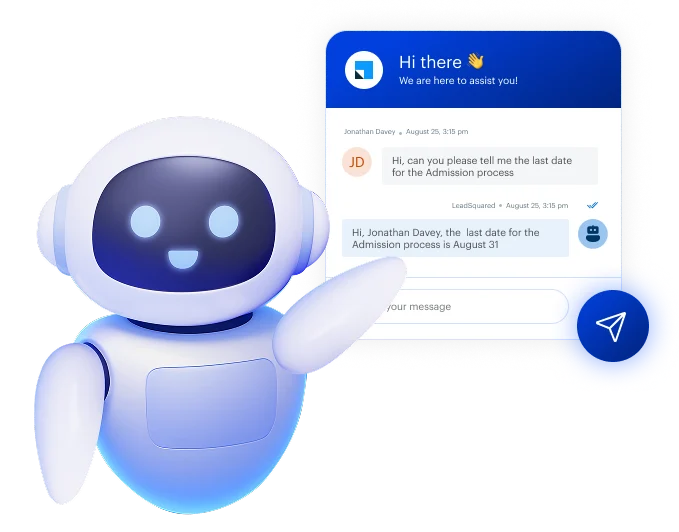
Application status updates. This high-volume inquiry type is perfectly suited for AI automation and delivers immediate relief to busy staff.
Event registration and reminders. Campus visits, information sessions, and virtual events can be scheduled and managed through AI, with automatic confirmations and follow-ups.
Document collection reminders. Proactive outreach about missing application materials improves completion rates while reducing staff workload.
AI agents are only as good as the information they can access. Before launch, audit your most common inquiries, document institutional policies clearly, and create decision trees for when and how to escalate to human staff.
This foundation work also benefits your human team. Clearer documentation helps everyone.
Positioning matters. AI agents are teammates, not replacements. Your staff should understand how the technology works, when to take over conversations, and how their feedback improves AI performance over time.
The goal is augmentation: counselors doing more meaningful work, not more work total.
Establish baselines before launch, then track the metrics that matter to your institution:
Data-driven iteration beats gut-feel optimization every time.
AI agents in higher education admissions are evolving rapidly. Gartner predicts they’ll progress from basic assistants embedded in business applications to task-specific agents capable of sophisticated autonomous action by 2026.
Eighty-five percent of enterprises are expected to be using AI agents in some capacity by the end of 2025. Higher education is catching up fast.
The trajectory points toward deeper personalization through predictive analytics, integration with voice assistants and emerging channels, proactive outreach based on behavioral patterns, and increasingly sophisticated reasoning about when and how to engage each student.
Let’s bring this back to where we started.
The demographic cliff is here. 2026 marks the beginning of 15 years of decline in traditional college-age students. Admissions teams are stretched to breaking point, with 71% turnover in entry-level positions and more than half of staff considering quitting. Students expect 24/7, personalized support that overwhelmed teams simply cannot provide.
AI agents in admissions aren’t a nice-to-have innovation. They’re becoming essential infrastructure for institutions that want to compete effectively for a shrinking student pool while preserving staff wellbeing and institutional knowledge.
The ROI case is compelling. The competitive pressure is real. The student expectation gap is widening.
The question isn’t whether AI agents will become standard in higher education admissions. It’s whether your institution will be a leader or a laggard.
Ready to see how AI agents can transform your admissions operations?
Book a demo with LeadSquared and discover what’s possible.
Chatbots follow pre-programmed scripts and provide information in response to specific keywords or questions. AI agents go much further—they can understand context, reason through problems, access multiple systems simultaneously, complete multi-step tasks autonomously, and make intelligent decisions about when to involve human staff. Think of a chatbot as a digital FAQ page and an AI agent as a digital team member.
No—and that’s not the goal. AI agents handle routine tasks and high-volume inquiries so counselors can focus on what humans do best: building relationships, exercising judgment on complex cases, representing the institution at events, and providing the empathetic support that anxious students and families need. The best implementations augment human capabilities rather than attempting to replace them.
Quality AI agent platforms are designed with FERPA compliance as a foundational requirement. This includes data encryption in transit and at rest, role-based access controls, comprehensive audit trails, and clear data retention policies. Before implementing any AI solution, institutions should verify compliance certifications and conduct thorough security reviews.
Results vary by institution, but documented benefits include significant reductions in staff time spent on routine inquiries, improved response times (from hours or days to seconds), higher application completion rates, and potential enrollment increases from better digital experience. Some analyses suggest ROI potential of 40:1 or higher, though realistic expectations should be based on your specific starting point and goals.
Basic implementations focused on FAQ support and status updates can go live in a few weeks. More sophisticated deployments with deep CRM integration, multi-channel presence, and complex workflow automation typically take two to four months. The most successful institutions start with focused use cases, prove value quickly, and scale based on results—rather than attempting comprehensive transformation on day one.
AI agents streamline admissions workflows by automating routine tasks like answering FAQs, collecting documents, scheduling visits, and sending reminders. They work 24/7, handle multiple inquiries simultaneously, and free counselors to focus on relationship-building and complex decisions that require human judgment.
Accuracy depends on deep system integration and continuous learning. Choose AI agents that sync in real-time with your CRM and SIS, regularly audit their responses against actual outcomes, incorporate staff feedback loops, and update your knowledge base as policies change. Quality platforms improve with every interaction.
Start with high-volume, rule-based tasks that consume staff time but don’t require human judgment. After-hours FAQ responses, application status updates, document collection reminders, and event registration are ideal first candidates. These deliver immediate relief to your team, go live quickly, and carry low risk. Once those are running smoothly, expand to more complex workflows like lead qualification, financial aid guidance, and yield communication.
Verify that your AI platform is designed with FERPA compliance as foundational, including data encryption, role-based access controls, comprehensive audit trails, and clear retention policies. Conduct thorough security reviews before implementation and ensure students know when they’re interacting with AI versus humans.

 15 min read 29 min read 19 min read


 How to scale AI use in higher education: A solid guide for admissions, academics...