





EDUCATION
CRM for FACTS SIS schools: Automate admissions before families even apply
Contents

 12 min read



Picture the family that visits your open house in October, picks up a brochure, chats with a teacher, and leaves without applying. Six months later, they enrolled somewhere else.
Nothing went wrong at your open house. What went wrong is that no one followed up, because there was no system tracking that family in the first place.
FACTS SIS wouldn’t have caught them either. FACTS Admissions Intelligence begins at the point a family submits an inquiry or starts an application. Until that happens, there’s no record for it to act on.
That’s the blind spot a CRM for FACTS SIS private schools is built to close. Online applications, enrollment contracts, tuition billing, re-enrollment campaigns: FACTS has that ground covered once a family formally engages. But the stretch before that: the open house follow-up, the “we’re just looking” tour request, the parent who downloaded your viewbook in February and hasn’t been heard from since? That earlier window is where most schools quietly lose families they never even knew they had.
None of this is a criticism of FACTS. It falls outside the job FACTS SIS was designed to do. Understanding where FACTS stops, and what a purpose-built CRM adds on top of it, is the difference between an admissions funnel that starts at “application submitted” and one that starts the moment a family first hears your school’s name.
Not exactly. FACTS Intelligence, the current FACTS platform, is organized into four hubs: Admissions Intelligence, Engagement Intelligence, Financial Intelligence, and Success Intelligence. All four run on FACTS IQ, which FACTS describes as its core intelligence layer and the system of record for student data. Between them, these hubs capture inquiries, build applications, issue enrollment contracts, and run re-enrollment campaigns.
FACTS does include email automation and school website tools in Admissions Intelligence. Both are built around families who have already submitted an inquiry. What the framework doesn’t cover is the stage before that: capturing a family the moment they show interest and staying in front of them over weeks or months, across email, SMS, and web behavior, before they’re ready to fill out an inquiry form at all. That earlier stage is where a dedicated FACTS SIS admissions CRM like LeadSquared comes in, sitting upstream of FACTS and handing over families who already know your school, rather than ones who don’t.
FACTS has been the backbone for tuition payments and school operations in the private and faith-based K-12 world for decades, and its footprint reflects that. FACTS is a Nelnet company (NYSE: NNI), and according to ListEdTech’s 2025 K-12 SIS market analysis, FACTS SIS holds roughly 15% of identified K-12 SIS implementations.
One naming note before we go further: What schools have long called FACTS SIS now sits inside the FACTS Intelligence framework as FACTS IQ. Market data still tracks it as FACTS SIS, and that’s the name most admissions teams still use, so this page uses both.
Under its current FACTS Intelligence framework, the platform is organized into four connected hubs, all running on a shared data layer:
Underneath all four sits FACTS IQ, which FACTS positions as its core intelligence layer and the system of record, connecting student data, academics, analytics, and integrations across every hub.
Notice where all of this begins: with an inquiry. A family fills out a form, requests a tour, or starts an application, and FACTS takes over from there: building the application, routing documents, collecting the enrollment fee, and eventually managing tuition. That’s a strong system for managing the admissions funnel once a family has made contact.
But “after a family raises their hand” is the operative phrase. Everything that happens before that moment — and a lot happens before that moment — sits outside FACTS entirely.
That’s a design decision. By FACTS’ own account, Admissions Intelligence brings inquiry, application, and workflow automation together in one place once a family enters the funnel, and gives school leaders reports on yield and enrollment revenue from that point on. It does that job well. The problem for admissions teams is that much of the enrollment journey happens before a family ever reaches FACTS, and that stretch needs a system of its own.
Think about how a family actually finds and evaluates a private or faith-based school. It rarely starts with an application. It starts with:
None of those activities touches FACTS. If a family attends your open house in October and doesn’t apply until March, FACTS has no idea they exist for those five months. If your team doesn’t have a system to capture that interest and stay in front of the family — with the right message at the right time — you’re relying on the family to remember your school on their own and come back. Some do. Many don’t.
This is the pre-application gap. Closing it is the whole point of a FACTS enrollment CRM private school admissions teams can build their outreach around — the layer that captures and scores families long before they’re ready to become a FACTS record. FACTS takes over once they are.
The cost of leaving this gap open isn’t always visible, because it doesn’t show up as a rejected application — it shows up as a family who simply never applied at all.
An admissions director looking only at FACTS reporting sees application volume, conversion rate, and yield, all of which look reasonable on their own. What that view can’t show is the open house attendee who never got a second touchpoint, the parent who bookmarked your tuition page and never came back, or the referral that went cold because no one followed up within the first week. Speed and consistency matter here, and both are hard to sustain by hand across a full inquiry season. Without a system built to catch and act on interest when it happens, that early advantage disappears quietly.
A note on how to read this page: It’s published by an enrollment technology provider that sells the CRM layer described below. FACTS’ capabilities are summarized from FACTS’ own published product documentation, current as of August 2026.
LeadSquared sits upstream of FACTS SIS, handling the part of the funnel FACTS was never built for, then handing off a warmer, better-qualified family once they’re ready to apply.
In practice, that looks like:

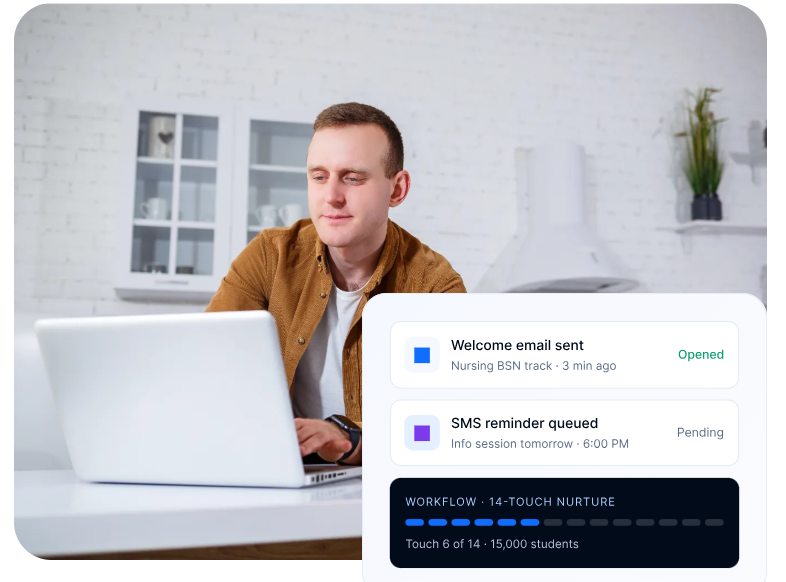
LeadSquared owns the “should we send our child here?” phase and FACTS owns the “we’re applying” phase. Family records move between the two through LeadSquared’s API, configured during implementation, so nobody falls through the cracks.
In practice, setting this up for a single-campus school means connecting your existing web forms and event sign-up sheets, then importing the inquiry data you already have.
FACTS has deep roots in Catholic, parochial, and other faith-based K-12 education, and that context shapes how admissions actually works at these schools. Enrollment runs less on paid marketing than on parish relationships and word of mouth, both of which are harder to track than a form fill.
A faith-based school admissions CRM FACTS schools can rely on needs to account for that reality:
For FACTS users, Catholic school enrollment software has to do more than automate emails. It gives admissions directors visibility into every touchpoint a family has with the school community, long before that family ever opens a FACTS application.
FACTS’ scale is part of why this gap matters. With roughly 15% of the K-12 SIS market and a strong concentration among Catholic and faith-based schools, FACTS is the operational backbone for a huge share of private schools. Yet in Niche’s private school admissions and marketing technology survey, fielded in 2022 and still the most recent public breakdown of CRM usage by vendor in this space, 18% of private and independent schools reported using FACTS as their CRM, second to SchoolAdmin at 20%. In other words, even among FACTS SIS schools, CRM coverage for the pre-application funnel has historically been far from universal.
Schools running FACTS SIS and looking for a CRM that speaks directly to their platform find surprisingly little guidance built specifically for them. LeadSquared is built to close that gap.
If your school already runs on other systems alongside or instead of FACTS, the same pre-application gap applies. See how LeadSquared works for schools on PowerSchool, and Veracross, or get the broader picture on our admission software page.
FACTS SIS gives your school a strong foundation for managing applications, enrollment contracts, and tuition once a family decides to apply. But decisions about private and faith-based education are rarely made in a single moment — they’re made over months of quiet research, open house visits, and conversations within a school community, all happening before a single FACTS record exists.
A CRM built to capture and nurture that earlier stage feeds FACTS. It turns cold inquiries into warm applicants and gives your admissions team visibility into the part of the funnel that currently runs on guesswork.
If your school is trying to close that gap, see how LeadSquared works alongside FACTS SIS to capture families from their very first touchpoint through to enrollment.
FACTS Intelligence includes admissions and enrollment tools through its Admissions Intelligence hub: inquiry forms, application building, and re-enrollment campaigns. It manages families once they’ve started engaging with your admissions process. It isn’t built for capturing and nurturing families who haven’t applied yet.
The best fit is a CRM that sits upstream of FACTS and specializes in K-12 private and faith-based admissions: capturing inquiries from every source, automating nurture sequences, and scoring engagement. LeadSquared is built for this role, handing families to your existing FACTS Admissions Intelligence workflow once they’re engaged and ready to apply.
Yes. While FACTS handles the mechanics of re-enrollment contracts and payments, LeadSquared can run structured, automated re-enrollment campaigns and track family engagement and response over time, complementing FACTS’ re-enrollment tools rather than replacing them.
Yes. LeadSquared is built to scale to a school’s size and admissions volume, and its ability to track parish outreach, community events, and referral-driven leads makes it particularly well suited to smaller faith-based and parochial schools where enrollment relies heavily on community relationships.
In practice, every inquiry, whether it comes from a website form, an open house, a parish event, or a referral, lands in one CRM. It moves through an automated nurture sequence based on engagement, then hands off to FACTS as a warm, informed application instead of a cold lead FACTS has to convert from scratch.
Enter your details and we'll send you a quick confirmation email to verify your address.
 10 min read
11 min read
10 min read
10 min read
11 min read