




EDUCATION
Student engagement strategies for higher education: A complete guide
Contents

 20 min read


Editorial note: This article is produced by a provider of enrollment management software. While we aim to offer objective guidance on enrollment strategy, readers should read this with that context in mind.
Nearly 90% of first college contact now happens digitally — according to RNL’s 2025 E-Expectations Report, and nearly half of prospective students expect a reply within 24 hours; Interest drops sharply if institutions take longer to respond.
For enrollment teams, speed-to-lead remains a defining competitive differentiator.
Increasing student engagement in higher education — from the first digital touchpoint through enrollment — is now as much an operational challenge as an academic one.
In conversations with LeadSquared customers across US colleges and career schools, several consistent operational challenges emerged. While these represent the experiences of institutions using our platform, they reflect themes widely documented in enrollment management research.


In this guide, let’s look at the proven student engagement strategies before and after enrollment.
But first, let’s have a glance at the current state of education in the US.
For most students, choosing a college is one of the most consequential decisions they’ll make. For institutions, attracting the right students — and converting interest into enrollment — is equally high stakes.
Current scenario: According to NCES IPEDS data released in January 2025, fall 2023 saw a 2.5% overall increase in postsecondary enrollment — the first broad uptick in over a decade. That recovery has continued: the National Student Clearinghouse Research Center reported that undergraduate enrollment reached 15.3 million in spring 2025, up 3.5% year-over-year, though still below pre-pandemic levels.
Students pursue colleges to build their careers, while colleges look to admit applicants who are the best fit for their programs.
To make this match possible, institutions work strategically to attract the right talent. While public colleges often have no shortage of applicants, private colleges must invest more effort in attracting prospective students. As a result, increasing enrollments has long been a pressing concern for private institutions.
Many universities focus on handling student inquiries mainly during the admissions season, often relying on call centers to manage incoming leads. While institutions invest in both offline and digital campaigns, these channels frequently operate in silos, making it difficult for admissions teams to track and organize leads effectively. At the same time, student engagement has shifted significantly: today’s digital-native students research colleges through websites and social media and reach out online for guidance, often with questions about financial aid, application processes, and institutional policies. As a result, colleges must be prepared to respond quickly and manage student interactions efficiently across multiple channels.
Also read:
10 Student Engagement Strategies For Higher Education
A Detailed Guide On Student Recruitment Strategies For Colleges In 2026
To address these challenges, we analyzed common admission bottlenecks and studied strategies to increase student engagement used by leading colleges. Based on these insights, we developed a five-step plan that can help accelerate enrollments at your institution.
The best part? You can implement this plan within your existing admissions process using a Higher Education CRM, with minimal effort.
Omnichannel refers to a cross-channel strategy that connects every touchpoint a prospective student uses — from Instagram ads and website forms to campus walk-ins and phone inquiries — into a single, coherent engagement experience. A mobile-first approach means designing those touchpoints primarily for the device students actually use.
Today’s students are digitally native and strategic about engagement — 59% will share their email address with a college, but only 32% will provide their home address. (Source). Meanwhile, the same research highlights a critical disconnect: high schoolers are active and responsive across digital channels, but colleges are frequently missing the opportunity to connect with them on the right ones, in ways that feel personalized and relevant. The cost of that misalignment is measurable enrollment and revenue loss.
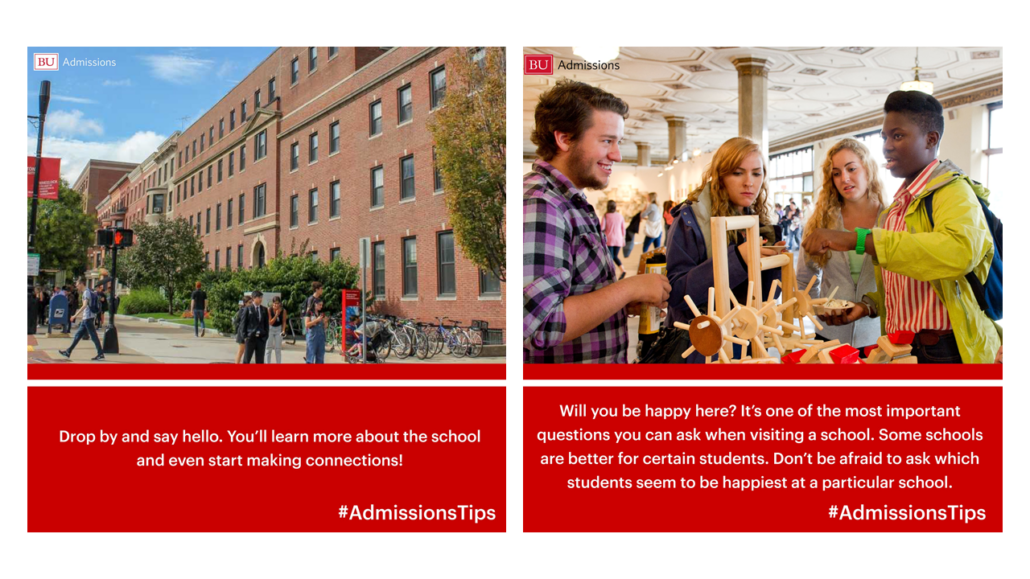
Boston University’s #AdmissionTips campaign on Instagram is a frequently cited example of an institution meeting students where they are — using narrative-driven social content to engage prospective students on a platform they already use daily, then converting that attention into direct inquiry, through consistent call-to-action messaging.
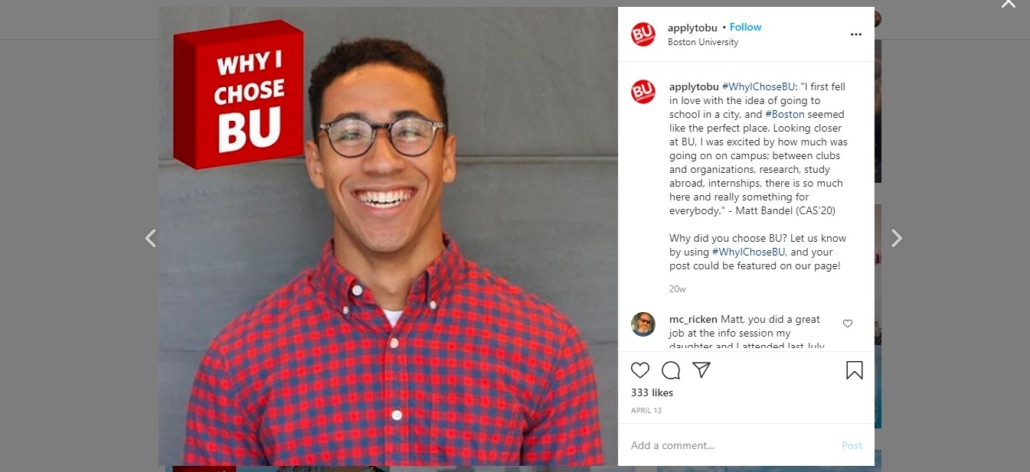
Their follow-up campaign narrates the stories of candidates who have enrolled and why other students should also consider the same.
How technology enables it
Enrollment management CRMs unify leads from every channel into a single database, giving admissions teams a complete picture of a student’s engagement history regardless of how they first made contact. This makes personalized, timely follow-up possible at scale — which is the core promise of omnichannel done well.
Inquiry segmentation is the practice of categorizing incoming student inquiries by profile, behavior, and enrollment likelihood — then routing and responding to them in priority order rather than on a first-come, first-served basis. It replaces a reactive queue with a proactive, data-driven workflow.
Nearly half of prospective students expect a reply within 24 hours, and interest drops sharply if institutions take longer to respond. (Source). But speed alone is not enough — research from Aslanian Market Research found that almost 80% of graduate students enroll at the institution that responds to them first, which means the institutions winning on response time are also winning on enrollment. The challenge is that not every inquiry carries the same urgency or likelihood of conversion. Treating all inquiries identically spreads admissions capacity too thin and risks slow responses to the students most likely to enroll.
Asher College implemented inquiry segmentation and prioritization through an enrollment CRM, resulting in a 13% increase in contact rate and a 5% improvement in scheduled campus appointments — with admissions staff reporting they could identify student interests and engage more meaningfully after having organized, and prioritized nquiry data.
Read more here: Asher College Boosts Student Engagement By 13% With LeadSquared
Enrollment management platforms automate the segmentation process by scoring and routing inquiries based on pre-set criteria as they arrive — removing the manual triage burden from admissions staff. Automated follow-up triggers ensure no inquiry goes cold while counselors focus their personal attention where conversion likelihood is highest.
Also read:
Personalizing Higher Education Marketing Campaigns At Scale 17 Education Workflow Automation Examples
Once a prospective student has been identified as a strong candidate, the relationship needs to move beyond automated communications into genuine one-to-one engagement — whether through virtual counseling sessions, virtual campus tours, live chat, personalized video, or campus visits. This is the stage where institutional fit is established, and objections are addressed.
According to RNL’s 2025 Marketing and Recruitment Practices report, face-to-face interaction continues to be the most effective recruitment tool for both four-year private and public institutions — a finding that reinforces what enrollment professionals have long observed: despite technological advances, students crave authentic personal connections when making significant life decisions.
However, the format of those interactions has evolved significantly. EAB’s 2024 First-Year Experience Survey found that 35% of students took their first virtual tour right before or during the application process — meaning virtual engagement is no longer a fallback option but a primary decision-making touchpoint, particularly for first-generation students.
Also read: How AI Improves Student Counselor Performance: 5 Use Cases
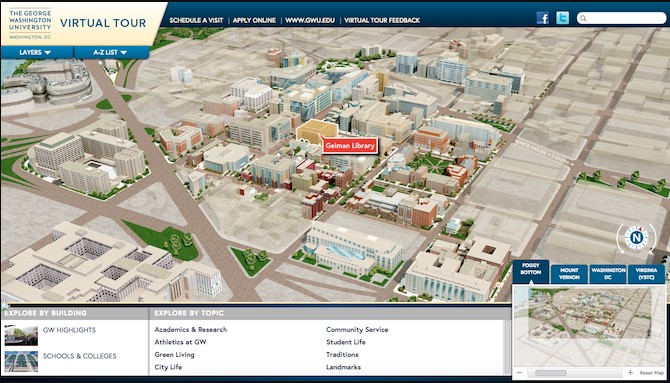
George Washington University’s introduction of virtual campus tours is a well-documented example of extending geographic reach without sacrificing engagement quality — allowing prospective students from outside the DC area to experience the campus meaningfully before committing to a visit or application. EAB has also noted early successes in 2024 with AI-powered admissions chatbots handling initial student questions, freeing counselor time for higher-value personal interactions.
Enrollment CRMs log every prior interaction a student has had — pages visited, emails opened, forms submitted — giving counselors a complete context brief before any personal conversation begins. Combined with personalized video tools, institutions can send individual video messages at scale, creating the warmth of personal outreach without the time cost of fully manual communication.
A self-serve application portal is a digital platform that allows prospective students to submit their application, upload documents, track their application status, and communicate with admissions staff — entirely online, without needing to visit campus or interact with staff for routine administrative steps.
The 2024–2025 Common Application cycle saw a 4% increase in applicants and a 6% rise in total applications submitted year-over-year, with students applying to an average of 6 institutions each. For admissions teams, that volume makes manual processing unsustainable. Today’s prospective students expect a seamless, personalized digital experience throughout their college search and application process — and a superior application experience can be a significant differentiator when students are choosing between multiple offers. Friction in the process — forms that don’t save progress, documents that must be physically submitted, status updates that require a phone call — directly increases application abandonment.
Institutions using integrated self-serve portals consistently report two compounding benefits: students complete applications faster because the process is on their schedule rather than office hours, and admissions staff redirect time previously spent on data entry toward higher-value activities like counseling conversations and yield outreach. AI-powered systems can now process transcripts with 99.3% accuracy and automate transfer credit evaluations, transforming traditionally manual workflows into efficient, paperless operations.
Self-serve portals are most effective when integrated directly with an enrollment management CRM — so that every document uploaded, every status change, and every student interaction in the portal is automatically logged in a single system. This eliminates the data silos that form when portals and CRMs operate independently, and gives counselors a complete, real-time view of each applicant’s progress without manual data transfer.
Financial aid discussion is the stage where enrollment decisions are won or lost. It covers guiding prospective students through available funding options — federal grants, institutional scholarships, and loans — scheduling meetings between students, families, and financial aid staff, and ensuring the process moves quickly enough to prevent drop-off before a deposit is made.
The data makes the stakes clear. According to the Lumina Foundation–Gallup 2025 State of Higher Education Study, 59% of FAFSA applicants said the amount of financial aid they received impacted whether they went to college at all — and 51% said the timing of when they received their financial aid offer affected where they enrolled.
Financial aid is not a secondary consideration for most students — it is the primary decision variable. FAFSA completion is one of the strongest predictors of college enrollment: seniors who complete the FAFSA are 84% more likely to immediately enroll in postsecondary education.
The 2024–25 FAFSA cycle illustrated this acutely — a delayed and troubled rollout drove completion rates down by more than 20%, with direct downstream effects on enrollment numbers across institutions nationwide. FAFSA completions have since rebounded strongly for 2025–26, up 15.7% year-over-year with gains across all 50 states, but the episode highlighted how dependent enrollment outcomes are on the financial aid timeline. (Source).
Institutions that treat financial aid outreach as part of the enrollment workflow — rather than a separate administrative process — consistently see stronger yield rates. Proactively contacting admitted students whose FAFSA shows unmet need, offering to schedule a one-on-one financial planning call, and providing clear next-step instructions have all been shown to reduce the gap between acceptance and deposit. Undergraduate students received an average of $16,360 in financial aid in 2023–24 — a figure worth communicating clearly and early, since many students underestimate available support and opt out before ever asking.
Enrollment management platforms can automate FAFSA completion reminders, flag students with incomplete financial aid files, and trigger counselor follow-up tasks at each stage of the aid process — turning what is often a reactive, manual workflow into a structured, proactive one. When financial aid data is integrated with admissions data in a single system, counselors and financial aid staff can coordinate outreach without relying on inter-departmental communication that slows response times.
Financial aid eligibility and availability vary by institution, student circumstances, and federal program guidelines. Students and families should consult their institution’s certified financial aid office or an independent financial aid advisor for guidance specific to their situation. Federal student aid information is available at studentaid.gov
Active learning methods can significantly improve student engagement while helping institutions achieve desired learning outcomes. However, students have diverse learning styles, interests, and levels of understanding—some are academically focused and actively participate in discussions and assignments, while others engage more through cultural or extracurricular activities. To address this diversity, educators should adopt practical, real-world teaching approaches that engage the entire class. Colleges can support engagement through both online and offline activities, though technology-enabled strategies are often more effective and scalable today.
Institutional leaders cannot ignore the importance of student engagement in the learning experience. A student-centered approach is essential because when students feel disconnected from the curriculum or campus culture, the risk of dropout increases. Following best practices for student engagement means investing in the right mix of technology, personal outreach, and academic support across the entire student lifecycle. Investing in the right technology can help institutions address this challenge by streamlining both pre- and post-admission workflows.
Enrollment management platforms bring lead generation, student engagement, and applicant management into a single system, helping colleges manage prospects more efficiently and accelerate the lead-to-enrollment process.

Similarly, Student Information Systems (SIS) support post-admission processes by managing student records and ongoing interactions throughout the academic journey.
By automating admissions with tools such as self-service and paperless application portals, institutions can reduce the administrative workload on admissions teams while creating a smoother, more responsive experience for prospective students.
Consider using a higher education admissions CRM, such as LeadSquared.
These resources provide independent research and guidance on enrollment management strategy, student expectations, and higher education financial data.
The most important consideration is whether the CRM can integrate cleanly with your Student Information System (SIS) — platforms like LeadSquared are common in US higher education. A CRM that operates as a standalone tool may create data silos: admissions activity lives in one system, academic records in another, and financial aid in a third, with no unified student view. At minimum, the integration should support real-time sync of inquiry and application data, automatic student record creation upon enrollment, and shared communication history across teams. Before choosing a platform, request a detailed integration specification and involve your IT department in the vendor evaluation process.
Students typically expect a response within 24 hours of submitting an inquiry, and interest drops quickly beyond that window. For graduate and career programs, expectations are even higher—many prospective students expect a response within minutes or at least within the hour. A practical benchmark is automated acknowledgment within minutes, followed by personal outreach the same day or within 24 hours. Institutions that respond first consistently outperform competitors in enrollment conversion, making speed-to-lead a key driver of enrollment outcomes
FERPA governs how institutions handle student education records and applies to any third-party vendor that processes student data, including CRM platforms and recruitment partners. Under the “School Official” exception, institutions may share data with vendors without individual consent if a formal agreement restricts data use, requires security safeguards, and prevents further disclosure. In practice, CRM contracts should include FERPA compliance clauses, role-based access controls, and preferably SOC 2 Type II certification. Institutions should also periodically review who has access to student data within the CRM and update permissions as roles change.
Technology adoption often fails due to weak change management rather than the platform itself. Admissions teams need training in three areas: how to use the system, how workflows and daily processes change, and how to maintain consistent data hygiene. The last is often overlooked but critical, since CRM insights depend on reliable data. Training should be staged—an initial session before launch, a follow-up after several weeks of use, and periodic refreshers when new features are introduced. Designating internal CRM champions within each department can further improve adoption and reduce IT support demands.
 29 min read 19 min read 16 min read


 CRM for Higher Education: 12 Best Options to Consider + Buying Guide