





EDUCATION
Veracross CRM integration: Admissions pipeline automation for K-12 private schools
Contents

 11 min read


Ask admissions directors at high-tuition private schools what’s not working, and you’ll hear the same complaint in different forms: the software runs the school well but doesn’t help recruit for it, the SIS is excellent but admissions still lives in spreadsheets, the systems don’t talk to each other.
Underneath all of it is the same gap: the system that runs their school beautifully isn’t the system that’s filling their seats.
Veracross keeps student records, billing, and academics in one clean database. But the actual work of admissions, the hundreds of small touches between a first inquiry and a signed enrollment contract, often happens in someone’s inbox, a shared spreadsheet, or sticky notes on a monitor.
That gap is exactly why Veracross CRM integration for private schools has become such a common search among admissions offices this year. Veracross is an SIS. It was never designed to be a full CRM for Veracross private schools running multi-touch, family-centered recruitment campaigns — and for schools managing a competitive applicant pool; that distinction matters more than it might seem.
Veracross is a single-record SIS built for private and independent K-12 schools. Its strength is that every constituent — applicant, student, parent, alum, donor — has one record shared across departments. That single-database model covers:
This is genuinely useful. Schools don’t have to reconcile five different systems to see a full picture of a student and their family. A registrar can pull a transcript, a business office can check tuition balance, and a development officer can see the family’s full giving history — all from the same underlying record, without re-entering data or chasing down another department.
But “admissions module” inside an SIS and a dedicated admissions CRM are two different jobs, and that’s where friction starts to show up.
An SIS is built around the assumption that a student is already part of the school community — enrolled, attending classes, receiving a bill. Admissions, by contrast, is the work of turning strangers into that community in the first place, often over a year or more of relationship-building before a single form gets submitted. Those are fundamentally different design problems, and it shows in how each system is built.
Veracross’s admissions functionality is built to manage applications once a family is already engaged — not to nurture the hundreds of loosely-interested families who show up earlier in the funnel. For a school running a large, competitive applicant pool, three gaps tend to surface quickly:
None of this makes Veracross a weak SIS. It just means the admissions office typically needs a connected layer built specifically for private school admissions automation on top of it. The teams that feel this most acutely are usually the ones managing the widest top of funnel — schools where hundreds of families make first contact through open houses, school fairs, referrals, and organic web traffic long before anyone fills out a formal application. Without a system built to keep every one of those early relationships warm, the admissions office ends up chasing the loudest signal: focusing energy on whoever reached out most recently, while quieter but genuinely interested families go cold.
Disclosure: This article is published by an enrollment technology provider.
High-tuition private and independent schools manage a longer, more relationship-driven journey than most public enrollment processes:
Inquiry → Campus tour → Shadow day → Application → Financial aid → Decision → Enrollment → Re-enrollment
Each stage involves a different set of people — admissions counselors, faculty hosting shadow days, financial aid officers, and eventually the family itself making a five- or six-figure annual decision. Multiply that by a few hundred families a year, and manual tracking in spreadsheets or SIS notes fields stops scaling. This is where a proper admission software layer earns its place.
This is where a connected Veracross admissions pipeline CRM takes over the heavy lifting:

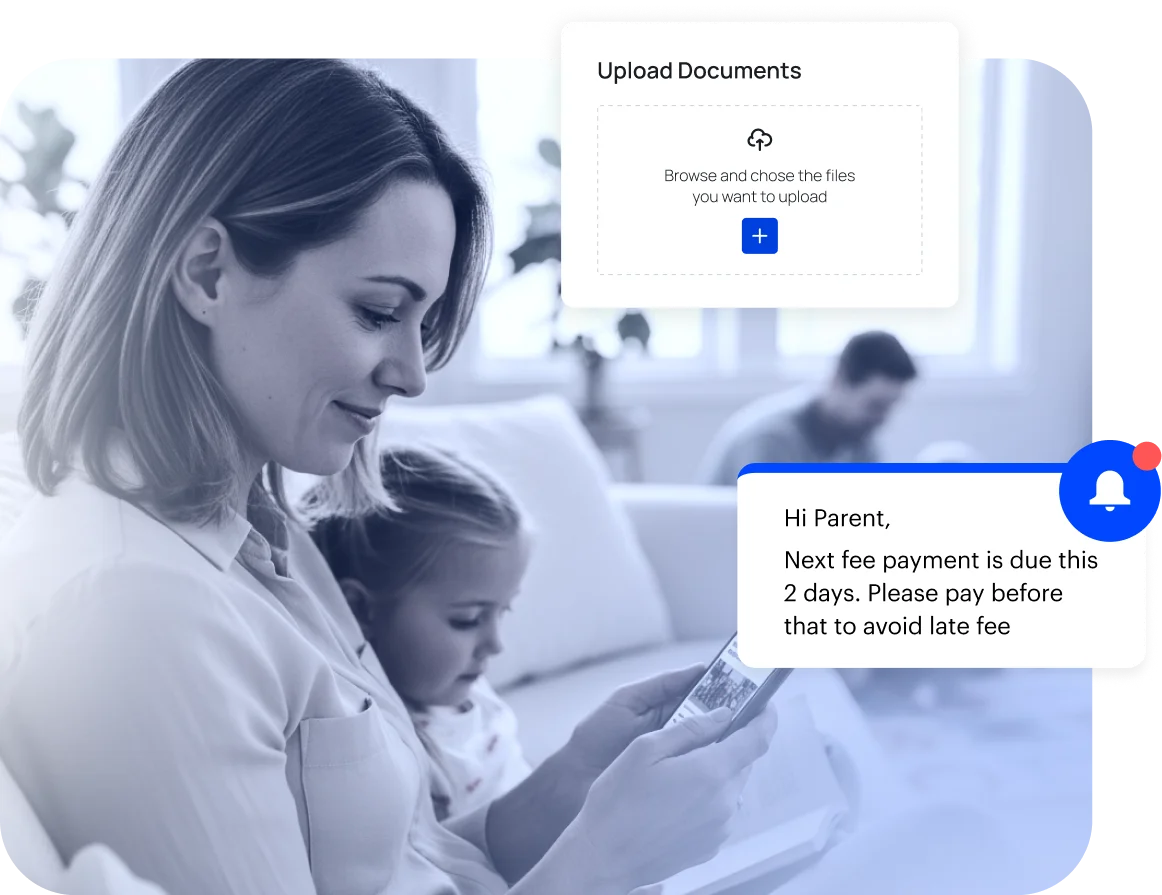
Together, these workflows are what an independent school admissions pipeline software is supposed to do — run the recruitment motion, not just record the outcome.
Veracross exposes an API that lets a Veracross compatible CRM sync data bidirectionally — inquiry and application activity from the CRM can flow into Veracross once a student is enrolled, and core student and family data from Veracross can inform CRM segmentation and communication. This is API-based, middleware-driven integration rather than a native, pre-built plug-and-play connection, which is worth flagging to your IT team upfront so the implementation gets scoped correctly.
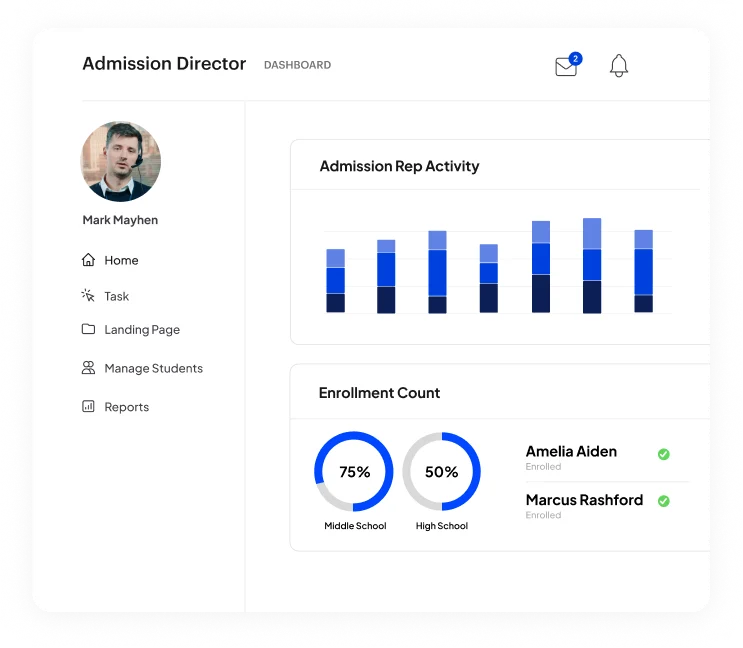
The result: Veracross stays the system of record for enrolled students, while the CRM runs the recruitment and conversion motion that happens before a student ever becomes a Veracross record. For schools comparing broader options, this is also where general school CRM software capabilities become relevant to evaluate.
Picture a $40,000-tuition day school fielding 300 applications a year for 80 available seats. That’s a highly competitive funnel where every stage — inquiry, tour, shadow day, application, aid, decision — needs individual tracking, because losing visibility at any single stage means losing a family that the school has worked hard to attract.
With Veracross alone, the admissions team can track who applied and who was admitted. The earlier nurture work is harder: the eight or nine touchpoints across a year-long consideration window still have to happen manually or through workarounds. Layer in a connected CRM, and the same team can run automated tour scheduling, staged nurture sequences by interest level, and real-time funnel reporting that shows exactly where the 300 applicants are thinning out to 80 enrolled students — and where a targeted follow-up could close the gap.
The same challenge shows up in a different shape at boarding schools, where a K-12 boarding school CRM admissions workflow has to manage families evaluating a school from another state or country — meaning tour scheduling, financial aid conversations, and re-enrollment all have to work well over distance and time zones, not just in person.
Veracross does an excellent job of being the single source of truth for your school’s student and family data — but admissions at a high-tuition, high-touch independent school is primarily a recruitment and relationship-management job, which reaches beyond record-keeping. A connected CRM fills that gap: automated nurture from first inquiry through shadow day, sensitive financial aid communication sequences, and re-enrollment and sibling pipelines that don’t rely on someone remembering to follow up.
None of this requires replacing Veracross or disrupting the systems your business office, registrar, and development team already rely on. It means adding a layer purpose-built for the part of the journey Veracross was never designed to run — the long, relationship-driven stretch between a family’s first inquiry and the moment they sign an enrollment contract. If your admissions office is still tracking hundreds of applicants in spreadsheets alongside Veracross, it’s worth seeing what that workflow looks like automated.
Explore how a purpose-built CRM fits into your broader education technology stack.
Book a demo to walk through admissions journey automation and financial aid communication workflows built for Veracross schools.
Veracross includes admissions and constituent-relationship features within its single-record SIS, but it isn’t a dedicated, purpose-built CRM for multi-touch admissions nurture. Most high-volume independent schools pair Veracross with a connected CRM for that layer of work.
Independent and private schools typically look for a CRM that integrates with their SIS (like Veracross) via API, and that’s purpose-built for education admissions — supporting inquiry pipelines, tour scheduling, nurture sequences, and financial aid communication rather than general-purpose sales CRM features.
By connecting inquiry capture (school fairs, referrals, website forms) to automated, staged communication sequences using a CRM — post-tour thank-yous, shadow day follow-ups, application reminders. So, no family stays waiting for a manual response during a competitive, time-sensitive process.
The right fit depends on your applicant volume and existing SIS, but the common thread across effective options is a CRM that integrates with your SIS via API, supports the full inquiry-to-enrollment funnel, and gives admissions teams real-time visibility into where families are dropping off. Consider evaluating LeadSquared as your admissions pipeline software.
Financial aid is one of the most sensitive, decision-critical parts of the admissions journey. Schools that manage it well use timed, personalized communication sequences around aid application deadlines, award notifications, and follow-up — often run through a CRM connected to their SIS’s billing and aid data — rather than one-off manual outreach.
Enter your details and we'll send you a quick confirmation email to verify your address.
 10 min read 12 min read 10 min read



 Diamond SIS CRM integration: Powering the career school enrollment journey with...
