




EDUCATION
Ellucian CRM vs LeadSquared: What Banner institutions use for modern enrollment
Contents

 14 min read


If your institution runs on Ellucian Banner, you already know what it does: Student records, registration, financial aid, billing.
What’s less settled, is what you should be running alongside it for recruitment and enrollment. Enter CRM for Ellucian Banner institutions.
Ellucian sells the in-house answer: CRM Recruit. But a growing number of Banner institutions are looking elsewhere, because their CRM needs to move faster than Ellucian’s product roadmap allows.
According to ListEdTech’s 2025 update, Ellucian Banner leads the North American higher-ed SIS market at 24% share — which means choosing the right CRM to run alongside Banner is a decision a lot of admissions and IT leaders are weighing right now.
We’ve covered the broader landscape in our Ellucian alternatives guide — this article goes deeper on the Banner-specific question.
This guide breaks down the LeadSquared vs Ellucian CRM comparison honestly: what CRM Recruit actually does, where it hits its limit, and how LeadSquared compares for institutions that want a faster, more modern alternative.
Editorial note: This comparison is published by an enrollment technology provider. Claims about both vendors are sourced where available. Readers should also consult independent review platforms (G2, Gartner Peer Insights, TrustRadius) before deciding.
Yes, they’re different.
Ellucian Banner is a Student Information System (SIS) — the system of record for enrolled students. It handles registration, financial aid, academic records, billing, and HR/finance functions.
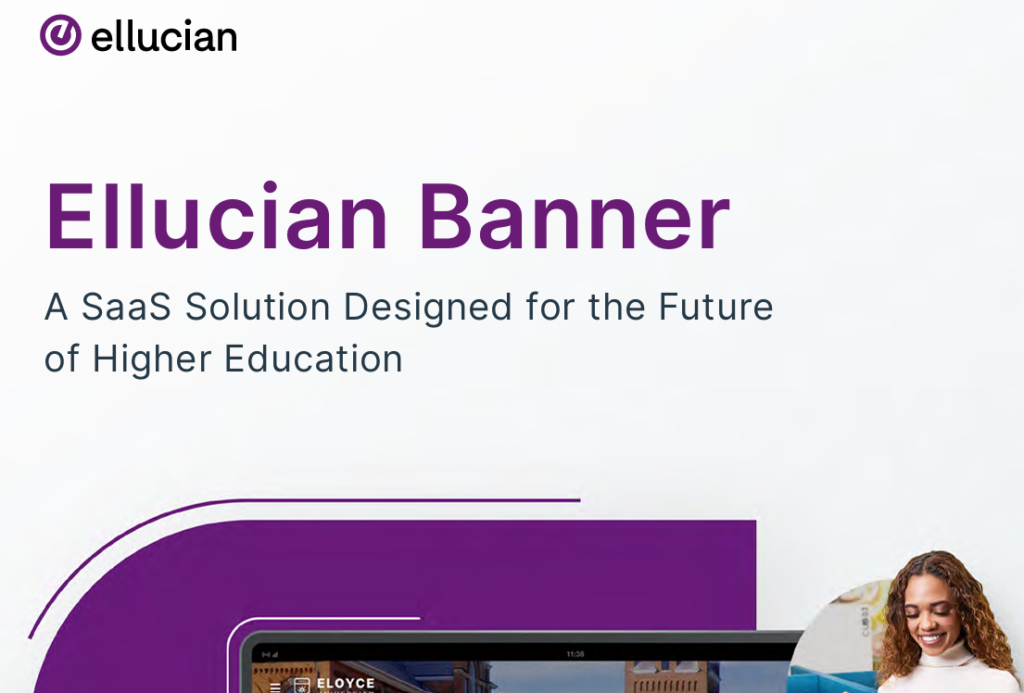
Ellucian CRM Recruit is a separate product — a Customer Relationship Management system built on Microsoft Dynamics 365 — used by admissions teams to manage prospective student communications, applications, and enrollment funnel activities.

Banner centralizes the data and processes that govern the student lifecycle after enrollment:
What Banner does not do well — and was never designed to do — is the high-volume, multi-channel, marketing-driven work of acquiring and converting prospects. Banner SIS enrollment marketing — the campaigns, nurture sequences, lead scoring, and counselor outreach that determine whether prospects become applicants and applicants become enrolled students — sits outside Banner’s scope entirely. That’s the gap a dedicated Banner SIS enrollment CRM is meant to fill.
No — not bundled with Banner itself.
Ellucian sells a separate CRM product called CRM Recruit, which integrates with Banner but is licensed and implemented separately. It’s one of four CRM products in Ellucian’s portfolio, alongside CRM Advise (student success), CRM Advance (advancement), and Ellucian Experience.
CRM Recruit is built on Microsoft Dynamics 365. It handles:
If you’re a Banner institution evaluating CRMs, CRM Recruit is the path of least resistance. Same vendor, pre-built connectors, and single procurement process. But “path of least resistance” isn’t the same as “best fit” — and that distinction is what this article exists to unpack.
CRM Recruit has well-documented limitations that surface repeatedly in evaluations. Five matter most for Banner institutions:
G2 reviewer data consistently flags implementation complexity as a friction point, with CRM Recruit scoring 5.3/10 for Ease of Setup against modern admissions CRMs scoring 6.2–8.0+. Deployment typically spans several months and requires substantial institutional resources, dedicated technical expertise, and change management capacity.
For an institution trying to launch ahead of a recruitment cycle, that’s often a non-starter. A CRM that goes live after the application season opens delivers most of its value the following year.
CRM Recruit is licensed separately from Banner. Institutions typically also pay for:
Ellucian publishes a dedicated CRM Recruit Optimization Services offering, which speaks to how much post-go-live tuning the product tends to require. For Banner institutions trying to keep CRM costs from compounding on top of existing Ellucian spend, this is often the breaking point.
CRM Recruit handles admissions workflows competently, but G2 reviewers consistently rate it lower than purpose-built admissions CRMs on meeting institutional requirements (5.8/10). Teams that want sophisticated nurture campaigns, behavior-based scoring, SMS or WhatsApp at scale, or AI-driven outreach typically end up bolting on additional point solutions — though Ellucian’s March 2025 Microsoft Dynamics 365 upgrade announcement signals advanced capabilities on the roadmap.
That said, its marketing automation, multi-channel campaign management, and lead scoring capabilities fall behind tools built specifically for high-volume enrollment marketing. Thus, admissions teams end up moving to dedicated admission software built for the job.
CRM Recruit’s interface is built on Microsoft Dynamics, which is engineered for enterprise CRM workflows rather than the consumer-grade simplicity counselors are used to from everyday apps. Thus, it typically requires meaningful training time before counselors are productive on the system.
This matters more than it sounds. Counselor adoption is widely cited as a leading predictor of CRM ROI in admissions — and a tool counselors don’t enjoy using is often underused, no matter how powerful it is on paper.
Ellucian releases on a timeline appropriate to enterprise SIS/ERP work — measured, conservative, infrequent. Modern admissions teams need their CRM to move faster: faster feature releases, faster experimentation, faster channel additions. That’s a structural mismatch, not a fixable one.
These limitations aren’t accidents. They’re the trade-off baked into buying a CRM from your SIS vendor — and for a lot of Banner institutions, it’s not a trade-off worth making.
Before comparing tools, it helps to define what “modern” means in this context. A CRM for Ellucian Banner institutions in 2026 should:
That’s the bar. Here’s how LeadSquared measures up against it.
LeadSquared is a purpose-built enrollment CRM used by hundreds of higher education institutions, vocational schools, and healthcare training providers globally. For Banner institutions, LeadSquared handles the prospect and applicant funnel, with data flowing both ways between the two systems.
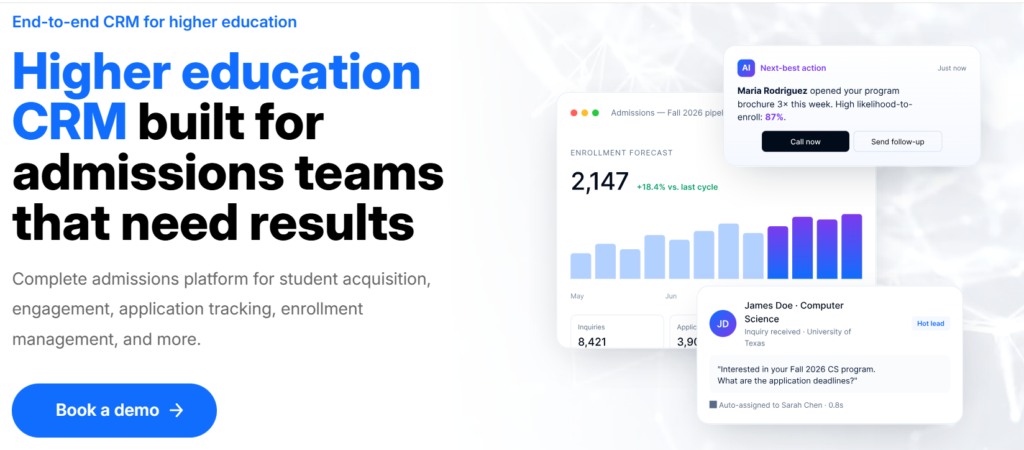
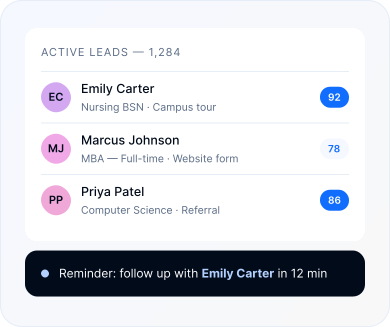
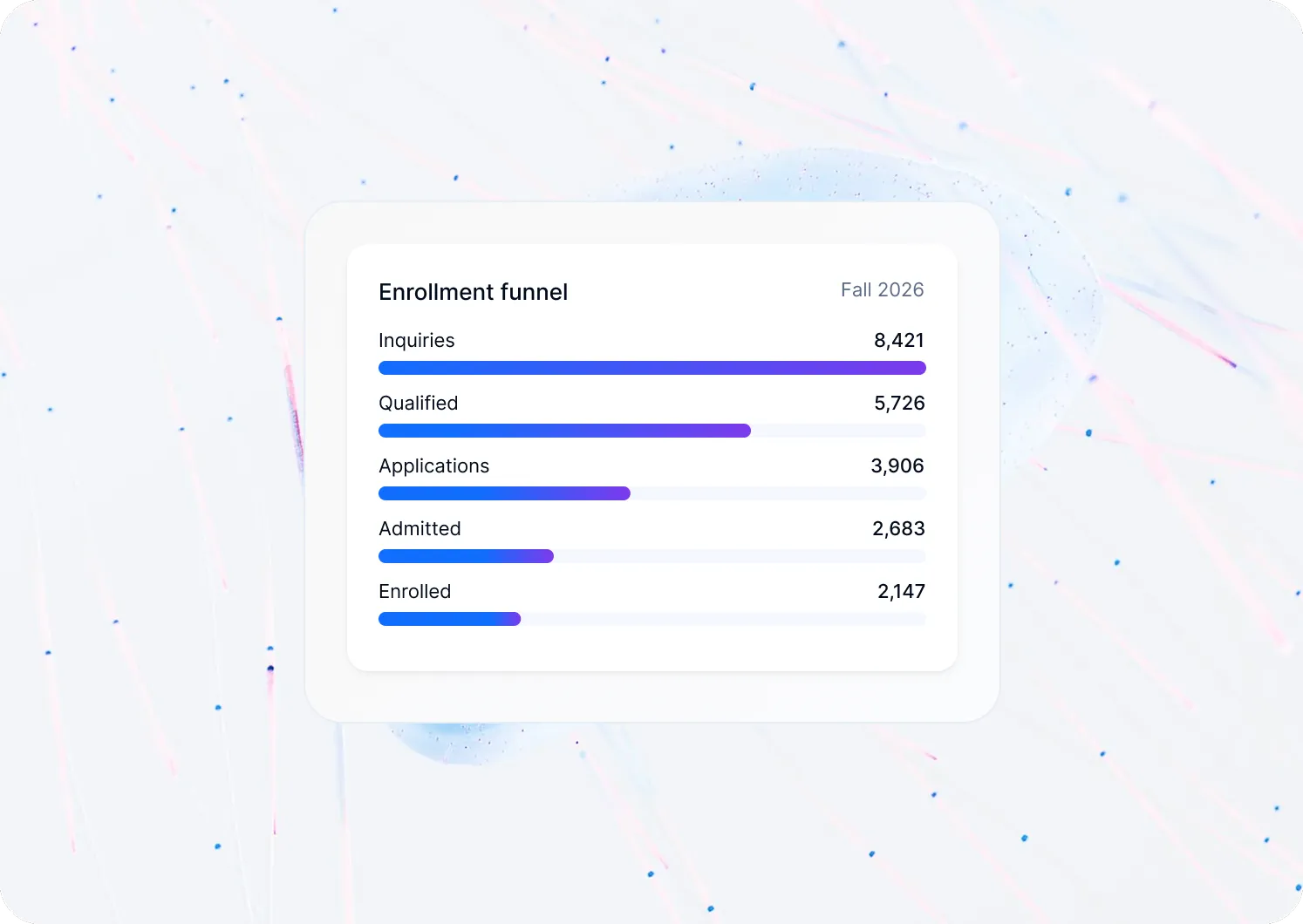
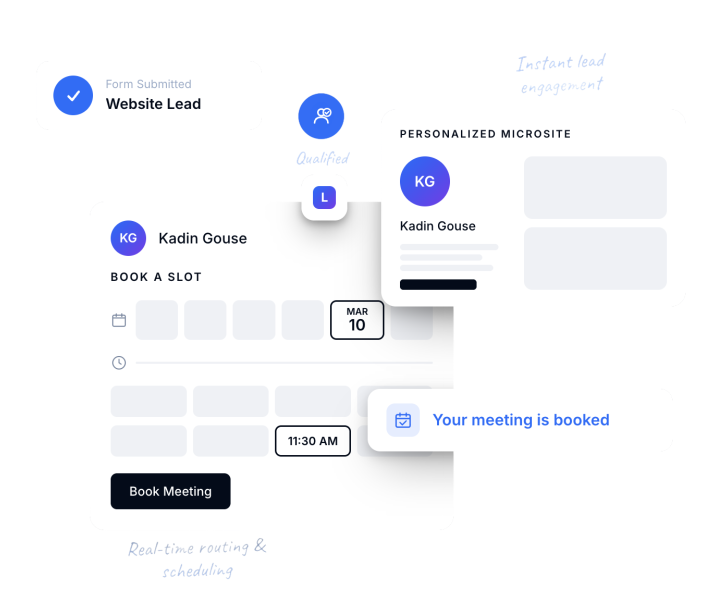
A few areas where it differs meaningfully from CRM Recruit:
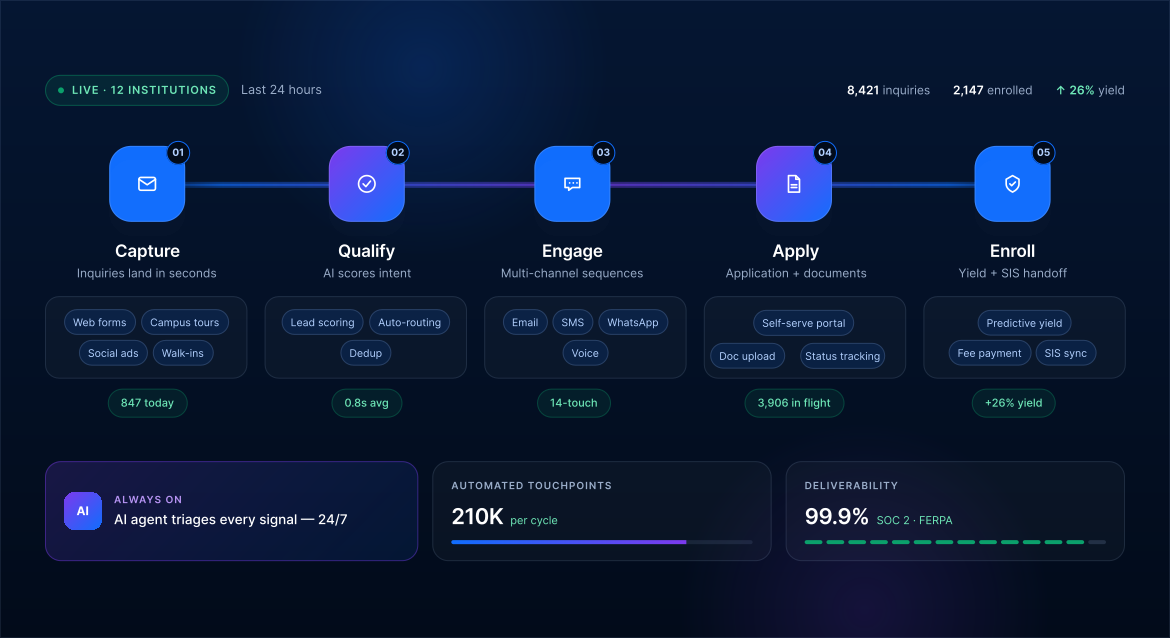
Can Ellucian Banner integrate with LeadSquared?
This is the question that matters most for Banner institutions: Can a third-party CRM coexist with Banner without creating data chaos?
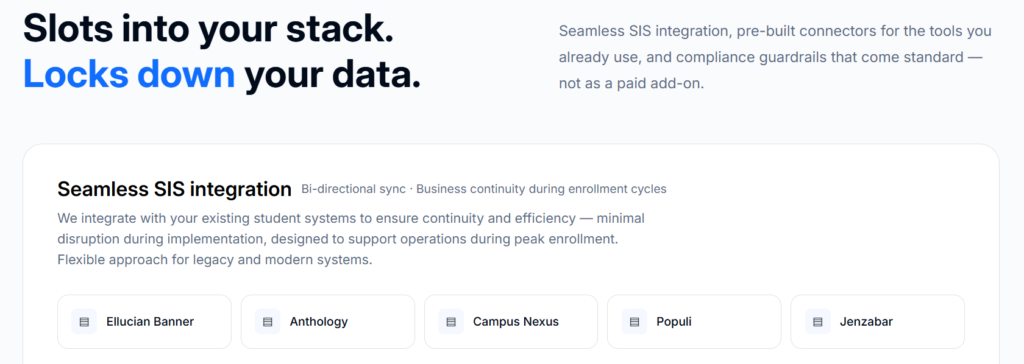
The short answer is yes. The pattern is well-established, with three standard data flows:
Prospects, inquiries, and applicants live in LeadSquared throughout the admissions funnel. When an applicant is admitted and confirms enrollment, the record is pushed to Banner — creating the official SIS student record without manual rekeying.
Banner remains the system of record for enrolled students. Enrolled student data syncs back to LeadSquared so retention, re-enrollment, and alumni engagement campaigns can run against a unified contact record.
As application stages progress in Banner — checklist items completed, financial aid packaged, decisions issued — those status changes flow back to LeadSquared, triggering the right counselor task or student communication automatically.
The result: Banner stays the system of record. LeadSquared handles everything before, around, and after the SIS — without forcing your IT team to maintain custom middleware.
| Capability | Ellucian CRM Recruit | LeadSquared |
| Underlying platform | Microsoft Dynamics 365 | Proprietary enrollment platform |
| Typical implementation time | Several months depending on scope | Configurable; accelerated 6-week path available for defined-scope deployments |
| Banner integration | Native Ellucian ecosystem integration | API-based SIS integrations with bidirectional sync |
| Marketing automation | Included; often extended with additional tools | Native email, SMS, WhatsApp, and voice campaign automation from a unified workflow engine |
| Lead scoring | Rules-based and configurable | Behavior-based automated scoring and workflows |
| Counselor experience | Dynamics-style interface | Native iOS and Android mobile apps; counselor workspace optimized for task execution |
| Voice/calling capability | Typically requires telephony integration | Native click-to-call; AI voice calling available via Invorto add-on |
| Scheduling automation | Basic workflow automation | Native scheduling workflows; FloStack add-on for advanced lead routing and instant engagement |
| Reporting | Standard Dynamics reporting | Pre-configured admissions dashboards covering funnel health, counselor activity, and source attribution |
| Best fit for | Institutions standardizing on Ellucian ecosystem | Institutions prioritizing speed-to-lead, omnichannel engagement, and rapid deployment |
What might this look like in practice?
The scenario below is illustrative and composite — not a specific customer — but reflects patterns that recur across Banner institutions evaluating modern CRMs.
Picture a public regional university with 12,000 students, running Banner as its SIS and CRM Recruit as its admissions CRM. The enrollment team is hitting a few familiar walls:
That speed gap matters more than it looks. A widely cited Harvard Business Review analysis of 2.24 million leads found that contacting a prospect within an hour made teams roughly seven times more likely to have a meaningful conversation than waiting longer — and the Lead Response Management Study found the odds of connecting are 100x higher at five minutes than at 30. An 18-hour average response time means most inquiries are effectively cold before a counselor ever picks them up. (Source).
The institution has two paths. They can keep investing in CRM Recruit and accept the pace. Or they can deploy LeadSquared alongside Banner, keep CRM Recruit running for the workflows where it’s already entrenched, and move the high-velocity prospecting and nurture work onto a faster platform.
Many institutions end up in this “augment first, replace later” pattern. It’s a lower-risk way to test whether a modern CRM actually moves the metrics that matter — yield, melt, counselor productivity — without forcing an all-at-once migration.
If your institution runs on Banner and you’re evaluating CRMs, the question isn’t really “Ellucian CRM Recruit vs LeadSquared.” It’s “What trade-offs are we willing to make?”
Choose CRM Recruit if same-vendor consolidation, pre-built Banner integration, and a single procurement contract matter more than implementation speed and feature velocity.
Choose LeadSquared if your enrollment team needs to move faster than Ellucian’s roadmap allows — and you want a CRM that counselors will use, integrated cleanly with Banner via API, live in weeks rather than quarters.
For most institutions feeling the speed-vs-cohesion tension, the answer isn’t either/or. It’s deploying the right tool for the right job — with Banner as the SIS backbone and a purpose-built enrollment CRM doing the work admissions teams need it to do today.
Want to see how LeadSquared integrates with Banner?
We’ll walk through Banner API integration, your enrollment pipeline, and what implementation would look like for your institution.
No — not bundled with Banner. Ellucian sells a separate CRM product called CRM Recruit, which integrates with Banner but is licensed and implemented separately. Ellucian also sells CRM Advise (for student success), CRM Advance (for advancement), and Ellucian Experience.
Ellucian CRM Recruit is a higher education CRM built on Microsoft Dynamics 365, designed for admissions and recruitment teams. It handles prospect tracking, application management, communications, and reporting. It integrates natively with Ellucian Banner and is most commonly adopted by institutions already running Banner as their SIS.
The most important variables are implementation timeline, marketing automation depth, multi-channel communication, counselor UX, and total cost of ownership across the first 24 months. Traditional CRM Recruit deployments can take multiple months depending on the scope of the project, while modern alternatives like LeadSquared are often deployed in weeks. Single-vendor consolidation is a real benefit of staying with CRM Recruit, but institutions should weigh that against the speed-to-lead, omnichannel engagement, and implementation agility offered by purpose-built enrollment platforms.
Yes. LeadSquared integrates with Banner via API, with bidirectional data flows for prospects, applicants, enrolled students, and application status updates. Banner remains the system of record for enrolled students; LeadSquared handles prospect, applicant, and engagement workflows. Implementation timelines are generally measured in weeks rather than traditional multi-quarter CRM deployments.
No. Banner typically remains the system of record for student information, registration, financials, and academic records. LeadSquared complements Banner by managing inquiry capture, admissions engagement, communications, workflow automation, and applicant conversion before enrollment. The two systems are commonly integrated so data flows automatically between recruitment and SIS operations.
LeadSquared is typically positioned as a CRM for Banner institutions without high cost loaded onto the Ellucian stack. It is a cost-effective alternative both in licensing and in total cost of ownership, given shorter implementation timelines and lower ongoing optimization needs. Actual pricing depends on institutional size and configuration. The fairer way to evaluate cost is total time-to-value across the first 24 months, not just licensing line items.
Banner institutions use a range of CRMs. Some use Ellucian CRM Recruit because it’s the same-vendor option. Others use third-party CRMs — including LeadSquared, Slate by Technolutions, Salesforce Education Cloud, and Element451 — because they want faster implementation, stronger marketing automation, or better counselor UX.
Institutions typically choose LeadSquared when they want faster speed-to-lead, simpler workflow automation, stronger omnichannel engagement, and quicker time-to-value. LeadSquared is designed around high-volume admissions execution, with built-in email, SMS, WhatsApp, calling, automation, and analytics workflows that can often be configured without heavy consulting or development resources.
Enter your details and we'll send you a quick confirmation email to verify your address.
 11 min read 11 min read 11 min read


 PowerSchool runs your SIS. What runs your admissions pipeline?
