





EDUCATION
PowerSchool runs your SIS. What runs your admissions pipeline?
Contents

 12 min read


If your school runs on PowerSchool, you already use it to manage what happens after a student enrolls — grades, attendance, scheduling, reporting.
What it doesn’t fully handle is everything that happens before: the months of inquiries, open house RSVPs, application follow-ups, financial aid questions, and yield conversations that determine whether a prospective family ever becomes an enrolled one.
There’s no marketing automation, no multi-channel nurture, no behavior-based scoring, no pipeline visibility from inquiry through decision. That gap is what a dedicated CRM for PowerSchool schools fills.
This guide walks through what PowerSchool covers (and doesn’t), the admissions pipeline workflows that need a CRM, how a complementary CRM integrates with PowerSchool, and what the right setup looks like for private K-12 schools, charter networks, and career schools running PowerSchool today.
A CRM for private school admissions sits alongside PowerSchool, handling everything from the first inquiry through enrollment decisions. It captures prospects from forms, ads, referrals, and open house sign-ups; nurtures them across email, SMS, and other channels; manages applications and document collection; and pushes enrolled student data to PowerSchool’s SIS when families convert.
The leading options here are LeadSquared, Finalsite Enrollment, SchoolMint Enroll, and SchoolAdmin. All of these can serve as private school admissions CRMs that offer integration with PowerSchool via API. In the interest of transparency, this guide is published by one of the CRM vendors named here. We list competitors so you can compare options on your own terms. The right fit depends on your school’s size, admissions volume, channel mix, and the level of automation your team requires.
PowerSchool is a dominant K-12 SIS in North America, holding 23% of identified SIS implementations (ListEdTech, 2025). Its core job is managing the operational data of enrolled students:
Beyond the core SIS, PowerSchool also sells PowerSchool Enrollment — a product that handles online registration forms, school choice and lottery management, and re-enrollment paperwork. It’s useful for replacing paper-based registration and managing the transactional side of enrolling new and returning students.
What it isn’t: A CRM.
Partially.
PowerSchool’s enrollment product page describes PowerSchool Enrollment as handling admissions, school choice, and lottery — and for schools that mostly need a way to take applications online and run a lottery, it does that job.
What it doesn’t include is the actual admissions pipeline:
These are the core functions of an admissions CRM. They represent the work admissions directors at private and charter schools handle every day. Yet many PowerSchool schools still rely on a mix of email tools, spreadsheets, calendar apps, and individual memory to get it done.
Not every PowerSchool school does. A traditional public district with assigned enrollment has limited need for prospect marketing. It’s also worth noting that many PowerSchool institutions are taking a broader look at their technology stack right now — the December 2024 data incident and subsequent vendor changes across the K-12 market have prompted a wave of stack evaluations. But several categories of PowerSchool institutions genuinely need a complementary admissions CRM regardless of that context:
For all four categories, the K-12 enrollment CRM PowerSchool integrates with acts as the admissions system of record. PowerSchool, meanwhile, remains the SIS for enrolled students.
What does a CRM actually do that PowerSchool doesn’t?
Six workflows make up most of the value:
Every inquiry — from your website, paid ads, referrals, partner schools, or open house sign-ups — flows into the CRM with the right source attribution and routing. From there it enters the PowerSchool admissions pipeline: a structured funnel from inquiry through application to decision to enrollment, with each prospect’s stage, source, and engagement level visible at a glance.
A K-12 open house automation CRM handles the whole event lifecycle: registration page, confirmation email, reminder sequences (the day before and the morning of), check-in capture, and follow-up nurture for both attendees and no-shows. This capability is more important than it may seem. Open house no-shows are a persistent drag on admissions events, and timely reminder sequences are one of the most reliable ways to reduce them. The difference between a passive RSVP list and an automated reminder-and-follow-up sequence is often the difference between a half-empty open house and a packed one.
Inquiries who become applicants get tracked through every stage: application started, documents collected, financial aid inquiry submitted, interview scheduled, decision issued, deposit paid. The CRM flags incomplete applications, triggers automated reminders for missing documents, and alerts counselors when a high-fit family is stalling.
Financial aid questions are often the single biggest converter — or killer — of a private school application. A CRM lets you build dedicated nurture flows for families exploring aid: explanation content, comparison frameworks, and proactive counselor outreach before the family quietly decides cost is a deal-breaker.
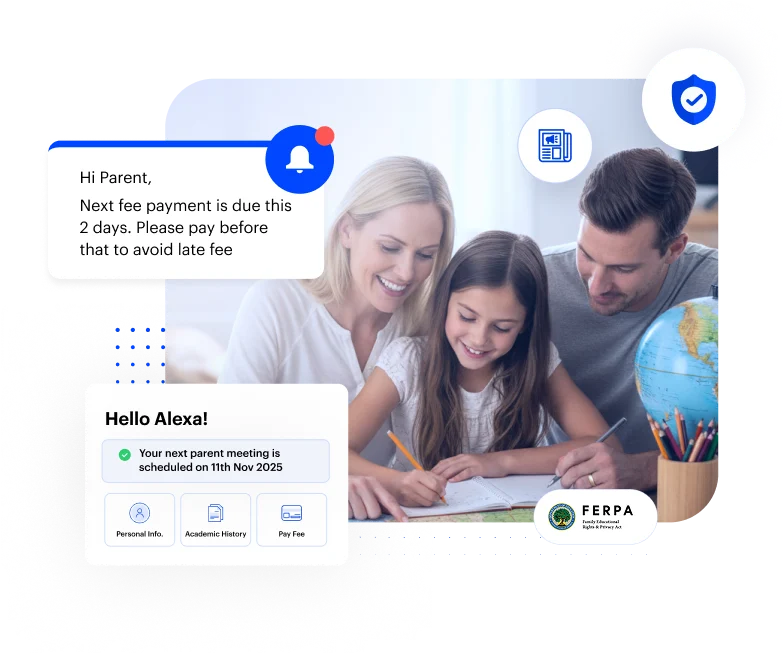
Annual re-enrollment is its own marketing campaign. The CRM segments existing families by likelihood to re-enroll, triggers timely reminders, surfaces at-risk families to counselors, and tracks completion — turning what’s often a chase-everyone-by-hand exercise into a managed campaign.
Private school waitlist management software is one of the most underrated CRM use cases. When a spot opens up unexpectedly, you don’t want to scramble through a spreadsheet — you want to know exactly who’s next, what their interest level is, and how to reach them on the channel they prefer. A CRM keeps the waitlist live, scored, and ready to convert.
The question every school IT and operations lead asks: Can a third-party CRM coexist with PowerSchool without creating duplicate records or data drift? Yes — and the integration pattern is well-established.
A PowerSchool compatible CRM like LeadSquared connects to PowerSchool via API with two primary data flows:
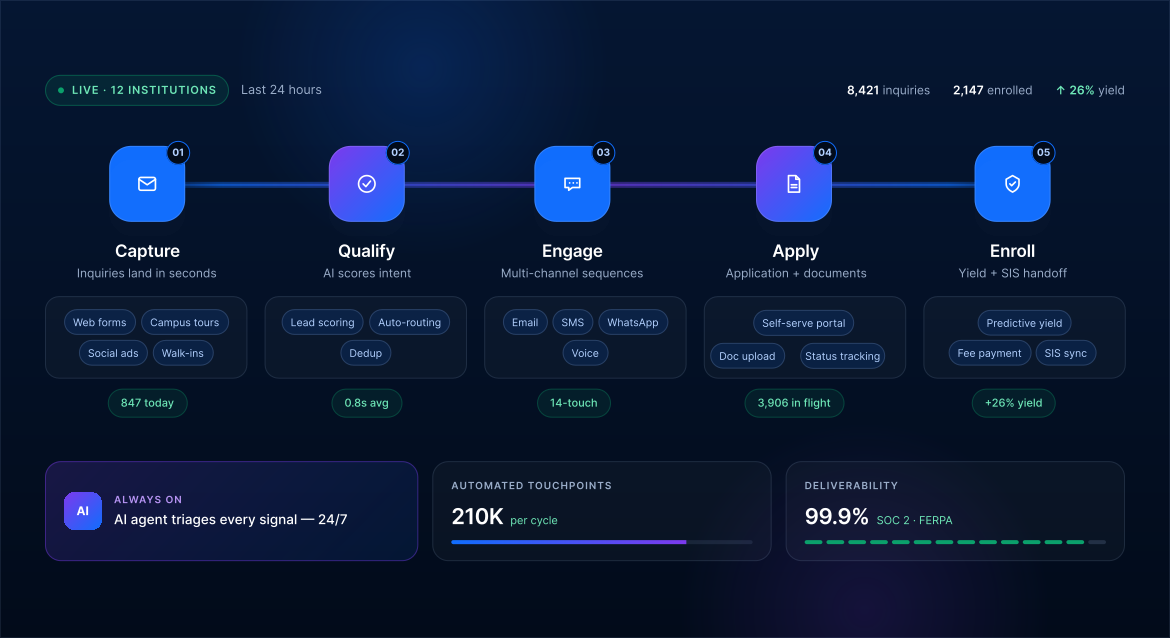
The result: PowerSchool manages enrolled students. The CRM manages everyone else: Prospects, applicants, waitlist families, and re-enrolling families — without anyone maintaining two separate databases by hand.
What does this look like in practice?
Picture a K-12 private day school with 500 students in total, an admissions team of two, and 200+ annual applicants competing for roughly 80 open spots across grade levels. The team is running PowerSchool SIS for enrolled students and a mix of disconnected tools for everything else:
The result: Counselors spend most of their week on data entry and follow-up logistics, not on relationship building. Open house no-show rates run above 50%. The team has no real visibility into the funnel until decision day. And the admissions director can’t answer the board’s question — “Where are next year’s families coming from?” — with anything more than a guess.
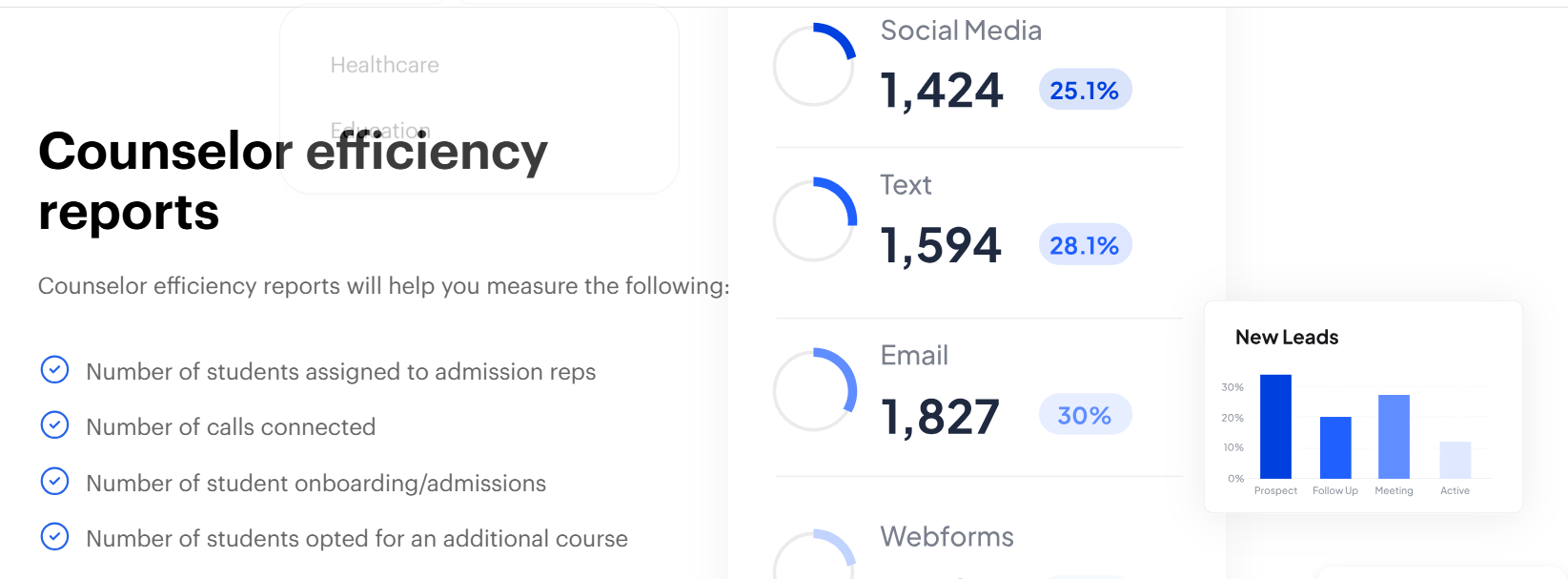
With a CRM layered on top of PowerSchool, the same team can run automated open house nurture, track every applicant through a single pipeline, score families by engagement level, and push enrolled students to PowerSchool with one click on decision day.
The two counselors stop spending their week on logistics and start spending it on the work that actually converts families — phone calls, tours, parent-to-parent introductions. Per NAIS’s most recent Facts at a Glance data, acceptance-to-enrollment rates at independent schools average 71.4%; the schools pushing meaningfully above that figure are typically the ones with intentional, technology-supported yield management.
Schools running this model see the gain firsthand. Career and vocational institutions on LeadSquared — which market like private schools, with inquiries, info sessions, and financial-aid conversations — have reclaimed real staff time; the Esthetic Institute, for one, recovered more than 10,000 minutes once manual follow-up moved into the CRM. (Read case study here). The same pipeline logic applies to K-12 schools layering a CRM over PowerSchool.
PowerSchool is the dominant K-12 SIS for a reason — it does a hard job well. But it was never designed to do admissions marketing, and the products PowerSchool sells in that direction (PowerSchool Enrollment, registration tools) don’t replace a real CRM. For private, charter, and career schools competing for families across a multi-month admissions cycle, a dedicated CRM for PowerSchool schools is what closes the gap between “we have a great SIS” and “we have a working admissions funnel.”

Want to see how LeadSquared automates open house management and admissions pipelines for PowerSchool schools?
We’ll walk through PowerSchool API integration, open house automation, and how your team’s specific pipeline could look on a CRM.
Disclosure: This guide is published by a CRM vendor that serves K-12, higher education and career-school market. Competing products are named so you can compare options on your own terms.
Not in the marketing-and-admissions sense. PowerSchool offers products such as PowerSchool Enrollment that help schools manage online applications, registration, school choice, lotteries, and re-enrollment workflows. However, these products are primarily focused on enrollment management and administrative workflows rather than serving as a full admissions and marketing CRM.
It doesn’t include multi-channel nurture, behavior-based scoring, campaign automation, or pipeline dashboards. Schools that need those capabilities run a complementary CRM alongside PowerSchool.
Common CRM platforms used by private and independent schools include LeadSquared, Finalsite Enrollment, SchoolAdmin, SchoolMint Enroll, and Ravenna. The right choice depends on enrollment volume, admissions complexity, communication needs, integration requirements, and budget.
A modern admissions pipeline at a private K-12 school looks like: inquiry capture across web, paid, referral, and event channels → multi-channel nurture (email, SMS, sometimes WhatsApp) → application tracking with automated document reminders → interview and decision workflows → yield campaigns for admitted families → enrollment commitment and PowerSchool sync. Schools relying heavily on spreadsheets and manual processes often struggle with slower response times, inconsistent follow-up, and limited pipeline visibility. The ones doing it well run it through a purpose-built CRM like LeadSquared, which handles each pipeline stage natively and syncs enrolled students back to PowerSchool.
Yes. PowerSchool CRM integration is possible with admissions and marketing platforms such as LeadSquared: Through APIs, middleware, or custom integration (depending on the PowerSchool products in use and the school’s technical environment). Prospects and applicants live in the CRM; once a family enrolls, the student record is pushed to PowerSchool. Enrolled student data syncs back to the CRM for re-enrollment and parent engagement workflows. The two systems stay in sync without manual data entry.
There’s no universal answer. The best CRM for a 200-student elementary day school is different from the best CRM for a 2,000-student boarding school or a 15-campus charter network. The right way to evaluate: Implementation speed, multi-channel coverage (email/SMS/WhatsApp), open house automation, scoring and pipeline visibility, PowerSchool integration depth, and counselor UX. For schools that want a purpose-built option, LeadSquared’s school CRM software and admission software pages walk through how this works in practice.
Implementation typically runs through configuration, integration, training, and launch support, and most schools go live within weeks — the exact timeline depends on integration depth, workflow complexity, and data-migration scope.
Enter your details and we'll send you a quick confirmation email to verify your address.
 11 min read 11 min read 11 min read



 HIPAA-Compliant CRM for Healthcare Providers
