




EDUCATION
PeopleSoft + CRM integration: Closing the enrollment gap for large research universities
Contents

 16 min read


Oracle PeopleSoft Campus Solutions manages student records at hundreds of large US research universities. Financial aid, billing, degree audit — it handles the complete enrolled student lifecycle, and institutions are deeply committed to it.
What it doesn’t handle is the 12-to-18-month journey it takes to get a student enrolled in the first place.
Prospective students today expect faster responses, personalized outreach, and a recruitment experience that reflects genuine interest in them as individuals. PeopleSoft wasn’t built for any of that.
That’s the pre-enrollment gap — and it’s exactly what a CRM for PeopleSoft Student institutions is designed to fill.
Admissions teams at PeopleSoft institutions are increasingly running a dedicated CRM alongside Campus Solutions — managing everything from first inquiry to enrollment confirmation in the CRM, then syncing confirmed students into PeopleSoft for registration and records. It’s not a workaround. It’s the architecture that makes modern enrollment operations work at a research university scale. Let’s unpack more on PeopleSoft Student CRM integration.
Most institutions on PeopleSoft use a dedicated enrollment CRM alongside PeopleSoft Campus Solutions — not instead of it. The CRM handles the recruitment and engagement layer: Inquiry capture, counselor workflows, multi-channel outreach, application tracking, and graduate recruitment pipelines. PeopleSoft runs the operational backbone — registration, billing, financial aid, and degree management. The two systems serve different functions, and the best enrollment operations use both strategically.
PeopleSoft Campus Solutions was built to manage students through their academic journey, not to recruit them. It handles the enrolled student lifecycle well:
These functions matter enormously. But every one of those functions assumes that the student is already enrolled. The system has no native answer for what happens before that — which, at a competitive research university, is where the real work is.
From a prospect’s first inquiry to their enrollment confirmation, the journey can span anywhere from a few weeks to 18 months. PeopleSoft has almost no native capability to manage what happens during that window.
The net effect: Admissions operations on PeopleSoft alone work harder than they need to, lose prospects they shouldn’t, and have limited ability to connect recruitment activity to enrollment outcomes.
The enrollment challenge at an R1 research university (R1 being Carnegie’s highest doctoral research designation) isn’t just a volume problem — it’s a structural one. These institutions are recruiting multiple distinct student populations simultaneously, each with different timelines, decision drivers, and information needs. A single generic workflow doesn’t serve any of them well.
Top R1 universities routinely process tens of thousands of applications in a single cycle. The largest flagships go well beyond that — UCLA, the most applied-to university in the country, received more than 173,000 applications for fall 2024, and that’s before counting the much larger inquiry pool that sits above the application stage.
At that scale, manual processes don’t slow things down incrementally — they create compounding failures. A prospect who has to wait days for a reply is far more likely to lose momentum and commit to a program that responds first. A graduate applicant whose questions go unanswered during the decision window often chooses a competing program that responds faster. Systematic automation — lead routing, timed communication sequences, counselor task queues, application status triggers — is the operational foundation that makes high-volume enrollment work well.
Undergraduate admissions follow a predictable annual cycle. Graduate admissions don’t. A prospective PhD student may spend 12 to 18 months researching programs, evaluating faculty research alignment, attending virtual information sessions, comparing funding packages, and revisiting their shortlist before committing. Professional master’s programs — MBA, MPH, MSW, engineering — see similar extended timelines.
The stakeholder map is also more complicated. Graduate enrollment involves admissions counselors, departmental graduate coordinators, faculty advisors, and financial aid staff who structure fellowship and assistantship packages. A CRM that treats graduate recruitment as a two-stage funnel misses most of what actually drives graduate yield. What these programs need is a pipeline that mirrors the actual decision process — — tracking inquiry, faculty contact, campus or virtual visit, application started, application submitted, admitted, funding offered, yield confirmed — with the right people notified and accountable at each stage. LeadSquared’s admissions software supports configurable pipelines built around this complexity, not despite it.
International students contributed $42.9 billion to the US economy in 2024–25 (NAFSA) — but that figure fell for the first time since the pandemic, and new international enrollment is projected to decline further in 2025–26. As the pool tightens and Canadian, UK, and Australian universities compete harder for it, responsiveness and a disciplined recruitment process matter more, not less.
Recruiting internationally introduces operational complexity that generic admissions workflows can’t handle. Communication needs to be time-zone aware. Outreach often needs to be delivered in multiple languages. Document collection is more involved — international transcripts require credential evaluation, English proficiency scores have validity windows, and financial guarantee documents require verification. Some institutions also need to align communication timing with visa application cycles.
Managing all of this through email chains and spreadsheets is how international enrollment operations lose prospects to better-organized competitors. A dedicated CRM pipeline with document collection workflows, language-specific communication tracks, and time-zone-aware automation brings the same discipline to international recruitment that domestic admissions teams take for granted.
Transfer students come in with a different set of questions — credit transferability, financial aid continuity, and how many credits will carry forward. Routing them through the same workflow as freshman applicants serves neither group well. Dedicated transfer pipelines, with communication tracks and stages built around the transfer journey, consistently improve conversion from this segment.
A PeopleSoft admissions pipeline CRM (a modern enrollment CRM running alongside PeopleSoft) should own the full pre-enrollment journey and hand off cleanly at the point of confirmed enrollment. These are the workflows that matter most at the scale of a research university.
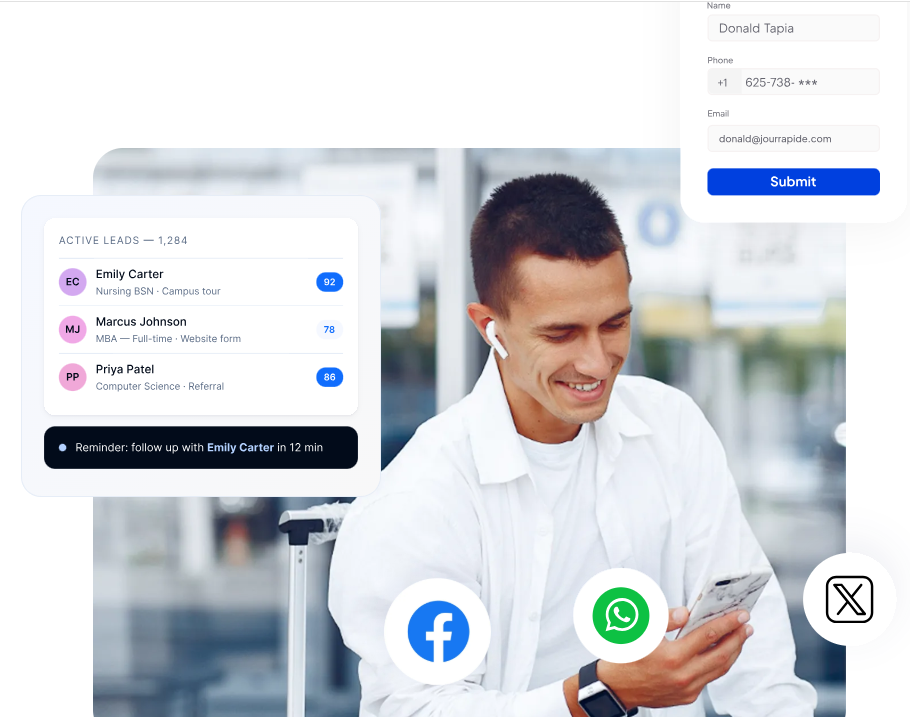
Every inquiry — from a web form, campus visit registration, college fair scan, chatbot conversation, or third-party lead source — should enter a single system, be automatically deduplicated against existing records, scored for engagement signals, and routed to the right counselor or admissions team based on program interest, geography, or enrollment stage. At institutions managing thousands of inquiries weekly, manual triage creates delays and inconsistency. Automation at the top of the funnel is what gives counselors the headspace to focus on high-value conversations rather than queue management.
A well-configured graduate pipeline tracks: Initial inquiry, program information request, faculty or coordinator contact initiated, virtual or campus visit completed, application started, application submitted, application complete, decision pending, admitted, funding package offered, yield confirmed. Each stage has different owners — sometimes admissions staff, sometimes department coordinators, sometimes faculty. The CRM makes these handoffs explicit and trackable, with automated alerts when applications stall beyond a defined threshold and dashboards that show graduate enrollment leadership the state of the pipeline across all programs in real time.
International pipelines require workflows calibrated for cross-border recruitment realities: Longer nurture sequences with time-zone-aware delivery, multi-language communication options, structured document collection stages, and integration with credential evaluation workflows. Keeping all of this inside a CRM — rather than distributed across email folders and shared drives — gives international admissions counselors a single working environment and gives leadership the visibility to know where each prospect stands.
Transfer recruitment benefits from CRM workflows that surface credit evaluation signals early — information counselors can use proactively in their conversations with prospective transfers. Automated follow-up sequences should run on community college academic calendars, not standard freshman admissions deadlines. And transfer-specific communication tracks should address the questions this audience actually has, rather than repurposing messaging built for first-year applicants.
LeadSquared is designed to operate as the front-office admissions and engagement platform while connecting to institutional systems of record like PeopleSoft. The integration architecture is flexible, accommodating the range of PeopleSoft configurations that exist across large research universities — without requiring a single native out-of-the-box connector.
Open APIs enable bi-directional data exchange between LeadSquared and PeopleSoft Campus Solutions, supporting automated syncing of applicant records, application status updates, and enrollment confirmations. Webhooks handle real-time, event-based synchronization — when a student’s status updates in either system, the change is reflected in the other without batch processing delays or manual intervention.
For institutions that need more complex data mapping or orchestration across multiple systems, LeadSquared supports custom integrations through LAPPS — its developer platform — as well as connections via enterprise middleware tools including MuleSoft, Boomi, and Workato. IT teams can build integrations that fit the institution’s existing data architecture rather than conforming to a fixed schema.
PeopleSoft Student CRM integration typically follows a clean directional architecture:
Lead sources → LeadSquared → PeopleSoft Campus Solutions
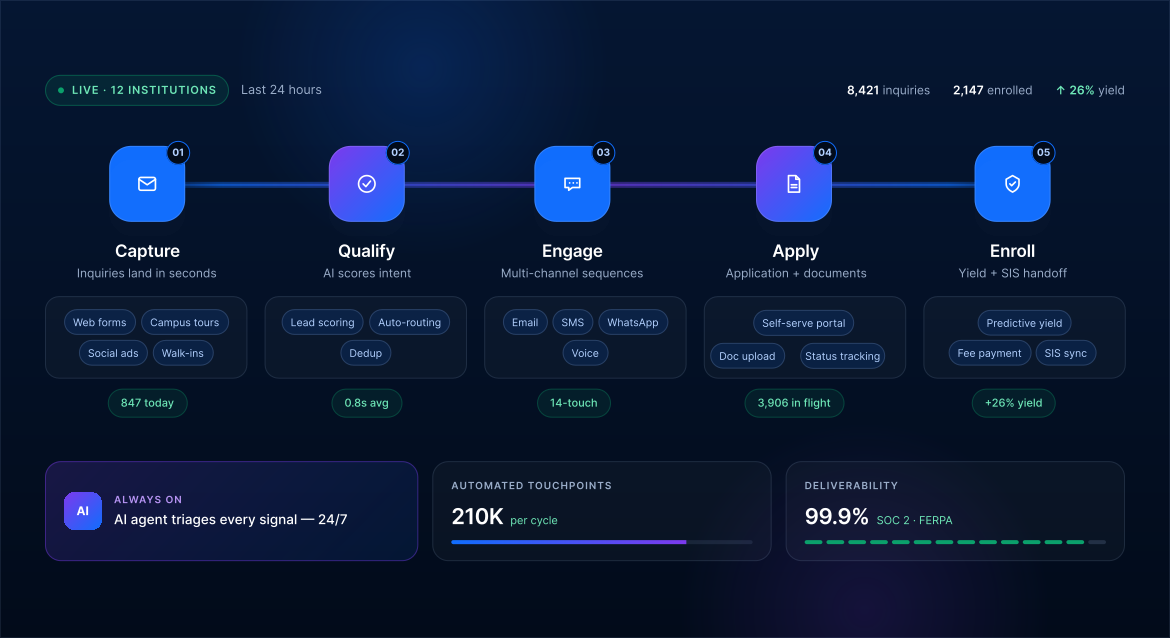
LeadSquared handles the front-office layer from inquiry to enrollment: capturing prospects from every source, running admissions workflows, managing email and SMS engagement, tracking applications, and generating pipeline reports. Once a student confirms enrollment, their record hands off to PeopleSoft, which becomes the authoritative system of record for registration, billing, financial aid, and degree tracking.
Common integration sync points for PeopleSoft institutions include:
The practical result: Counselors work in LeadSquared throughout the recruitment cycle without needing to touch PeopleSoft until a student is ready to register. No duplicate entry, no manual re-keying, and a single version of the truth at every stage.
For a broader view of how LeadSquared approaches enrollment, see our student enrollment management system page.
The following is an illustrative scenario, not a specific institution.
Consider a large flagship state university — Carnegie R1, substantial graduate school, significant international enrollment, active transfer pipeline — running entirely on PeopleSoft Campus Solutions.
Before a dedicated enrollment CRM, the picture is familiar. Undergraduate counselors manage prospect lists in spreadsheets and follow up through personal email. Graduate departments recruit in silos — one uses a shared Google Sheet, another relies on faculty to manage outreach informally, a third runs a homegrown tracking system only one staff member fully understands. International recruitment is coordinated through email chains between admissions and partner agents, with no central view of where each prospect stands.
The results are predictable: inconsistent response times, prospects dropping out of the funnel unnoticed, yield rates that fluctuate without clear explanation, and a scramble every cycle to understand where the class is tracking before it’s too late to act.
With LeadSquared integrated into the PeopleSoft environment, the operation changes. Every inquiry — from a web form, a college fair scan, an agent referral, a faculty recommendation, or a chatbot conversation — enters LeadSquared automatically, is deduplicated, scored, and assigned to the right counselor or department queue within minutes. Counselors have a live task list, not an overflowing inbox.
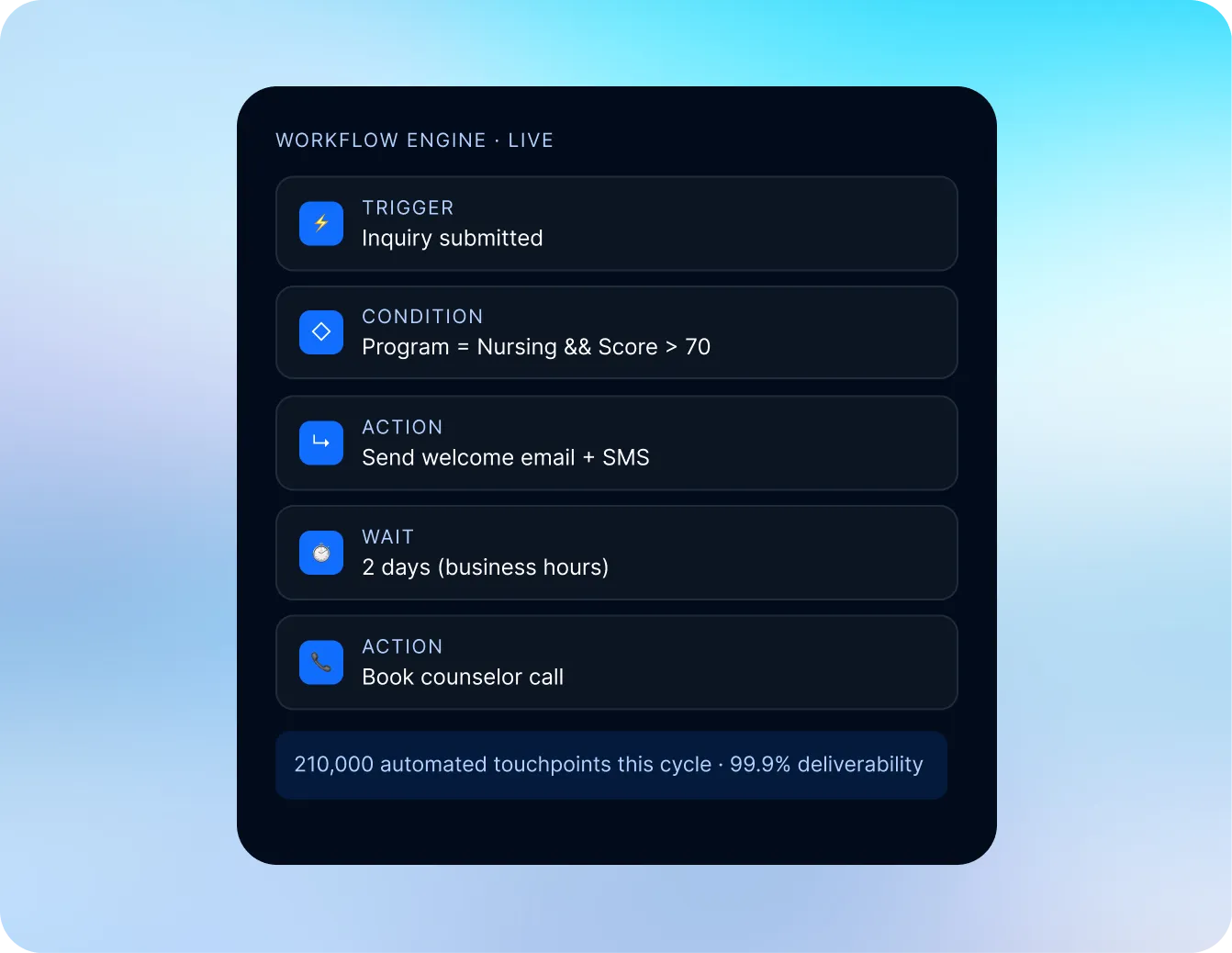
Graduate program coordinators log into a shared pipeline view for their department. They can see every prospective student in the funnel, what stage they’re at, when the last communication occurred, and what the next scheduled touchpoint is. When a faculty member refers a prospective PhD student, that referral enters the CRM automatically — routed to the right graduate admissions coordinator, with a task created and the faculty member’s notes attached.
International prospects receive automated sequences calibrated to their time zone and country of origin. Document collection workflows trigger at the right stage — a language score reminder goes out when the application hits a certain completion percentage, not when a counselor manually notices the gap. Credential evaluation flags surface early, before they become bottlenecks at the review stage.
Transfer inquiries move through a separate pipeline with communication built around credit transferability, financial aid continuity, and enrollment timing — and with early credit evaluation information available to counselors from the first conversation.
When a student confirms enrollment, their record syncs into PeopleSoft automatically. The counselor’s work is done. PeopleSoft takes over for registration, billing, and the rest of the student lifecycle — without anyone re-entering data.
And throughout the cycle, admissions leadership has a real-time view of where the incoming class stands: By program, by geography, by student segment, by counselor. The visibility that used to arrive too late to act on is now available months in advance.
Running PeopleSoft Campus Solutions without a dedicated enrollment CRM means managing one of the most competitive, relationship-driven processes in higher education with tools that weren’t built for it.
Institutions that pair PeopleSoft with a purpose-built CRM gain what Campus Solutions alone can’t give them: automated inquiry capture and routing, configurable graduate and international pipelines, multi-channel outreach, and real-time pipeline visibility — with a clean handoff to PeopleSoft at enrollment confirmation.
Ready to see how LeadSquared works alongside PeopleSoft?
We’ll walk you through the graduate admissions pipeline and international student tracking built for large research universities.
No. PeopleSoft Campus Solutions is a student information system (SIS), not a CRM. It manages the records, finances, and academic progress of enrolled students. It has limited native capability for the pre-enrollment journey — tracking prospects, automating outreach, routing inquiries, or running admissions pipelines. Most PeopleSoft institutions run a dedicated enrollment CRM alongside Campus Solutions to manage the prospect-to-applicant-to-enrolled-student journey, then sync confirmed enrollment data back into PeopleSoft.
No. A dedicated CRM doesn’t replace PeopleSoft — it sits in front of it. PeopleSoft remains the system of record for enrolled students, handling registration, billing, financial aid, and degree tracking. The CRM drives the recruitment and engagement layer — inquiry capture, counselor workflows, multi-channel outreach, and application tracking — and syncs with PeopleSoft as students move toward enrollment. Institutions keep the SIS investment their operations are built around and add the recruitment and engagement capabilities PeopleSoft was never designed to provide. With LeadSquared, that connection runs through open APIs and webhooks, so there’s no duplicate data entry and no competing system of record.
Large research universities typically use purpose-built higher education CRMs designed for high application volumes, complex graduate pipelines, and multi-segment recruitment across undergraduate, graduate, international, and transfer populations. Options in this space include LeadSquared, Slate by Technolutions, Salesforce Education Cloud, and TargetX. The right fit depends on program mix, SIS integration requirements, and whether the platform can support graduate and international workflows at the depth those programs require. For more on how LeadSquared approaches enterprise enrollment, see our higher education CRM overview.
Graduate pipelines span 12 to 18 months from first inquiry to enrollment commitment and involve more stakeholders than undergraduate admissions — faculty advisors, departmental coordinators, and financial aid staff who structure fellowship packages. Institutions that manage these effectively use a CRM with configurable stages that mirror the actual graduate decision process, automated communication that keeps prospects engaged across a long cycle, and handoff tracking so faculty referrals and departmental touchpoints don’t fall through the cracks. Without a CRM, graduate recruitment activity lives in email threads, spreadsheets, and individual faculty inboxes — creating continuity risk every time a staff member turns over.
Yes. LeadSquared integrates with PeopleSoft Campus Solutions through open APIs, webhooks, and its LAPPS developer platform, as well as enterprise middleware tools like MuleSoft, Boomi, and Workato for institutions that need more complex data orchestration. There’s no dependency on a single native connector — the setup adapts to the institution’s PeopleSoft version and existing IT architecture. The typical flow keeps LeadSquared as the front-office admissions platform throughout the recruitment cycle, then syncs confirmed enrolled students into PeopleSoft as the system of record. Common sync points include applicant records, application status updates, enrollment confirmations, and academic program data. Get in touch to discuss the integration approach that fits your environment.
The best admissions CRM for a large university is one built for the full complexity of that institution’s enrollment operation — not just the undergraduate funnel. For PeopleSoft institutions managing high application volumes across multiple student segments, that means configurable pipeline stages for graduate and international recruitment, multi-channel communication automation, clean SIS integration, and enrollment dashboards that give leadership real-time visibility across programs and counselors. LeadSquared’s admissions software and enrollment management platform are built for exactly this scale. Book a demo to see the graduate admissions pipeline and international student tracking workflows in action.
Enter your details and we'll send you a quick confirmation email to verify your address.
 10 min read 12 min read 10 min read



 Workday Student CRM integration: Do enrollment teams still need a separate...
