




EDUCATION
Mongoose Cadence starts the conversation. A CRM finishes it.
Contents

 12 min read


If your enrollment team uses Mongoose Cadence, you already know it does one job well: it gets prospects talking. Two-way SMS, conversation templates, mass campaigns, fast replies — it works. And with students far more likely to read a text than an email, usually within minutes, texting matters more than ever in higher ed.”
But a conversation isn’t an enrollment. Getting from one to the other, tracking each student from reply to application to deposit, is pipeline work. And it’s what Cadence was never built to do.
A student texts you back. Where does that conversation go next? What stage is she in? Which deposited students still haven’t registered for orientation? And which campaign drove the most enrollments — not the most replies?
These are CRM questions, not texting questions. And the schools getting the most out of Mongoose Cadence aren’t choosing between Mongoose and a platform like LeadSquared. They’re using both: Cadence as the conversation channel and LeadSquared as the system that manages the entire inquiry-to-enrollment journey.
This guide walks through what that Mongoose Cadence + CRM integration looks like in practice: what each tool does, where the gap is, and how to wire them together so texts actually drive enrollments.
Disclosure: This page is published by an enrollment technology provider and reflects that perspective. Evaluate any platform against your institution’s own requirements.
Mongoose Cadence is a higher-ed texting platform. It’s built for two-way SMS and chat, with message templates, mass campaigns, AI-assisted replies, and reporting on delivery and response rates.
But it was never built to be the system of record for your enrollment journey — the place where every student’s status, stage, and next step lives.
That means Cadence doesn’t own:
For all of that, you need a CRM running alongside Cadence — the system that turns the conversations Cadence starts into enrolled students. Picking the right CRM for Mongoose Cadence in higher education matters as much as picking the texting platform itself.
Before describing the gap, let’s give some credit. Cadence — now part of Mongoose’s broader Conversation Intelligence Platform alongside Mongoose Chat and WhatsApp — handles the texting layer comprehensively:
In short: Cadence is a strong higher-ed texting CRM pipeline input. It’s the front door — and many schools layer it alongside whatever CRM they already use rather than relying on the CRM’s built-in texting.
Where it stops is everything after the conversation — the orchestration, scoring, and pipeline tracking that determine whether a prospect actually crosses the finish line to enrollment.
(For schools that prefer a single-system approach, LeadSquared supports outbound and two-way texting for education teams as part of its communication and engagement capabilities.)
Here’s the workflow most Cadence-using schools run today:
That’s the pipeline gap. Cadence captured 80 conversations. The school still doesn’t know:
This is where Mongoose Cadence enrollment automation stops, and a CRM has to take over. The fix isn’t replacing Cadence — it’s adding the Mongoose Cadence pipeline management that the platform alone isn’t designed to provide.
What the right setup looks like:
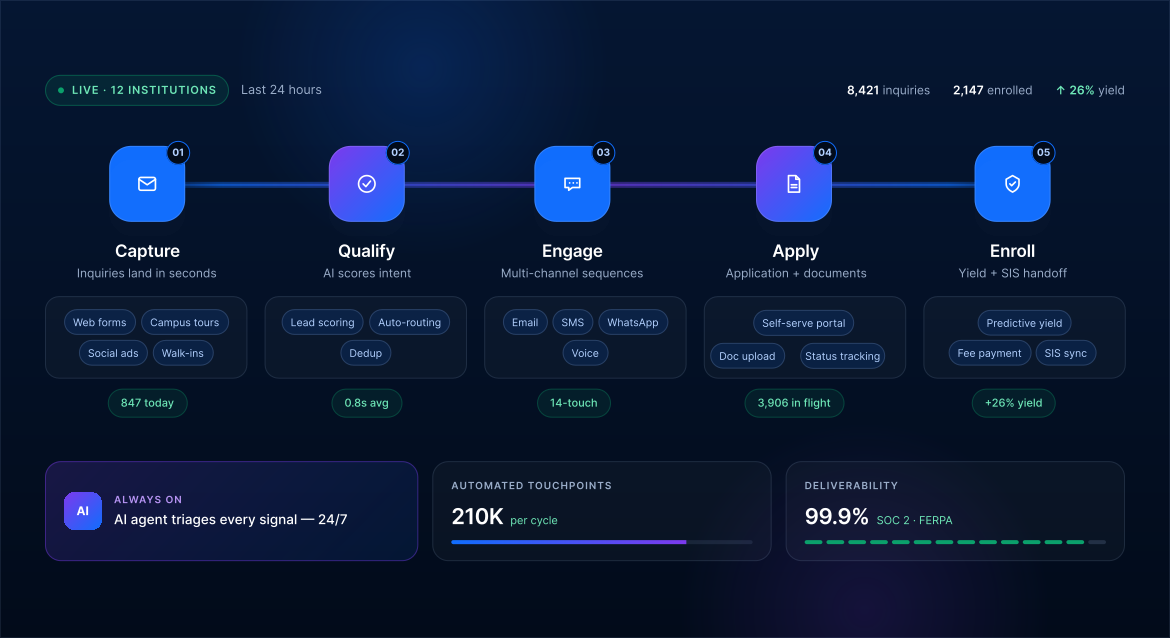
Text conversation in Mongoose Cadence → CRM pipeline (LeadSquared) → automated multi-channel nurture → enrollment
In practice:
That’s what an enrollment SMS CRM workflow actually looks like: conversations go in, enrolled students come out
What does a CRM do that Cadence doesn’t? Five workflows make up most of the value:
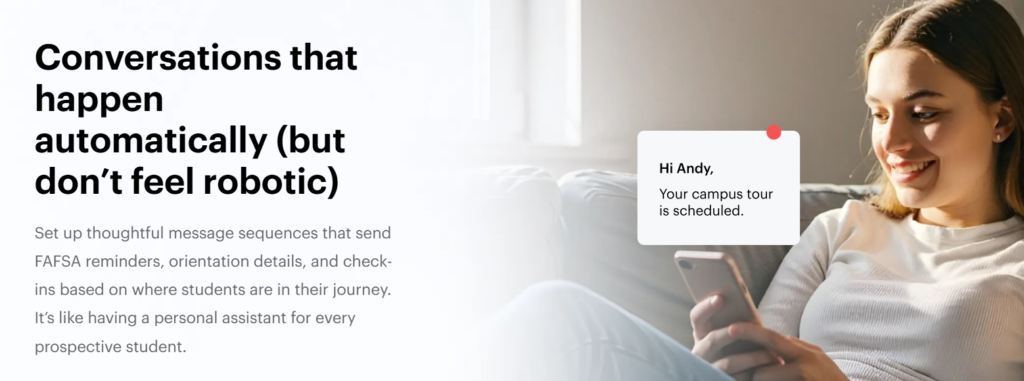
When a student opts into Cadence — through a campus form, QR code, event, or website chat — the CRM creates their record automatically. No export, no re-keying. From their very first text, the student exists in your system with full context.
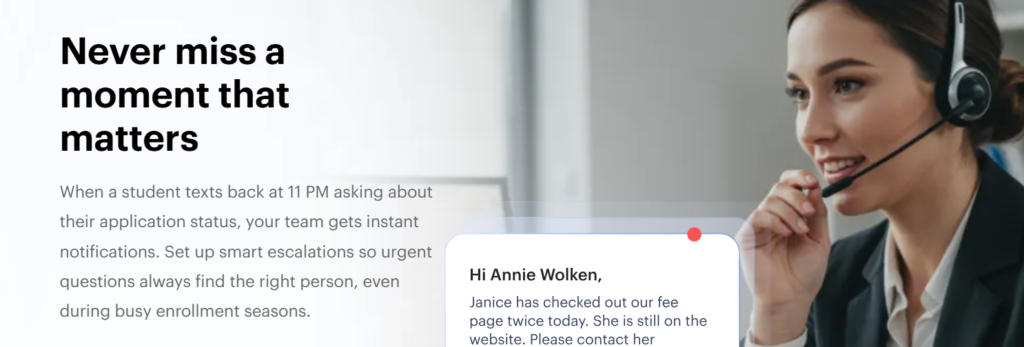
When a prospect replies, the CRM auto-routes them to the right counselor based on rules — territory, program of interest, application stage, language preference. The counselor sees the conversation, the student’s pipeline stage, and recent activity in one place.

The CRM scores prospects on text engagement (reply rate, response time, sentiment) alongside non-text signals (application progress, event attendance, financial aid inquiries). High-fit, high-engagement prospects rise to the top of the counselor’s daily list automatically.
When a prospect texts about applying but doesn’t submit within a defined window, the CRM triggers a multi-channel sequence — a follow-up Cadence text, an email with the application link, a counselor task to call. The student doesn’t fall through because the system noticed the silence.
The highest-impact workflow for community colleges. The CRM identifies deposited students who haven’t completed the next required step — orientation registration, FAFSA verification, course enrollment — and triggers tailored outreach through Cadence and other channels. Recent district-level data is sobering: in the School District of Philadelphia, 42.5% of the 2024-25 senior class with college plans didn’t enroll the following fall, up from 40.5% the year before, with two-year college-bound students and students of color hit hardest. Summer melt prevention text messaging is one of the most evidence-backed interventions there is — but only when it’s connected to a CRM that knows which student needs which message, and when.
The integration pattern is straightforward: Cadence pushes data to the CRM via webhook on key events, and the CRM pushes campaigns and lists back to Cadence via API.
Cadence → CRM (webhook events):
CRM → Cadence (API push):
LeadSquared can integrate with third-party platforms using standard API and webhook frameworks. If you’re looking for a Mongoose + LeadSquared integration or evaluating a Mongoose + LeadSquared deployment, the implementation approach and timeline will depend on the specific workflows you want to support, such as lead synchronization, communications, campaign triggering, or status updates. LeadSquared’s open API architecture is designed to support these integration scenarios.
Picture a 12,000-student community college that has seen summer melt rates of around 30% for the past three enrollment cycles. The admissions team has used Mongoose Cadence for several years and regularly texts deposited students, yet the melt rate has remained largely unchanged.
The challenge is not a lack of communication. It’s a lack of visibility into where each student stands in the enrollment journey.
Counselors send Cadence campaigns, receive replies, and work through conversations one by one. Meanwhile, many students who never respond still have critical enrollment steps outstanding. Some are missing FAFSA verification. Some have not registered for orientation. Others have not selected classes. The team can see conversations, but they cannot easily see the complete enrollment picture.
In a workflow where Mongoose and LeadSquared are connected, the admissions team could:
In this model, the communications platform becomes more effective because it is connected to a system that tracks progress across the enrollment journey. Instead of measuring only message activity and reply rates, the institution can evaluate outreach based on the enrollment outcomes it is designed to influence.
Mongoose Cadence is the right tool for higher-ed texting. It isn’t the right tool for managing an enrollment pipeline — and was never meant to be.
The schools getting the most out of Cadence pair it with a CRM that picks up where the conversation ends: Scoring the prospect, assigning the counselor, orchestrating the next message across email or voice, and tracking each student all the way through to enrollment.
For schools running Cadence today, a CRM like LeadSquared turns every text into a pipeline event — not just a conversation. That’s what a Mongoose Cadence CRM integration is actually for.
Want to see how Mongoose Cadence + LeadSquared works in practice?
We’ll walk through the text-to-pipeline-to-enrollment workflow, including melt prevention sequences for deposited students.
No. Mongoose Cadence is a higher education conversation platform designed for student engagement across channels such as SMS, chat, WhatsApp, and conversation analytics. It includes automation and AI features inside the text channel, but it’s not a CRM in the system-of-record sense. Its primary focus is student communication and engagement rather than comprehensive enrollment pipeline management, admissions workflow automation, and end-to-end CRM functionality. For those workflows, Cadence-using institutions layer a CRM alongside the platform.
Most institutions use texting at three stages: pre-application (event reminders, deadline nudges, inquiry follow-up), application (document collection, status updates, counselor outreach), and post-deposit (orientation reminders, FAFSA follow-up, summer melt prevention). Many institutions integrate texting into their CRM workflows so communications are tied to student records, application stages, and counselor activity. LeadSquared supports outbound and two-way texting as part of its communication tooling, offering an alternative to a standalone conversation platform.
Mongoose lists Slate, Salesforce, Ellucian, Workday, and Blackbaud as named native CRM/SIS integration partners. Other CRMs — including LeadSquared — connect via standard webhook and API integrations. Most modern CRMs can integrate through APIs, middleware, or webhook-based workflows. The question is which CRM gives your enrollment team the pipeline workflows that fit how they actually work. Implementation speed, multi-channel coverage beyond text, counselor UX, and scoring sophistication tend to matter more than whether the integration is “native”.
The evidence-backed playbook: Identify deposited students who haven’t completed the next required step (FAFSA verification, orientation, course registration), then run personalized outreach through text and other channels reminding them of what’s left. Castleman and Page’s foundational research found that text-based summer melt interventions cost roughly $7 per participant and increased enrollment by up to 7 percentage points — but importantly, later national-scale text campaigns by the same research network and others have shown mixed and even null results.
Institutions that are most successful typically combine student data, workflow automation, and personalized outreach. Whether messaging is delivered through a standalone texting platform or directly through the CRM, effectiveness depends on reaching the right student with the right next-step guidance at the right time.
There’s no universal answer — best depends on student volume, channel mix, integration needs, and budget. For community colleges, the variables that matter most are: Speed-to-lead (response time on inquiries), multi-channel coverage (text + email + voice + chat), summer melt prevention workflows, ability to handle high prospect volumes per counselor, and integration with the SIS already in use. LeadSquared is purpose-built for high-volume admissions and enrollment teams, combining inquiry management, workflow automation, counselor productivity tools, analytics, and multi-channel engagement in a single platform.
Enter your details and we'll send you a quick confirmation email to verify your address.
 12 min read 10 min read 10 min read



 CRM for Canvas LMS institutions: Winning students before they reach the LMS
