





- Home

- Learn
- Manufacturing
- WhatsApp + DMS Integration: Utilizing India’s Largest Communication Platform to Your Advantage
MANUFACTURING
WhatsApp + DMS Integration: Utilizing India’s Largest Communication Platform to Your Advantage
Contents

 17 min read


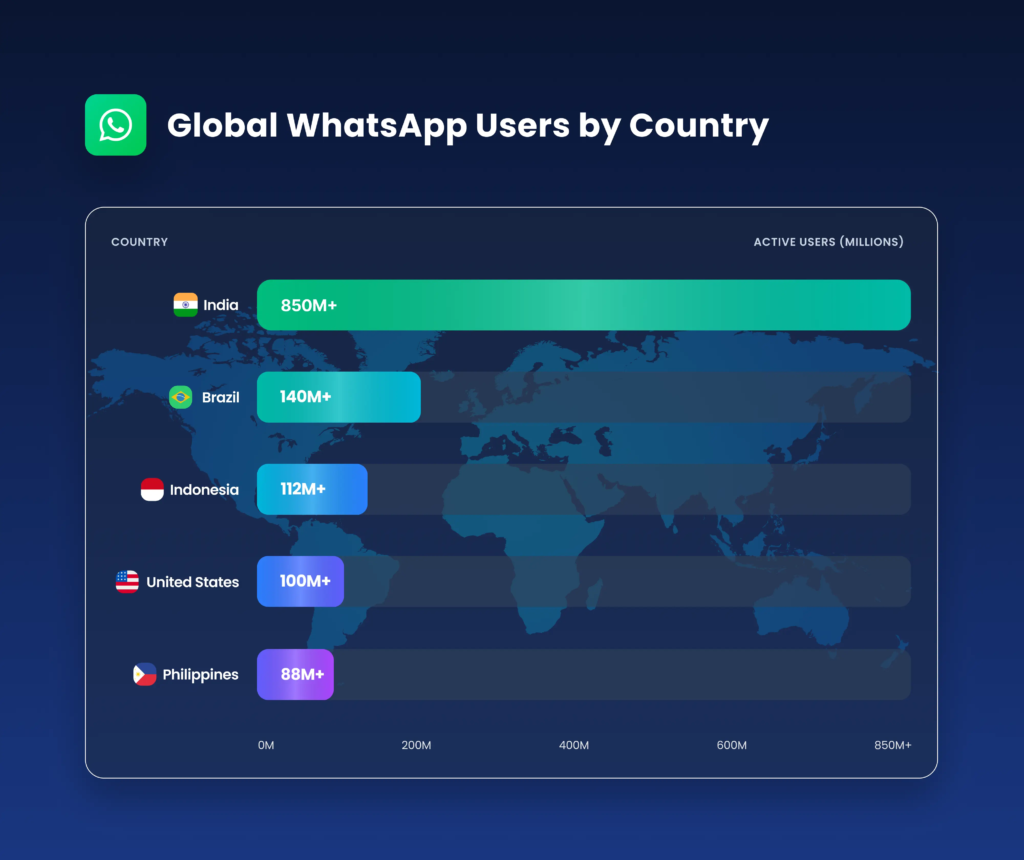
Over 800 million people in India currently use WhatsApp to chat with one another, making it the most widely used messaging platform. The first to adopt WhatsApp Business in 2018 were SMEs and D2C brands. They effectively utilized the platform to communicate with their customers, announce new product launches, and create catalogs, making it easier for customers to place orders conveniently. WhatsApp proved to be far more effective than email and SMS because of its exceptionally high open rates (~90%). This, in turn, was driven by the fact that people were already using WhatsApp for their day-to-day communication.
Gradually, more companies realized the platform’s potential and began using it for a wide range of use cases: updating customers on product deliveries, handling complaints, managing orders, and processing payments. The possibilities seemed endless.
Manufacturing companies with extensive dealer and distribution networks also started using WhatsApp to communicate with their partners: to share schemes, benefits, new product launches, order dispatches, manage quotations, and more.
Although it has been eight years since WhatsApp Business was launched, and saw a strong push for adoption, only a few companies have managed to truly optimize this channel to their advantage. As we work on dealer and distributor engagement solutions for manufacturing companies, we continue to see it remain underutilised.
This article provides a comprehensive overview of how WhatsApp can serve as a powerful tool for manufacturing companies with an extensive dealer network. How firms can boost dealer engagement and ensure they have easy access to information (catalogs, pricing data, order history, etc). It also outlines how to select the right WhatsApp Business vendor and design customer-friendly flows to drive adoption and engagement.
In India, managing a dealer network is quite complex, and orders are usually placed at the last minute through phone calls. Dealers or distributors typically contact their go-to salesperson, from a specific manufacturer, to place an order.
However, from the salesperson’s perspective, there’s a lot to process. This includes sharing the quote with the dealer and ensuring that there’s proof of acceptance from the vendor. They also must enter the order into DMS, update the vendor on delivery timelines, and later inform them about the scheme and their goals.
So, time is of the essence when it comes to communication, and WhatsApp has become the go-to platform for it. Plus, here are a few more ways manufacturing sales teams might use WhatsApp for:
These are just a handful of examples. When it comes to using WhatsApp in the manufacturing space, you can segment the communication flow into 4 different categories.
Commercial discussions with dealerships are never a linear process. They have questions about the products, schemes, and incentives. Also, they request quotations for different quantities across various product verticals.
Queries related to stock availability, order modifications, delivery updates, billing clarifications, catalogs sharing, and more directly impact the sales.
This is where WhatsApp comes in – a tool that allows quick coordination with dealers on all important things.
WhatsApp is crucial to manufacturing companies because they sit at the intersection of revenue and partnerships. However, all these chats currently occur outside the formal systems and governance, which makes it risky and difficult to track the conversations with dealers and distributors.
Sales for automotive brands rely heavily on quick responses and timely follow-ups. This demonstrates that the brand values its customers, which in turn impacts the brand loyalty. WhatsApp has allowed dealerships to engage with customers faster. If an inquiry comes in, automotive brands can run a simple automation that informs the customer that a representative will contact them shortly.
Again, this is just one piece of the puzzle; automotive brands now manage test drives, document collection, and insurance policy discussions all through WhatsApp.
The issue is that there are many active conversations and informal commitments (like negotiations, queries about the service, follow-ups, and quotations on different models) that often go unrecorded in the DMS. Consequently, the DMS offers an incomplete picture of the sales funnel. It’s either black or white, and it overlooks the crucial grey areas. One such example is when the salesperson must share multiple rounds of quotations with the customer before the deal is closed. where all these informal discussions are still happening with customers.
Service experience is central to customer trust, and today, that trust is being built on WhatsApp.
From service reminders to vehicle pickup updates, order-related issues, and other customer support queries, all important communication is being carried out on WhatsApp.
But here’s the challenge: the conversations are mostly unstructured, which makes it hard to see the complete picture of customer complaints. Teams lack visibility into the types of issues that frequently arise, their frequency, and the resolution times.
This directly impacts loyalty, brand perception, and customer satisfaction with issue resolution.
Sales, support, operations, and finance teams constantly collaborate to either onboard new dealers, engage with the existing ones, or resolve issues. These issues may be related to document verification, dealer credit checks, order status, and more. WhatsApp makes it easy to exchange information and communicate with different teams instantly.
Even though these conversations hold important information, they don’t have any official record. Approvals and customer information exchange occur in private messages, and then salespeople must go back and enter this information into the CRM to maintain order. Over time, these administrative tasks consume more time than they should, becoming counterproductive.
The real problem is that once the scale increases, things become complicated. If your communication procedures aren’t set up correctly, and there’s no middleware to support that communication, you can’t realize the full potential that WhatsApp has to offer.
What happens if you don’t configure WhatsApp to handle communications at scale?
WhatsApp conversations with dealers and distributors usually happen on a salesperson’s personal number or, for visibility, a group is created with all the dealers to inform them about new product launches, schemes, etc. This method is manageable when you have 10 – 12 dealerships to update.
But what if there are 3000 dealerships across India? How does anyone know if dealers are getting timely responses? Several critical questions often remain unanswered: Which specific quotation led the dealer to place an order? What kinds of complaints are being raised repeatedly?
Without a proper system, leadership will never have clear visibility into what is being communicated to dealers.
WhatsApp provides only the phone number and profile name of a dealer. While this information is essential, it doesn’t include the dealer or outlet ID, territory or region, credit status, order history, or open tickets. Most importantly, it doesn’t capture the relationship history.
On a small scale, such as 20 dealers, this might not seem significant. But when managing 20,000 dealers, this lack of context becomes a significant issue. Without these details, managers lose visibility into patterns; for example, which dealers face recurring issues, why certain products sell better in specific regions, or which territories are struggling.
If conversations happen on salespersons’ personal numbers, it becomes difficult for the new rep to pick up where the previous one left off.
When a phone number changes or an area manager is replaced, all past conversations with the dealers are often lost. So, in case of a resignation or reassignment, critical knowledge about the dealers in their network leaves with them.
Eventually, this leads to dealers having inconsistent experiences with the company.
When companies say, “our WhatsApp is connected to the DMS,” there are various degrees of integration at play. You can connect your DMS with WhatsApp for simple messaging or engage in conversations with dealers and consumers from DMS as well. Here’s a look at that:
Notifying customers about new product launches, pricing updates in the product catalogs, new scheme information, or the ticket ID when dealers raise a service request. These are some of the basic capabilities that manufacturers must have on WhatsApp.
This means that the communication is one-way; you’re just sending messages from your WhatsApp business account, and there’s no back-and-forth interaction. This poses a risk if a customer attempts to contact you about an issue or makes an inquiry, because no one in your team will be alerted about it.
There are reports to evaluate the WhatsApp campaigns currently in progress, and a bot is set up to handle some basic queries. However, if something falls out of the bot’s capabilities, it takes a while to route the issue to the appropriate agent handling the dealer/customer.
It is an improvement over the previous version – at least conversations are now visible and linked to the relevant dealer/customer who made an inquiry or service request. That said, the TAT for resolving these queries remains high, and extracting and passing along information from these chats can be quite challenging.
The conversations on WhatsApp are back and forth. That means these interactions are linked to the lead, and there is a seamless handoff from the bot to the salesperson responsible for handling the dealers.
To enable two-way communication, you need to have a simple architecture in place for the sales teams: “WhatsApp + CRM + DMS.”
DMS excels in storing operational data, such as dealer codes, order status, inventory, and, to some extent, the dealer information as well. However, it’s not designed for customer interactions. Today, integration is possible; you can send out scheme updates, track orders, share QR codes for easier payments, share quotations, and more. But the sales/service representatives are not instantly notified when someone responds to the message sent.
This is also one of the reasons companies adopt a CRM when scaling their operations, as it acts as a bridge between WhatsApp and DMS. It’s perfect for the sales reps interacting with dealers in the field—those who need the complete customer profile in their hands. Previous quotations, pending payments, scheme eligibility status, orders, and delivery status are all made available to the salesperson.
To streamline and improve dealer engagement, WhatsApp provides several key features. When these features are utilized across your dealer network, you’ll notice an increase in orders and easier communication within your network.
In the WhatsApp Business app, a catalog is where you list your entire product category, giving dealers/distributors to browse and find specific products in an organized way through WhatsApp, rather than scrolling through unstructured lists.
It transforms WhatsApp from a freeform messaging tool into a structured commerce interface, where dealers can effectively discover and inquire about products.
Quick replies in WhatsApp business will allow you to save and organize FAQs that can be used to resolve basic queries asked by the dealers. The automations save a significant amount of time for team members, as they operate completely based on the flows already set up to address commonly asked questions by dealers and distributors.
When you’re deploying WhatsApp Business for enterprise use cases, labels correspond to actual workflows in the CRM. For example, a conversation labelled as “Awaiting response from dealer” or “query resolved” could trigger a backend action to move the deal to the next stage.
Managers can review all conversations by labels to analyze pipeline stages and identify areas or territories that are underperforming. They become integrated into the business logic of how conversations are managed.
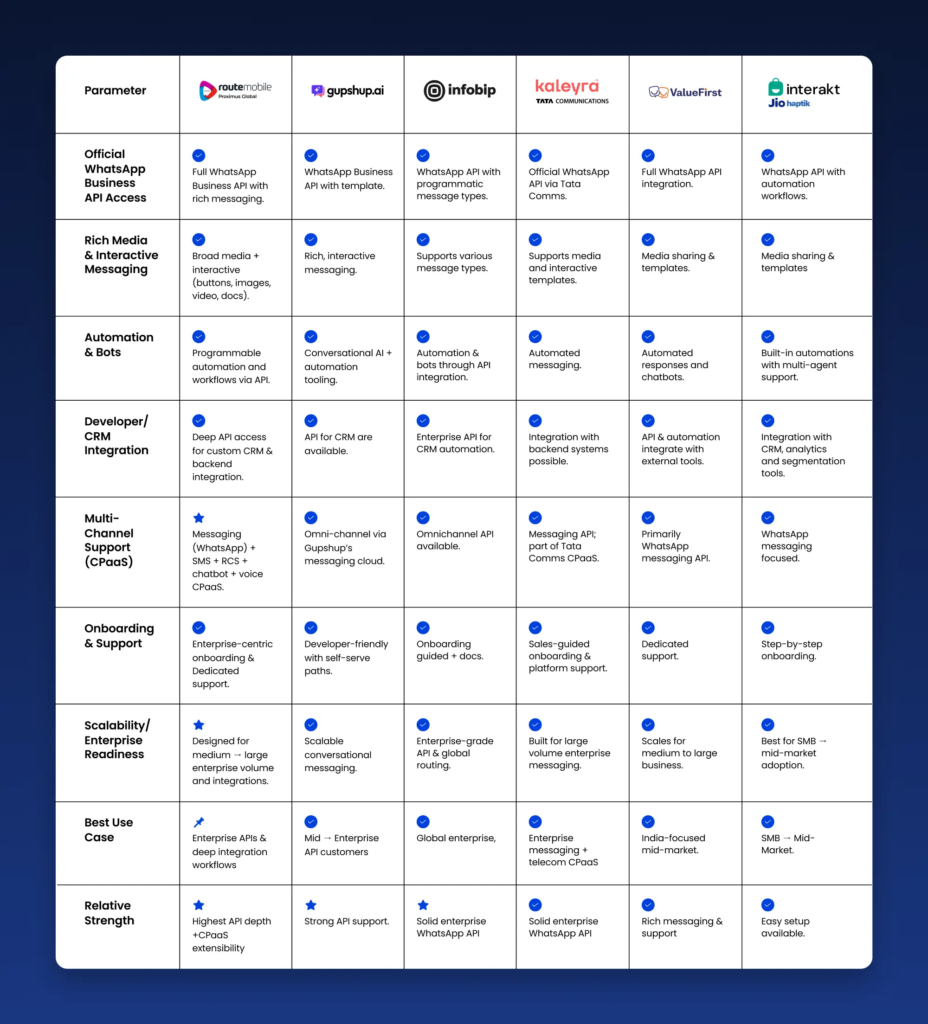
To build a reliable WhatsApp infrastructure, the key component is to choose the right service provider. It impacts the campaign performance, template approvals, compliance, and support. Here’s how you can choose the right service provider based on your business needs.
If you’re managing WhatsApp communications for an enterprise manufacturing firm, offers and scheme-related information need to reach thousands of dealers simultaneously. You’re handling high volumes of back-and-forth messages. Therefore, you need to consider options that can meet these expectations. RouteMobile is one of the best options available. They offer robust APIs, their support is excellent, and they’re also highly compliant with the WhatsApp guidelines.
If you’re not looking at big volumes, and the dealer ecosystem consists of 200-350 dealers/distributors, and you want to keep interactions regular and seamless, then look out for vendors that offer the ability to build workflows that are easy to customize and publish, also make sure they are compliant with the WhatsApp Business guidelines.
You must be cautious when evaluating an aggregator before opting for them as a service provider, as they often oversubscribe or have poorly designed systems. This will directly impact your send and open rates of the campaigns.
Most manufacturers in India prefer enterprise-grade BSPs because they operate on a large scale, and Meta is also very strict with guidelines.
Inconsistencies in responses will decrease significantly, and dealers will receive uniform responses regardless of region. The responses will adhere to the same standards and SLAs established by leadership teams.
Almost instantly, managers will be able to see the nature of WhatsApp interactions and based on the volume, categorize them. This will help them better understand their territories — such as which products are being sold the most, at what price points, and how new launches are being received. That visibility means no more decision-making based on hearsay.
Most issues get resolved early because the system (CRM) nudges them to respond to customer queries. Proactive communication keeps dealers and customers up to date and directly improves CSAT.
Saved the best for last: once a sales or service representative leaves or quits their position, the business in that territory won’t slow down or stop because someone else seamlessly picks up the chat thread in the CRM interface. If a territory manager changes, their conversations with dealers are not lost, and that’s a big win for business continuity.
In summary, you’ll quickly notice that the integration enhances good communication discipline across all customer-facing teams. However, just plugging in all three components together won’t instantly make your organization perfectly efficient. You will identify the weak spots because the system will reveal them, and with some managerial effort and oversight, you’ll be able to address them. Overall, you’ll be ahead of the curve compared to others.
For manufacturing organizations in India, WhatsApp is already integrated into their daily operations. The companies that are getting ahead are using it as a strategic tool, making it a measurable part of their dealer activities.
A WhatsApp + CRM + DMS integration infrastructure turns this WhatsApp medium into a scalable system. It enables you to have conversations with 100 or 10000 dealers within a framework that supports growth.
Because more than 800 million poeple use WhatsApp for day-to-day communication, with an instant reach, and ~90% open rates, and it’s easier to coordinate compared to email or SMS.
Conversations between the salesperson and the dealer stay hidden in personal chats, which also leads to poor governance. One more crucial element is the loss of sensitive information (quotations, pricing data, product catalogs, and more).
Yes, DMS stores all the operational data such as dealer codes, product codes, inventory level, billing information and history. It’s not built to track conversations that sales have with dealers and distributors. CRM acts as an orchestration layer that facilitates two-way communication, alerts sales teams when necessary and maintains complete information about dealers.
The provider should be compliant with all the meta guidelines; Enterprise manufacturers should prefer API-first BSPs with the capability to scale and provide support.

 13 min read
  12 min read 16 min read



 How to re-engage and re-enroll stopped-out students at scale: Strategies that...