





SALES
Incremental Sales [Formula, KPIs, And Best Practices]
Contents

 10 min read


How do you know your marketing or a sales promotion campaign was effective? How many more customers were you able to win?
While you might already be tracking campaign metrics, one method that can help you evaluate the effectiveness of a campaign and measure the success more objectively is incremental sales.
This article describes the basics of incremental sales, the formula to measure it, KPIs, and the ROI you can expect.
Incremental sales is a metric or KPI that gauges the efficacy of a marketing or sales promotion campaign. It calculates the difference between the sales you made during a promotion and the sales that you would have made if there was no promotion running during the same period.
A simple formula to calculate incremental sales is:
Incremental Sales = Total Sales – Baseline Sales
Here, two key terms are baseline sales and total sales.
Baseline sales is the amount of revenue you would have generated without a promotion or a marketing campaign. It is an important metric in the incremental sales formula since it defines the status quo. Campaigns where incremental sales metric matters the most are seasonal offers like Black Friday sales, or when you test a new marketing channel, and want to assess its effectiveness.
Total sales is, of course, the overall sales you make for the specified period when the said campaign was live.
Let’s say a retailer expects to sell $50,000 worth of sports accessories in a month without advertising.
The retailer launches an influencer campaign that costs $20,000 and sells $80,000 worth of items.
In this case, incremental sales will be $30,000:
Incremental sales = $80,000 – $50,000
= $30,000
Please note, incremental sales is different from the marketing ROI. Here, the goal is to evaluate the additional revenue generated from promotional campaigns.
To accurately measure incremental sales, you must know your baseline sales. Then look at how many new customers you acquire during a campaign. You can look at up using your CRM solution.
Note that companies differ on what they consider as “new.” A customer can be new if they have never interacted with your brand before. Some brands consider them new if they have not made any purchase in the last six months or a year.
Some businesses enforce the single source rule. Suppose you have an affiliate marketing program. When the customer buys through the affiliate link, then only it will be counted as an incremental sale.
A catch here is, the customer may be influenced to buy it via the affiliate program but does not use the link to make the purchase. So, even though the program led to the sale, the business will not consider it as an incremental sale.
The incrementality test is one way to gauge your campaign performance. This test is similar to medical tests where the test group gets the actual drug, whereas the control group gets a placebo. This test allows you to see which method performs better. The results can even help you tweak your campaigns to be more effective and eventually drive up your sales.
According to Trevor Testwuide, Co-founder and CEO of Measured, Incrementality indicates the portion of last touch conversions driven by media.
Incrementality = (Test Conversion Rate – Control Conversion Rate) / (Test Conversion Rate)
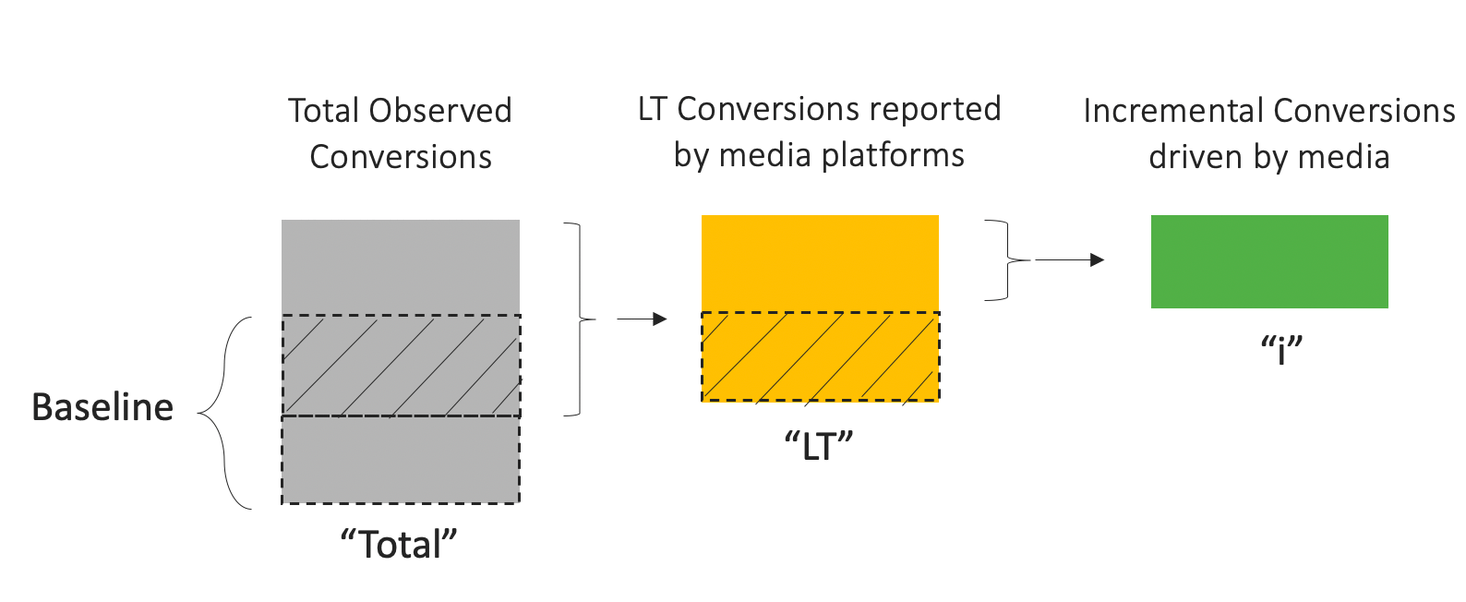
Where, LT = last touchpoint or channel that a user interacted with before converting on your site.
Because of other variables in brand marketing, you may also want to consider the following factors while calculating incrementality.
It is the percentage of revenue that a partner brings in by being the first point of contact of the customer. It could be an affiliate partner or a marketing campaign partner. The first-touch percentage allows you to understand how a partner indirectly drives the revenue even though they may not be the last touchpoint. An example of this could be influencer marketing. The customers see an influencer using the product or the service. Customers can then do further research and make the purchase separately.
It is the revenue you won because of a partner, but the partner was not credited for it. Generally, partners are paid on the basis of the last-touch structure.
It is the revenue you get from an affiliate where the affiliate partner interacted with the customer at some point during the sales process.
This metric is the best way to see the effectiveness of a marketing campaign or an affiliate program. However, this metric also heavily depends on how a brand defines its new customer. For instance, a loyal customer may be influenced to purchase because of a marketing campaign, but the brand may not consider that at all.
The quick conversion rate lets you know when a lead makes a purchase in a few minutes after the last referral click. Brands generally prefer a longer conversion rate. A quick conversion often means that the customer is actively searching for a coupon code, and the business may lose money in that case. Say, for example, a customer wants to purchase a subscription for software. They go online and search for coupon codes for that software. They find the promo code from an affiliate link and make the purchase. The company can lose out money on that sale, and they also need to pay the affiliate partner a commission for that sale.
All these metrics help you understand incrementality, the factors that increase sales, and where you need to focus more. While the incremental sales metric gives you an overview of how effective a campaign was during a particular period, the other metrics listed above help you dig deep.
It is obvious that the higher your incremental sales numbers are, the better your business is doing. It shows that your marketing campaigns are effective, your sales team is doing equally well, and you are efficiently converting leads into customers.
In contrast, if you’re not getting the desired ROI from your campaigns, you might want to backtrack some KPIs.
The incremental sales KPIs will help you identify shortcomings and increase your profit margin by improving them. You may find that you are paying commissions for leads that you would have gotten anyway. These are expenses that you can eventually skip. Thus, you can increase your profit while making the same number of sales.
When you accurately measure incremental sales, you will be wiser in your marketing spend. If you see that your marketing efforts are working, then you can increase your ad budget too. If your conversion rate is not improving, you can decrease your ad budget and focus more on sales efforts.
Also read:
Before you start measuring incremental sales, look at other KPIs that influence your incremental sales. Also, look at average purchase value, cost of goods sold, and more. While you cannot plug in these KPIs directly into the Incremental Sales KPI, it will give you an intuition of how you can improve your sales metrics.
Improve your marketing collateral, target specific audience groups, and engage more with customers. It will give you a better overall experience with your marketing efforts.
See which channels work better for your business. Different target audiences are reachable via various social media platforms. Look at related metrics to see which platforms offer a better return on investment.
Customer behavior and social media trends can change in an instant. Therefore, your marketing efforts should adapt to these changes too. Be aware of the changes in marketing trends and consumer behavior. Do not shy away from trying a new marketing technique, as trial-and-error is the best way to form an effective strategy.
When you create a marketing strategy, test and analyze the results. Look at your incremental sales values and check other related metrics as well.
While incremental sales give you a concrete idea of how well your marketing efforts are working, other numerous metrics will help you understand the various facets of your marketing and sales efforts.
If you want to keep a tab on your sales performance, campaigns, channels and gain better customer insights, you must consider a CRM. Take LeadSquared for a test spin and see how it takes your sales to the next level.
While both metrics evaluate campaign performance, they measure different things. Incremental sales tells you how much additional revenue a campaign generated beyond what you would have earned anyway — it focuses purely on the volume of extra sales. Marketing ROI, on the other hand, measures the profitability of a campaign by comparing the net profit generated against the money spent on the campaign. You can have high incremental sales but a poor ROI if your campaign costs were too high. Using both metrics together gives you a complete picture of campaign efficiency.
Baseline sales — the revenue you’d have made without any campaign — can be calculated using several approaches. The most common method is to look at your historical sales data for the same period in previous years and adjust for seasonal trends or market growth. Another method is to use a control group: run the campaign for one audience segment and withhold it from a similar segment, then treat the control group’s sales as your baseline. The more accurately you define your baseline, the more reliable your incremental sales figures will be.
There is no universal benchmark, as a “good” incremental lift varies widely by industry, channel, and campaign type. In retail, a 10–20% sales lift from a promotional campaign is generally considered strong. For digital advertising, even a 5–10% lift can be significant depending on margins. The key is to compare your incremental lift against your campaign cost — if the additional revenue comfortably exceeds what you spent, the campaign delivered value. Tracking lift percentages over time across different campaigns also helps you set internal benchmarks specific to your business.
Organic sales refer to revenue generated through natural customer demand — purchases that happen without any active promotional push, discount, or marketing campaign driving them. Incremental sales, by contrast, are the additional sales generated specifically because of a campaign or promotion, above and beyond what organic demand would have produced. Separating the two helps businesses avoid a common mistake: crediting a campaign for sales that would have happened anyway, which leads to inflated ROI estimates and poor budget decisions.
Enter your details and we'll send you a quick confirmation email to verify your address.

 19 min read
  17 min read
  8 min read


 Top 10 HealthTech Companies In The United States
