





EDUCATION
How to make your admissions counselors more productive and increase enrollments
Contents

 18 min read


A lot has changed in the last few years for college admissions.
With more institutions entering the market and online learning becoming mainstream, students have far more options to pursue higher education than ever before. In fact, more than 5.7 million students enrolled exclusively in online programs in 2024.
Amid this changing environment, admissions counselors face a pressing question: How do you attract the right students, evaluate applications efficiently, and communicate with prospective learners in a way that truly stands out?
To find the answer, LeadSquared spoke with admissions leaders from top higher education institutions across the United States. Their insights revealed key gaps in the traditional enrollment process – gaps that can be bridged with the right technology. That’s where solutions like an Admissions CRM comes in, empowering teams to meet their recruitment targets.
With the landscape of higher education shifting rapidly, having a well-thought-out admissions strategy is no longer a luxury—it’s a necessity. Let’s look at how a focused plan can give admissions offices an edge:
Developing a strategic plan future-proofs your admissions efforts, helping you not just hit your numbers, but build a thriving, mission-driven student body.
Here’s the deal—while admissions offices might steer the recruitment ship, it’s the richness of a school’s programs and academic leaders’ passion that draw students in for the long haul.
When admissions professionals regularly connect with department heads, faculty, and coaches, a few great things happen:
Even small steps—like inviting faculty to participate in open houses or Q&A panels—let prospects see the real people who will shape their college experience. After all, students and families are eager to meet those who will guide and inspire them.
Bringing admissions and academic leaders together doesn’t just strengthen presentations; it helps create a more authentic, compelling narrative that resonates with today’s discerning applicants.
For deeper insights, you can listen to enrollment experts – Tom King and Lexington Maximus from The Art of Admissions.
Or, take this short-cut: scroll to read the takeaways below!
While colleges are spending time recruiting reps, they don’t always have the right resources to optimize their performance. This seemingly simple shortfall leads to unfilled classes.
The following tips can help admission officers in better recruitment.
Getting hold of a student, setting an appointment, and ensuring they show up is, no doubt, difficult. It is also the most important part of your enrollment cycle.
Once they show up, it’s relatively simple to get them excited with virtual or in-person tours (especially if they are even slightly interested in your program). If you can master the “lead capture to show up” process, you can expect a massive increase in your enrollments.
However, when we asked admission officers what KPI(s) are most important for your admissions team, 65% of them responded – number of starts.
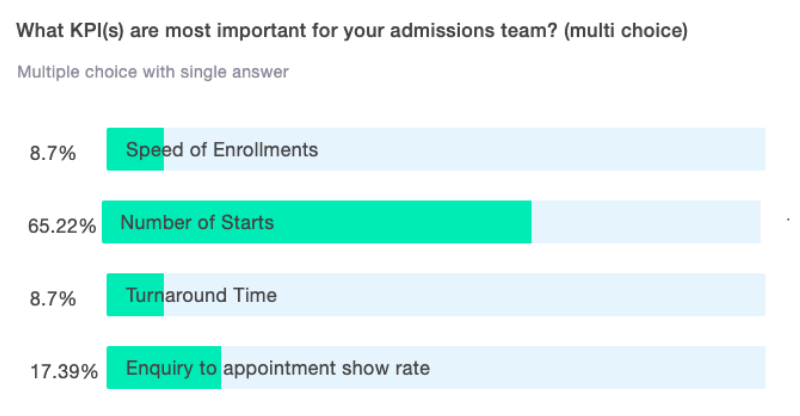
We get the impression that admission counselors are more focused on the results, whereas they should focus on the KPIs that will bring those results.
Career schools and colleges that successfully meet their admission targets focus on the following KPIs.
Once you start tracking these KPIs, you will know exactly where the problem is. For example, if your appointment show rate is low, you’ll devise measures to fix that. You can send a reminder SMS/WhatsApp text to the students about the appointment schedule and reduce the instances of no-show.
This way, by monitoring individual KPIs, you can identify and address bottlenecks, ultimately leading to a higher number of admissions. e more admissions.
Many times, institutions have a chaotic, unstandardized follow-up process. They often don’t know where the inquiry is coming from and who is following up with them. It is also the reason for a low inquiry-to-appointment show rate.
When we asked higher-ed institutions about their inquiry-to-appointment show rates, 58% of schools have an inquiry-to-appointment show rate below 30%.
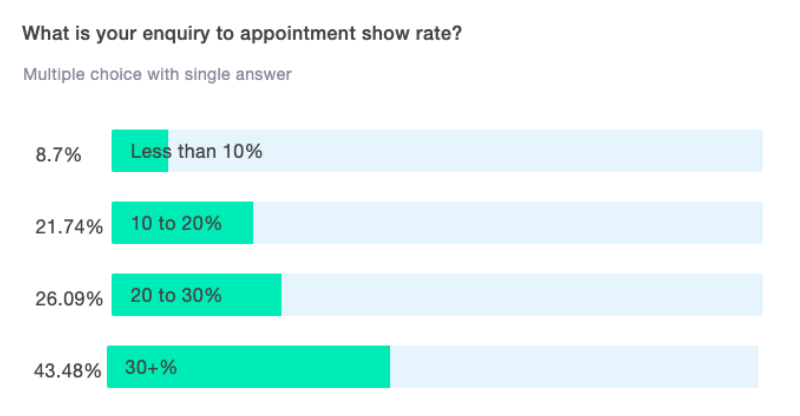
Most admission reps want to maximize their “Appointment Set” rates. But not all of them are good at appointment setting. It’s not that they’re not putting in the effort. The gap is because they are not trained for such tasks. Also, because they are doing everything else – engaging with prospects, doing paperwork, getting the enrolled students started, and 100 other tasks – they don’t have enough hours a day to set appointments.
Solution: To let your staff focus on a dedicated task, split your admissions team to handle the following tasks. This approach is key to increasing productivity and outcomes for your admission counselors.
So, when your staff/team members are able to do their tasks proactively, you’ll observe better results.
When it comes to increasing student recruitment, your school’s community is your secret weapon. Students, parents, alumni, and even teachers can become natural advocates—no fancy marketing budget required! After all, who better to tell your school’s story than the people living it every day?
Here’s how you can put that community power to work:
Word travels fast when people are genuinely excited. The reality is, prospective families trust real stories from real people more than they trust glossy brochures. Tap into your school’s living network—and watch your enrollment conversations begin where they matter most: in the community.
In our survey, we found out that 40% of schools do not have a pre-defined contact cadence. Only 10% of schools have a set script (a specific sequence of emails and call scripts).
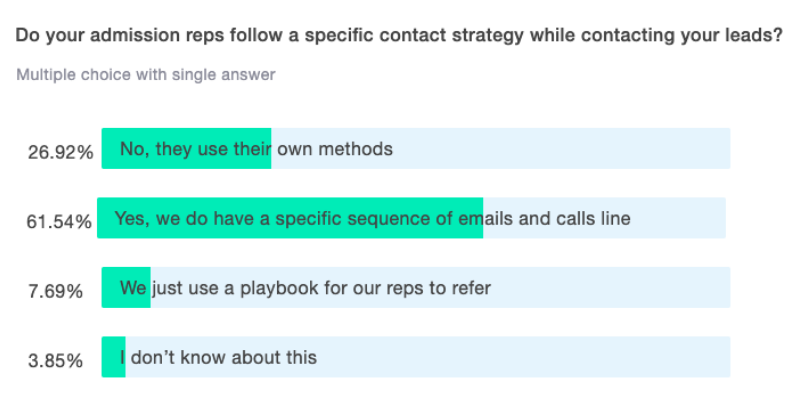
If you let your reps use their unique methods every time, you will never know what works best. If your team doesn’t know what to communicate, there’ll be inconsistency and ambiguity in your messaging.
So, brainstorm and create a plan (with scripts, replies, resources) before the enrollment season. Share all the materials with everyone involved in the admission process.
To sum up:
42% of schools have an appointment-to-enrollment rate below 30%.
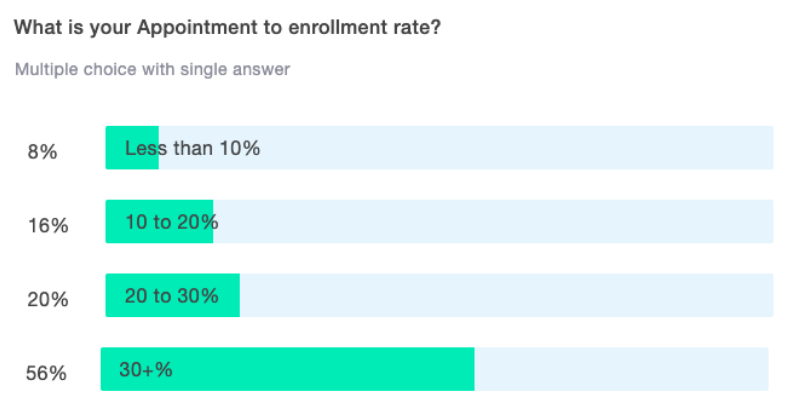
Campus tours exist to attract students with the look and feel of the college. Without this, schools may witness drop-offs from their admissions funnel.
However, you can still focus on virtual presentations and campus tours and recreate a similar experience. We have seen virtual presentations increase the lead-to-show rate by 29% and the lead-to-application rate by 19%. Virtual presentations are much easier as compared to in-person interactions. They can be fun, are much faster and compliant. Here are the best ways to do virtual presentations:
With a helpful presentation, you can influence students to apply and enroll.
Admissions isn’t just about numbers—it’s about creating a memorable journey for prospective families. Every step, from the initial inquiry to signing the enrollment form, leaves a lasting impression about your school’s culture and values.
Here’s how you can ensure a positive experience every time:
Remember, a smooth admissions experience doesn’t just help fill seats—it encourages positive word-of-mouth and builds foundations for long-term relationships.
In general, because of the lack of a streamlined process, admission officers don’t have complete ownership over leads. That is why the instances of missed follow-ups and lesser enrollments are important.
A simple way to make your team accountable for their tasks is to track their performance regularly. However, not all institutions do that. We found out that nearly 40% of higher-ed institutions generate reports manually (through excel sheets).
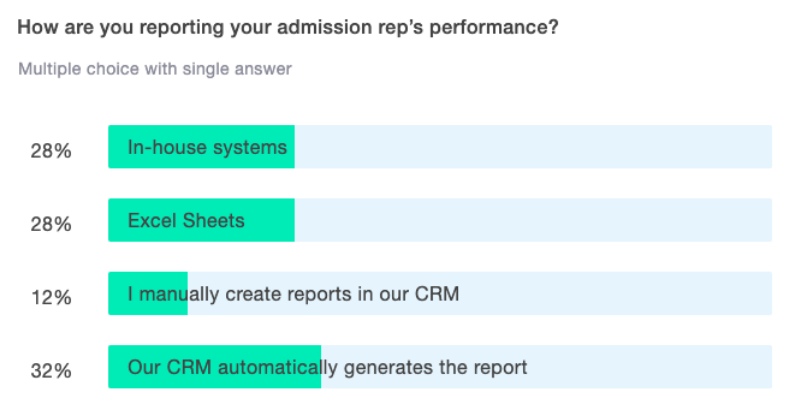
But if you see, tools like a higher education CRM provide automated reports that can save hours spent navigating excel sheets. It is also the success mantra of many renowned institutions. These tools are essential for increasing productivity and outcomes for your admission counselors.
So, get an admissions CRM that lets you customize and generate daily activity reports with just a few clicks. You can create custom dashboards and see just the information that matters to you and remove the rest of the noise.
To make your task easy, here’s something a happy client had to say:
“With LeadSquared, our contact rate went up by 13%, and scheduled campus appointments improved by 5%”
– Kim Gasper, Corporate Director of Marketing, Asher College.
Try LeadSquared.
Making your admissions counselors more productive starts with streamlining their workflow and removing non-essential tasks. Split your team into specialized roles: dedicated appointment setters, admission reps focused on student interactions, and student coordinators handling paperwork.
Equip them with a CRM system that automates reporting, tracks KPIs in real-time, and provides clear dashboards. Implement standardized contact scripts and follow-up sequences, so counselors spend less time deciding what to do next and more time building relationships.
Finally, track the right KPIs—lead contact rate, appointment show rate, and application rate—so you can identify and fix bottlenecks quickly. When counselors have clear roles, the right tools, and data-driven guidance, productivity naturally improves.
An admissions representative is a staff member at a school or college who works with prospective students throughout the application process.
Admission counselors can use LeadSquared to centralize communication. LeadSquared’s Admissions CRM centralizes all student communications—phone calls, emails, text messages, WhatsApp, and social media—into one unified platform where counselors can view complete interaction history with each prospect.
Successful enrollment isn’t a lucky break—it’s built on a set of intentional, actionable strategies. Here are foundational approaches that can strengthen any private school admissions plan:
Define your ideal student and tailor your message.
Avoid broad, generic outreach. Build a clear profile of the students who thrive at your school—academically, socially, and culturally—and shape marketing and communications around what matters most to those families.
Use data, not intuition.
Track the full enrollment funnel: inquiry-to-visit rates, application completion, decision timelines, and yield. Identify where families stall or drop off. Admissions CRMs like LeadSquared, Slate, or Blackbaude make this easier and enable quick, targeted improvements.
Partner beyond admissions.
Your strongest recruitment assets are your academic and extracurricular programs. Collaborate with teachers, coaches, and program directors to showcase successes, participate in events, and help families visualize fit.
Balance digital strategy with traditional outreach.
Ensure your website, social content, and emails are clear, segmented, and action-oriented. Use videos, stories, and testimonials. Combine this with community presence, print materials, and events to reach families through multiple channels.
Make the process personal and simple.
Respond quickly, streamline forms and scheduling, and keep communication warm and human. Add small personal touches—handwritten notes, follow-up calls—that make families feel seen and valued.
Activate your community.
Families, alumni, students, and staff are powerful advocates. Encourage referrals, shareable invites, and recognition for those who bring in new prospects.
Stay flexible with timing.
Not all families begin their search in September. Offer rolling or mid-year admissions and have a smooth onboarding process for late entrants.
Colleges must expand their thinking beyond the traditional fall intake. Students and their families are more mobile than ever—life circumstances, transfers, and fresh priorities can prompt a search for new educational opportunities at any point in the year.
By keeping the doors open for rolling and mid-year admissions, schools demonstrate both flexibility and responsiveness. This not only helps fill sudden vacancies but also builds positive relationships with families navigating transitions. Ensuring that your admissions staff is prepared to guide students through this process smoothly, and providing onboarding resources tailored for mid-year entrants, positions your institution as welcoming and adaptable.
In this fluid educational landscape, embracing such flexibility could mean the difference between missing out on strong candidates and creating a more dynamic, diverse student body.
A unified message between admissions and academic departments can make a real difference in how prospective students and families perceive your school. Start by building stronger relationships between your admissions team and key academic leaders—think department heads, program directors, and faculty members. Regular catchups or quick meetings can go a long way toward keeping everyone on the same page.
Make it a point to share each department’s goals, recent successes, and student outcomes with your admissions reps. This way, admissions can confidently communicate program strengths and answer detailed questions during tours, open houses, and interviews.
You might also consider inviting faculty to participate actively in admissions events. Hearing directly from teachers or program leads often gives prospective families a deeper, more authentic sense of what your school offers. Use their stories and insights to enrich your brochures, videos, and website content, ensuring that every touchpoint highlights what makes your programs truly unique.
By having easy, ongoing communication—and sharing knowledge between teams—you can ensure that families experience a consistent, compelling story about your school from their very first inquiry.
To boost enrollment, start by strengthening your website—your school’s digital front door. Make it easy to navigate, up-to-date, and focus on what families care about most: curriculum, campus life, and student support.
Expand your reach with targeted social media campaigns aimed at specific groups, and share compelling content like success stories, testimonials, and short videos or live Q&As.
Use segmented, personalized email campaigns to guide families through their decision-making process, highlighting events, programs, and opportunities that match their interests.
Don’t overlook traditional channels—local publications, mailers, and community billboards still build credibility and reach audiences who may not be active online.
Blend digital strategy with traditional outreach to stay visible, build trust, and connect with families at every stage of their enrollment journey.
You can ensure counselors consistently meet admissions targets by combining clear goals with real-time visibility and automation. LeadSquared helps set measurable targets, track counselor activity and outcomes, prioritize high-intent leads, and trigger timely follow-ups—so counselors stay focused, accountable, and on track to convert more students.
Start by aligning both teams around shared funnel metrics, SLAs, and clearly defined handoffs. Automate lead capture, routing, follow-ups, and nurturing to reduce manual effort and response time. Use real-time dashboards to track performance and identify bottlenecks early.
With LeadSquared, you can centralize inquiries, automate engagement across channels, prioritize high-intent prospects, and give both marketing and admissions a unified view of the pipeline—helping teams work faster, collaborate better, and drive higher conversions with less effort.
Additional Links
The Ultimate Guide To Higher Education Marketing In 2025
5 Education Marketing Channels & 8 Strategies: Boost Conversions

 10 min read 15 min read 18 min read


 How to improve patient follow-up for better care & engagement