





EDUCATION
Admission challenges: How to identify key bottlenecks for institutional growth
Contents

 14 min read


Enrollment growth has stalled at most institutions—and the culprit isn’t marketing.
According to the Common Application’s 2024-25 End of Season Report, first-year applications increased from 9.4 million in 2023-24 to over 10.1 million in 2024-25—the first-time applications surpassed 10 million.
Yet preliminary data from the National Student Clearinghouse Research Center shows that first-year enrollment declined 5.8% among 18-year-olds in fall 2024.
Your marketing team delivers inquiries, but somewhere between first contact and matriculation, prospects vanish. Most institutions face hidden friction points that quietly erode conversion rates and extend cycle times, turning what should be a smooth enrollment journey into an obstacle course.
This guide helps enrollment leaders diagnose the specific admission challenges blocking growth, quantify their impact, and implement targeted fixes that move the needle within 90 days.
Traditional enrollment strategy focuses on top-of-funnel volume: more inquiries, bigger ad budgets, broader outreach. But when growth plateaus despite rising inquiry counts, the problem isn’t awareness—it’s conversion.
Bottlenecks are constriction points where prospects queue up, drop off, or slow down. They manifest as:
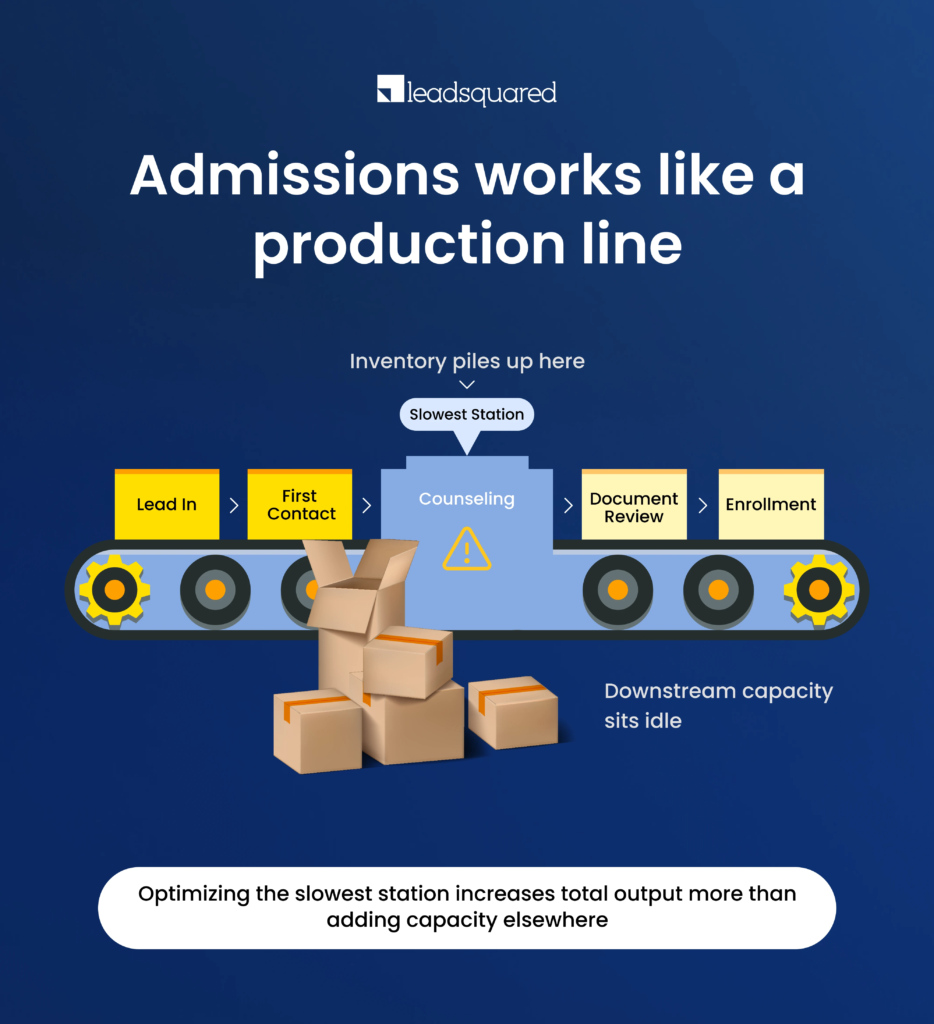
Think of your admissions operation like a production line. If one station runs slower than the others, inventory piles up behind it while downstream stations sit idle. Optimizing that single constraint delivers more output than adding capacity elsewhere.
Before fixing bottlenecks, you need to see them. Build a stage-by-stage funnel that tracks five dimensions:
- Volume: How many prospects enter each stage?
- Velocity: How long do they spend there?
- Conversion: What percentage of them advance to the next stage?
- Cost: What does each stage cost per prospect?
- Capacity: How many prospects can your team handle per stage?
For each stage, calculate stage conversion rate and median time-in-stage. Flag any stage where:
These are your bottlenecks.
What bottlenecks exist in the admissions journey today? Here are 8 friction points that consistently emerge as conversion killers:
Symptoms: Inquiries arrive but aren’t contacted within 24 hours; leads assigned to counselors who are at capacity; duplicate records created across systems.
Root causes: Web forms submit to marketing automation but don’t trigger CRM workflows; territory assignments rely on outdated rules; no queue management or load balancing.
High application volumes combined with manual processes create systemic bottlenecks that compound during recruitment cycles.
Fixes:
Tools: CRM with workflow automation, lead scoring and routing engine
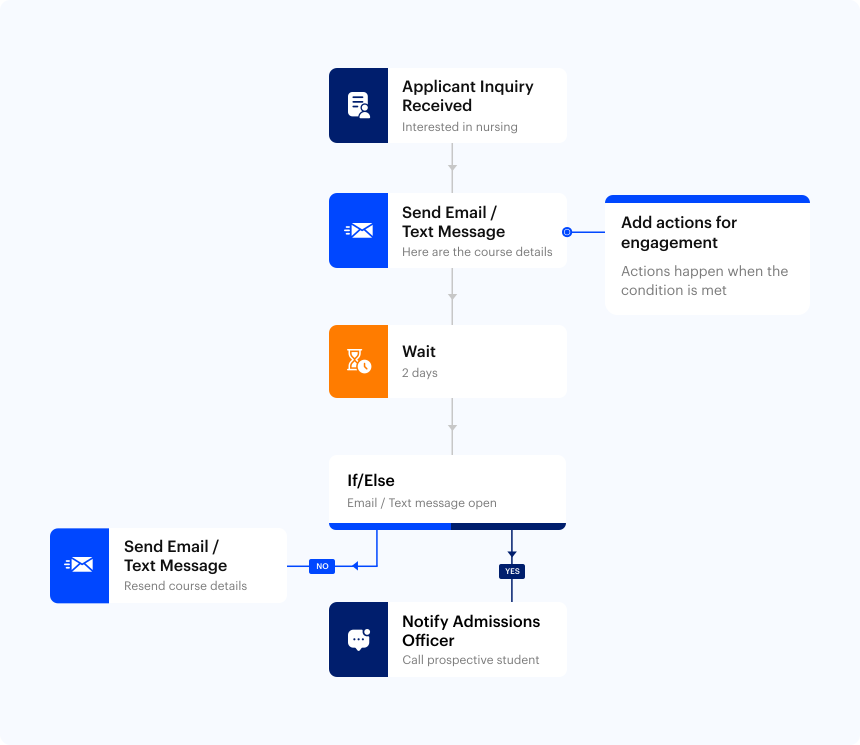
Symptoms: Average time-to-first-contact exceeds 48 hours; inquiry-to-application conversion decreases; prospects cite “went with a school that responded faster” in exit surveys.
Root causes: Manual lead assignment; counselors unaware of inbound inquiries; no after-hours or weekend coverage; teams prioritize events over follow-up.
Fragmented communication systems mean inquiries submitted through different channels (web, social media, partner portals) don’t trigger unified response protocols.
Fixes:
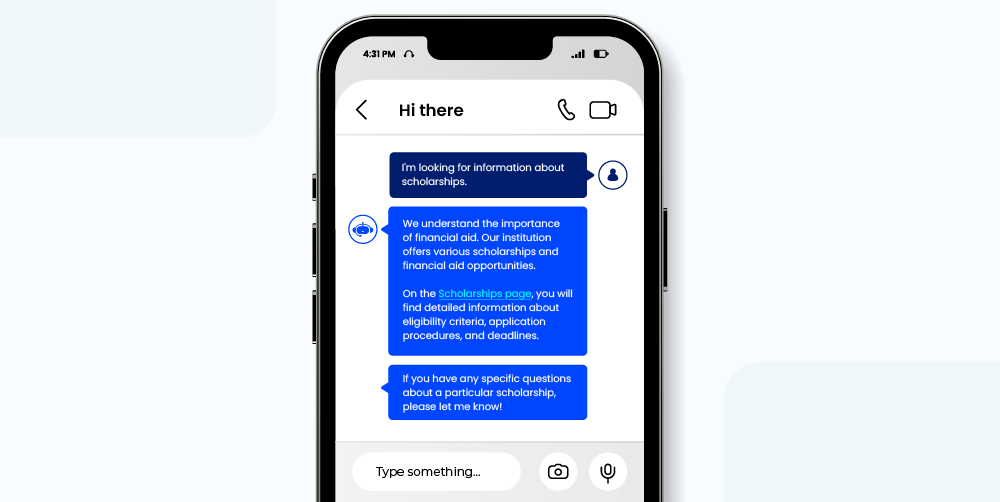
Tools: CRM mobile app with push notifications, text automation, chatbot with intelligent handoff
Symptoms: High started-but-not-submitted rates (40%+); applicants require multiple reminders; credential chase emails dominate counselor time. Prospective students submit incomplete documents, upload partial transcripts, or fail to include required certifications—often because requirements weren’t clearly communicated upfront.
Root causes: Applications requiring essays, test scores, or transcripts upfront; confusing navigation; no save-and-resume functionality; unclear document requirements. Applicants don’t understand what’s needed, make errors on forms (addresses, program selections, test scores), or apply for programs that don’t match their qualifications.
Fixes:
Tools: Modern application platform with conditional logic, mobile-responsive design, automated document verification tools
Symptoms: Counselors can’t see inquiry source, prior outreach, or engagement history; IT tickets for “missing records”; duplicate effort across admissions, financial aid, and registrar teams. Marketing campaigns run independently of admissions priorities, leading to misaligned messaging and wasted budget on prospects who don’t match institutional enrollment goals.
Root causes: Inquiry data lives in marketing automation; applications in SIS; communications in email; no unified student record. Poor integration between enrollment systems and institutional marketing platforms means recruitment efforts aren’t informed by real-time enrollment data.
Fixes:
Tools: Integration platform (iPaaS), master data management layer, marketing-enrollment data bridge

Symptoms: Visit registration rates below 30% of admitted students; no-show rates above 25%; visit-to-deposit conversion under 50%.
Root causes: Generic invitations; no personalized itineraries; visits scheduled too late in the cycle; no follow-up protocol. Prospective students and parents don’t understand the value of campus visits, skip open houses, or fail to ask critical questions during visits because they’re unsure what to inquire about.
Fixes:
Tools: Event management system integrated with CRM
Symptoms: Award letters sent 4+ weeks after admission; students cite “got a better offer elsewhere” as decline reason; melt rates spike between deposit and enrollment.
Root causes: Manual verification processes; understaffed financial aid office; disconnect between admissions timeline and FA office workflows. Inconsistent communication leaves families uncertain about total cost, payment options, or when to expect final aid packages.
Fixes:
Tools: Financial aid management system with automated verification
Symptoms: International completion rates 20+ points below domestic; credential evaluation takes 4–6 weeks; applicants miss deposit deadlines. Institutions struggle with document matching across different educational systems, leading to processing delays or wrongful denials based on misunderstood credentials.
Root causes: Manual transcript review; unfamiliarity with foreign grading systems; language barriers in document interpretation.
Fixes:
Tools: Credential evaluation service integration
Symptoms: Deposit-to-enrollment rates below 85%; summer melt exceeds 10%; students cite “changed my mind” or “found a better fit” without specifics. Prospective students face wrongful denial based on age, minor inaccuracies on applications, or other unfair grounds—creating legal risk for institutions and frustration for applicants.
Root causes: Weak post-deposit engagement; competitor outreach between May and August; unresolved concerns about cost, fit, or outcomes; lack of peer connection opportunities.
Fixes:
Tools: Student success platform, peer mentoring software
Helpful resources:
Enrollment & Admissions Funnel Guide For Colleges
What Can You Do To Reduce Summer Melt?
Effective bottleneck diagnosis requires real-time visibility into funnel health. Track conversion rates at each stage: inquiry-to-application, application-to-complete, complete-to-admit, admit-to-deposit, and deposit-to-enrolled.
Operational metrics matter just as much as conversion rates. Monitor time-to-first-response (institutions responding within 24 hours see significantly higher conversion), application completion time, financial aid turnaround time, and campus visit conversion rates.
Benchmark performance against your own historical data and peer institutions of similar size, selectivity, and market position. Conversion rate targets vary significantly by institution type—community colleges, selective four-year institutions, and online programs each have different baseline expectations.
Modern CRM platforms should deliver these views out-of-the-box. If you’re exporting to Excel weekly, you’re already behind.
Responsible: VP of Enrollment
Accountable: Enrollment Operations Manager
Consulted: IT, Financial Aid, Marketing
Informed: Provost, Cabinet
A helpful resource: 7 Tips To Increase Admissions Counselor Productivity & Enrollments
Most enrollment leaders know something is slowing growth—but can’t pinpoint exactly where prospects are leaking out of the funnel or why velocity has dropped.
LeadSquared’s higher education CRM helps institutions eliminate admissions bottlenecks with intelligent lead routing, automated follow-up, unified applicant records, and real-time funnel analytics. Customers typically see 25–40% improvements in inquiry-to-enrollment conversion within the first year.
You can schedule an admissions bottleneck consultation, and also get to see the platform in action!
Response speed. Most teams underestimate how much conversion suffers when inquiries wait days for first contact. Students interpret delays as disinterest and move on.
Calculate impact = (current conversion rate – target conversion rate) × stage volume × average revenue per enrollment.
Fix the bottleneck with the highest dollar impact first.
Yes. Automation, workflow redesign, and capacity reallocation often deliver 20–40% throughput gains without new hires. Focus on eliminating low-value manual work first.
Many bottlenecks—FA delays, IT system gaps, academic program clarity—require cross-functional collaboration. Use data to build the business case and secure executive sponsorship for structural changes.
Quick wins (lead response automation, application simplification) can show measurable impact within 30–60 days. Structural changes (system integration, FA process redesign) typically require 90–180 days.
It varies widely by institution type, selectivity, and market position. Directional targets: 10–15% for moderately selective institutions, 5–10% for highly selective, 15–25% for open-access programs. Focus on improving your own trend line rather than hitting arbitrary benchmarks.
Start with internal diagnosis using the framework above. Bring in external expertise if bottlenecks involve complex system integration, organizational change management, or specialized knowledge (international admissions, adult learners, graduate programs).
With LeadSquared Education CRM, you can identify at-risk prospects using real-time alerts, inactivity reports, missed follow-ups, low engagement scores, or stalled applications in specific funnel stages. Smart views and automated reports highlight students with pending documents, delayed responses, or incomplete applications—enabling counselors to take timely action and improve conversions before the month closes.

 16 min read 17 min read
  9 min read



 How to increase student enrollment: 10 proven strategies for college admissions...
