




EDUCATION
How AI improves student counselor performance & outcomes
Contents

 14 min read


Every day, student counselors turn away opportunities they can’t pursue.
Application volumes surged 32-65% from 2020-2024 according to Common App data and industry analysis, while many institutions implemented hiring freezes and staff reductions in enrollment departments to manage budget pressures. (Sources: CKT College Coach, Inside Higher Ed).
The average enrollment counselor now manages hundreds of prospects per cycle with flat or declining staff support. Meanwhile, expectations soar: personalized outreach, 24-hour response SLAs, proactive intervention, multilingual support across text, WhatsApp, and email.
Education CRMs powered by artificial intelligence show how AI improves student counselor performance. It makes humanly impossible caseloads manageable—and measurably better.
Now, this isn’t a speculative hype. Institutions deploying AI-augmented counseling workflows report measurable gains across key metrics: 5-26% gains in conversion rates, and 30-40% increase in counselor capacity through workload automation, backed by rigorous before/after analysis.
This guide explains which AI capabilities deliver the highest ROI, how to quantify impact on core counselor KPIs, and how to implement responsibly across global compliance regimes.
Two main forces converge to make AI adoption for admission counselors urgent:
International student enrollment reached 1.58 million in 2024, a 5.3% increase from 2023, while the median US institution added zero net counselor FTEs. Indian higher education institutions experience seasonal inquiry surges during admissions cycles, overwhelming teams that still rely on manual spreadsheet triage and face a counselor shortage.
Boards and accreditors now demand real-time dashboards on time-to-application, yield rates, and term-to-term persistence. Manual tracking is too slow; AI-driven analytics bake these metrics into daily workflows.
Caveats:
Results vary by data quality, use-case scope, and change management rigor.
What it does:
This is essentially AI lead scoring.

Machine learning models analyze behavioral signals—website visits, email opens, form abandonment, financial aid calculator usage, conversation sentiments—and assign each inquiry a “likelihood to enroll” score (0–100). The CRM auto-routes high-propensity leads to senior counselors and surfaces at-risk students who’ve gone silent.
KPIs tracked:
Conversion rate by score band, counselor response time (target: <4 hours for hot leads), cost-per-enrolled-student.
What it does:
Conversational AI bots embedded in the CRM handle back-and-forth scheduling (syncing calendars, sending reminders via SMS/WhatsApp). Post-meeting, generative models transcribe calls, extract action items, and auto-populate CRM case notes in the counselor’s voice.
Platform spotlight: FloStack by LeadSquared
FloStack is an automated meeting scheduling and lead engagement platform that improves lead response time from days to seconds. Within seconds of a form’s submission, FloStack can auto-qualify leads, intelligently route them to the right counselor, and instantly schedule meetings or appointments.
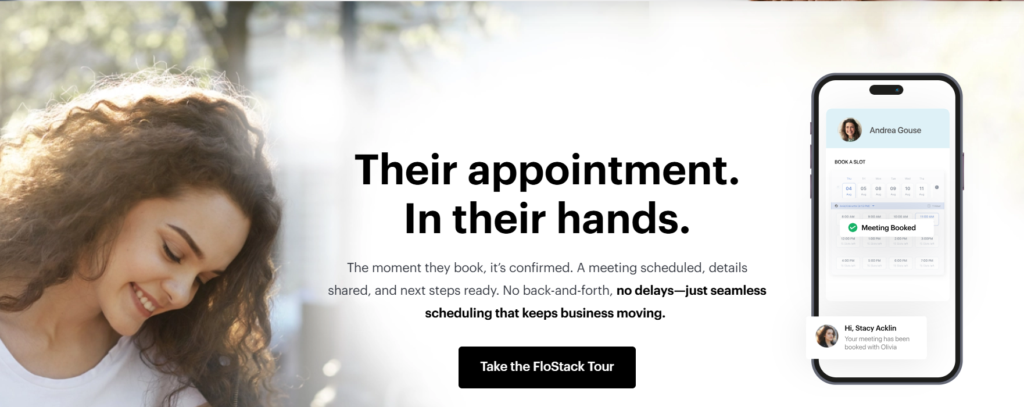
The platform replaces generic email responses with instant, personalized microsites, keeping students engaged from the first inquiry while seamlessly integrating with CRMs to build rich student data profiles.
West Coast Training reduced response times by 20% using FloStack, with prospective students self-booking appointments that sync directly to staff calendars, eliminating friction and enabling real-time scheduled touchpoints.
Read full case study here.
KPIs tracked:
Scheduling turnaround time, no-show rate (AI reminders reduce no-shows by 20–35%), average handle time per case.
What it does:
Natural language processing (NLP) scans email, chat, and SMS threads for distress signals—financial anxiety, academic struggle keywords, declining engagement frequency. The CRM flags cases and notifies counselors via real-time dashboard alerts.
KPIs tracked:
Early alert response time (<24 hours), term-to-term persistence rate, retention lift in flagged cohorts.
What it does:
AI orchestrates personalized reminder sequences across email, SMS, WhatsApp, and others. Timing, tone, and channel are optimized using reinforcement learning based on historical response patterns.
KPIs tracked:
Show rate, channel engagement rate, time-to-first-response.
What it does:
Large language models (LLMs) with retrieval-augmented generation (RAG) ingest institutional knowledge bases—admissions policies, financial aid rules, academic catalogs, FAQs—and serve real-time answers to counselors mid-conversation. The counselor reviews and sends, ensuring accuracy.
KPIs tracked:
Time-to-resolution, first-contact resolution rate, counselor satisfaction (measured via internal NPS).
Never automate high-stakes decisions without counselor oversight:
- Financial aid recommendations, academic warnings, probation alerts: Require counselor review and sign-off.
- Admissions decisions: AI can score and rank; final admit/deny must remain human.
- At-risk interventions: AI flags; counselor assesses context (e.g., student experiencing grief may not need academic warning—needs referral to counseling services).
Frame AI as counselor augmentation, not replacement. Students and counselors must understand why the AI made a recommendation.
| Region/Law | Key Requirements | CRM Implementation |
| FERPA (US) | Consent for directory info; no disclosure of education records without consent | Map FERPA-covered fields; gate AI access behind consent flags; audit access logs |
| GDPR (EU/UK) | Lawful basis (consent or legitimate interest); right to explanation; data minimization | Maintain consent registry; provide model explainability dashboards; auto-delete after retention period |
| COPPA (US, <13) | Parental consent for K–12 | If serving minors: dual-consent workflow; prohibit profiling for marketing |
| LGPD (Brazil) | Consent; data subject rights similar to GDPR | Deploy data residency in São Paulo region; appoint DPO |
| POPIA (South Africa) | Consent; purpose limitation | Host data locally or use POPIA-compliant EU/US processors |
| PDPA (Singapore, Thailand, Malaysia) | Consent; notification of data use | Implement granular consent UI; translate notices into local languages |
| PIPL (China) | Consent; data localization; security assessment for cross-border transfer | Store all Chinese student data in China-based servers; obtain CAC approval for international transfers |
Best practice: Conduct a Data Protection Impact Assessment (DPIA) before deploying AI. Document data flows, risk mitigation, and compliance measures. Update annually.
1. Over-automation without oversight
Symptom: AI sends dozens of generic nudges; students feel spammed.
Fix: Cap automated touches at 3 per week; require counselor approval for fourth+ messages.
2. Hallucinations in generative copilots
Symptom: Copilot invents a scholarship that doesn’t exist.
Fix: Use RAG with citation requirements; display source documents alongside answers; train counselors to verify before sending.
3. Poor data lineage
Symptom: Model accuracy degrades over time because upstream SIS changed field definitions.
Fix: Implement data contracts; monitor schema drift; revalidate models quarterly.
4. Lack of multilingual/localization support
Symptom: Spanish-speaking students in Texas receive English-only SMS; Indian students get USD-based financial aid examples.
Fix: Deploy multilingual LLMs (GPT-4, Claude support 50+ languages); localize templates by region; hire bilingual counselors for QA.
5. Change management gaps
Symptom: Counselors circumvent AI, continuing manual workflows.
Fix: Co-design with end users; celebrate early adopters; tie AI usage to performance reviews (lightly—focus on outcomes, not tool compliance).
Pre-implementation (Weeks 1–3):
Pilot phase (Weeks 4–9):
Scale and sustain (Weeks 10+):
LeadSquared offers a comprehensive platform for managing student acquisition, engagement, application tracking, enrollment, and post-enrollment processes. It lets you streamline admissions, personalize student engagement, and improve student retention.

AI-augmented counseling workflows can lead to gains of 15-35% in conversion, retention, and counselor capacity. LeadSquared uses AI to automate tasks and outreach, enabling institutions to run processes on autopilot and improve efficiency.
LeadSquared offers customizable dashboards for education, with in-built reporting and analytics to track application completion and drop-off rates, counselor efficiency, and more.

Within the next few years, more institutions will realize that AI improves student counselor performance and outcomes. AI-powered counselor workflows will be table stakes, not competitive advantage. The institutions moving now will harvest compounding benefits—stronger yields, better retention, higher counselor satisfaction—while laggards scramble to catch up amid tightening budgets and rising student expectations.
The evidence is clear: AI improves counselor performance measurably, equitably, and compliantly when implemented with rigor and humanity. The question is no longer if, but how fast can your institution deploy it.
LeadSquared is trusted by 800+ higher education admissions and marketing teams around the world. Its AI features enable admissions teams to turn more prospects into enrolled students and retain them, with its specially designed solutions for higher education, extensive analytics, and proven outcomes.
See it in action!
AI helps counselors identify at-risk students early, personalize academic and career guidance, and automate routine tasks. Platforms like LeadSquared can centralize student data and trigger timely follow-ups, allowing counselors to focus more on student support.
AI analyzes data such as grades, attendance, assessments, and LMS activity to detect patterns and forecast outcomes like performance gaps or dropout risk. When integrated with systems like LeadSquared, these insights can drive proactive interventions and track their impact.
Start with predictive lead scoring (prioritizes where to spend time) and automated meeting scheduling (eliminates back-and-forth admin). Once those stabilize, layer in generative copilots for policy Q&A and sentiment-based early alerts.
By automating repetitive tasks—data entry, meeting reminders, note-taking, routine Q&A—AI frees 30–40% of counselor time. Real-world data shows counselors handle 200–400 more inquiries per cycle without adding additional headcount.
(1) Map which data fields are FERPA/GDPR-protected;
(2) obtain explicit consent before AI processes PII;
(3) encrypt data at rest/in transit;
(4) implement role-based access;
(5) maintain audit logs;
(6) conduct annual DPIAs.
This is why human-in-the-loop is mandatory for high-stakes actions, as we discussed in this article. Configure your CRM so AI drafts messages or recommendations, but counselors must review and approve before sending. Also, use RAG with citations so counselors can verify sources.
AI helps improve counselor performance by automating routine tasks and guiding smarter interactions. With LeadSquared’s AI capabilities, counselors get prioritized leads, recommended next actions, call insights, and performance analytics—allowing them to focus on high-intent students, respond faster, and convert more inquiries into enrollments.

 16 min read
  9 min read 17 min read


 Lead generation strategies for higher education: AI, CRM, and global best ...