




EDUCATION
How to Improve Student Experience in Higher Education
Contents

 15 min read


Here’s a sobering stat: 1 in 4 students never complete their college applications.
Why? Because somewhere between “Submit Application” and “Confirm Enrollment”, the experience falls apart. Think back to your own college search—filling out the same information on four different portals, waiting weeks for generic responses, sitting through virtual tours that felt like PowerPoint presentations. Now multiply that frustration across thousands of prospective students, and you’ll understand why enrollment teams are losing qualified applicants.
The colleges that win today aren’t the ones with the biggest budgets or the most prestigious names. They’re the ones that make every interaction, from that first Instagram ad to orientation day, feel seamless and personalized. Also, genuinely helpful. That’s what we’re diving into today: how to build a student experience in higher education that doesn’t just attract applicants, but actually gets them to show up on campus.
Educational institutions are now using technology extensively to drive admissions. For example, they run targeted email and ad campaigns, engage on social media, and much more. But when you reverse the roles and view these ads from a learners’ perspective, you see them swamped and overwhelmed with promotional emails from hundreds of institutions. It leads to more distractions and choices than ever before.
Even when interactions are digital, creating a meaningful and memorable student experience is essential—arguably more so than ever. Beyond the quality of education itself, a well-defined strategy for managing online admissions has become a key differentiator for institutions.
“The admission process is shifting to the digital space. There is a need to streamline and automate the process for counselors as well as students. Organizations are adopting an online student onboarding model that is also helping student counselors in closing admissions faster. There is a lot of personalization in the overall communication, and the admission process in 2021 will be even more evolved.”
– Rajiv Swarup, Former President, Shiv Nadar University
Digital student onboarding is the admission process that takes place almost exclusively online. It starts with the student applying for admissions online and continues until the student enrolls into your institution. It involves several touchpoints, such as virtual campus tours, financial aid discussion & grants, checking eligibility, ID verification, and access to premises/online classrooms.
Let’s take an example. Vihaan is about to finish school and has started his search for top engineering colleges in India. He compiles a list of universities and adds your university to it. What’s more, he finds clear ways to access your prospectus, check his eligibility, and apply online on your website. Just as he downloads the brochure, a counselor reaches out to him to guide him through his career goals and the admission process. This response is a positive student experience for Vivek. It gives him the impression that you care for him. In a way, it gives you a competitive advantage over other colleges that did not respond to his query.
Let us now say that Vihaan has decided to enroll in one of your courses. Now, instead of filling out lengthy forms, he can complete the application online and submit the documents. Next, you can verify the documents, check eligibility and approve his admission.
What used to take days and months and multiple campus visits is now possible in just a few clicks. Thus, digital onboarding plays an important role in improving the student experience in higher education.
However, the admissions journey is often long and complex, involving multiple milestones before a student enrolls. To guide students successfully through this process, institutions must deliver a personalized, engaging experience at every stage—made possible through an omnichannel engagement strategy and a centralized lead management system.
A helpful resource: 5 Education Marketing Channels & 8 Strategies: Boost Conversions
Traditional admissions were fragmented and time-bound. Today’s digital student experience is always-on, connected, and designed for speed and ease.
Instead of isolated steps, students move seamlessly from social media and websites to virtual tours, live chats, and applications—all within one continuous journey.
Key differences include instant access, personalized communication, reduced friction, and ongoing engagement across every touchpoint. Because each interaction is connected, even small issues can impact the overall experience.
This shift enables a more responsive, student-centered admissions process that aligns with modern expectations.
Also read: Digital Transformation In Education: Key Trends, Strategies, And Tips
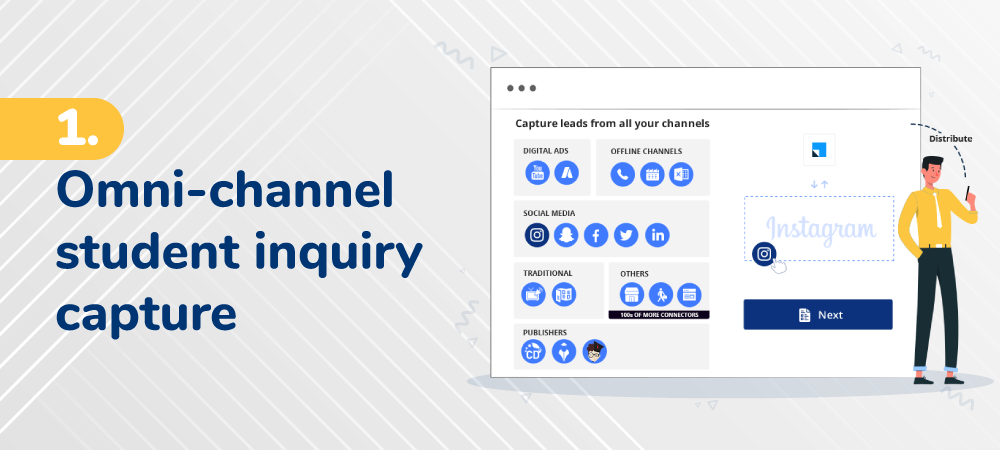
There are over a billion learners globally – each one looking for the right university for them. Gone are the days when colleges find students through offline sources. Today, digital channels are becoming the most prominent source to get student inquiries.
Examples of these channels are social media, such as Instagram, TikTok, LinkedIn, or Meta, and third-party marketplaces or publishers, such as Collegedunia, Sulekha, Niche, College Board (BigFuture) etc.
With so many channels generating student inquiries, attracting leads isn’t the challenge—managing them is. Without an automated system, consolidating inquiries from multiple platforms becomes tedious, and tracking their status or following up across individual channels is time-consuming. These delays often lead to missed leads, inconsistent follow-ups, and slower responses, ultimately harming the student experience.
Implementation approaches for omnichannel inquiry capture
APPROACH 1 – CENTRALIZED CRM PLATFORM ($$$)
Best for: Institutions with 5,000+ annual inquiries
– Unified dashboard for all inquiry sources
– Automated lead routing and scoring
– Integration complexity: Medium-High
– Implementation: 8-12 weeks
– Cost: $50-200 per user/month
– Examples: LeadSquared, Slate
APPROACH 2 – INTEGRATED POINT SOLUTIONS ($$)
Best for: Institutions with 1,000-5,000 annual inquiries
– Marketing automation (LeadSquared, HubSpot, Marketo) + Form builders
(Typeform, Jotform) + Communication tools (Intercom)
– Manual data synchronization or Zapier integration
– Implementation: 3-6 weeks
– Cost: $20-80 per user/month
APPROACH 3 – MANUAL AGGREGATION ($)
Best for: Institutions with <1,000 annual inquiries
– Google Forms + Sheets + Email
– Suitable for institutions testing digital channels before
major investment
– Implementation: 1-2 weeks
– Cost: $0-20 per user/month
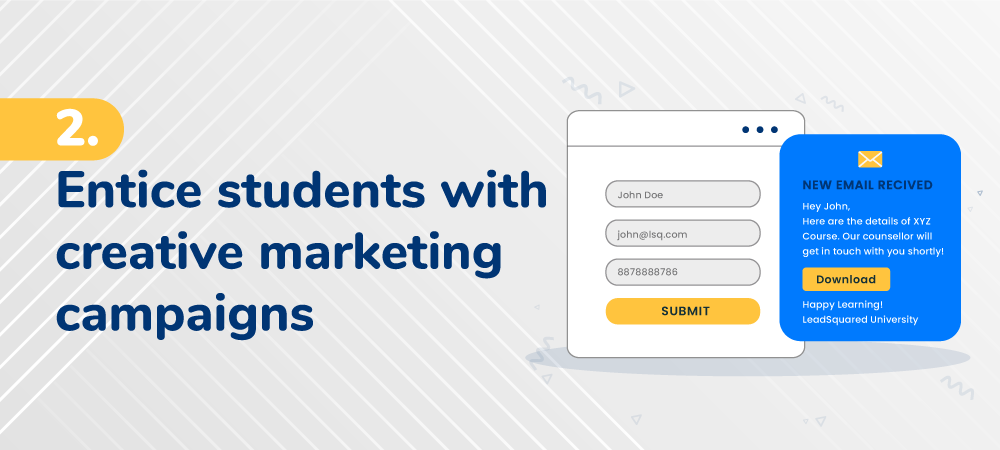
Marketing campaigns are not just for admissions but go a long way until graduation and beyond. Engaging with students and parents along the student lifecycle will enhance the overall digital student experience. Great experience brings with it good word of mouth, which in turn, will inspire the upcoming batches to take admission at your institution.
So, you must identify the best offers, A/B test emails, ads, landing pages and find the best marketing channels for effective communication with students.
Email remains the dominant communication channel. Statista’s 2024 global email statistics report documented 4.48 billion email users worldwide, with projections reaching 4.73 billion by 2026. (Source).
Thus, make the most of your email marketing campaigns. These tips can help.
IMPLICATION: Mobile-optimized email templates are non-negotiable, not optional enhancements.
Remember that the first impression matters the most. With the right messaging, you can improve the admission rate to a great extent. However, one must also remember that no matter how good a campaign is, delivering what is promised in your campaign will lead to a good student admission experience.
Helpful resources:
The Ultimate Guide To Higher Education Marketing In 2026
Personalizing Higher Education Marketing Campaigns At Scale
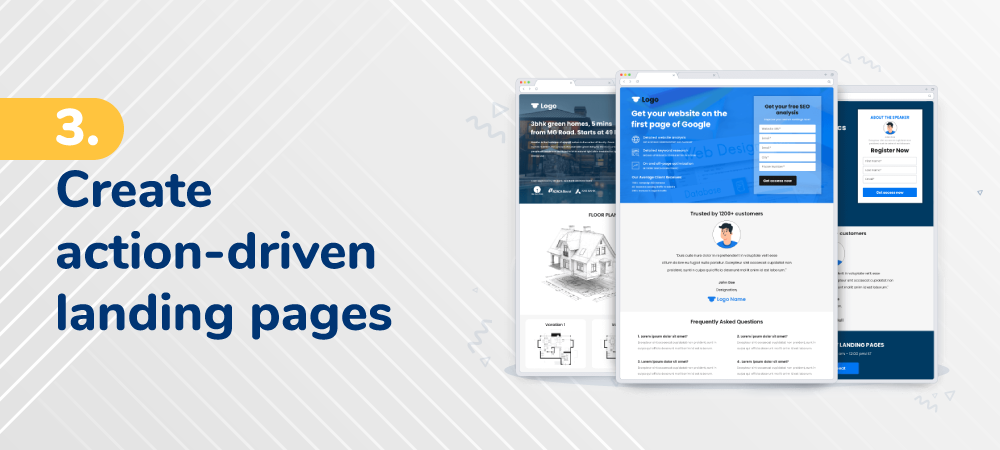
A landing page is a standalone web page created specifically for a marketing or advertising campaign. Landing pages are an effective lead capture and conversion tool.
Universities can have landing pages for a specific campus, course, or offer. The messaging should encourage students to fill out the admission form.
Building targeted landing pages makes your campaigns relevant for different courses, campuses, etc.
In terms of your strategy, you could judge what works and what doesn’t work while creating digital campaigns. Moreover, you would be able to generate a detailed report on conversion analytics for high and low- performing keywords, traffic sources, locations, and more. It can help you make data-driven marketing decisions.
To make the most of your landing page, keep it precise. Having multiple lead capture fields will only increase the drop-off rate. To increase engagement, send an automated acknowledgment email to the student when he submits his details on the landing page.
To maximize landing page conversions, follow these best practices:
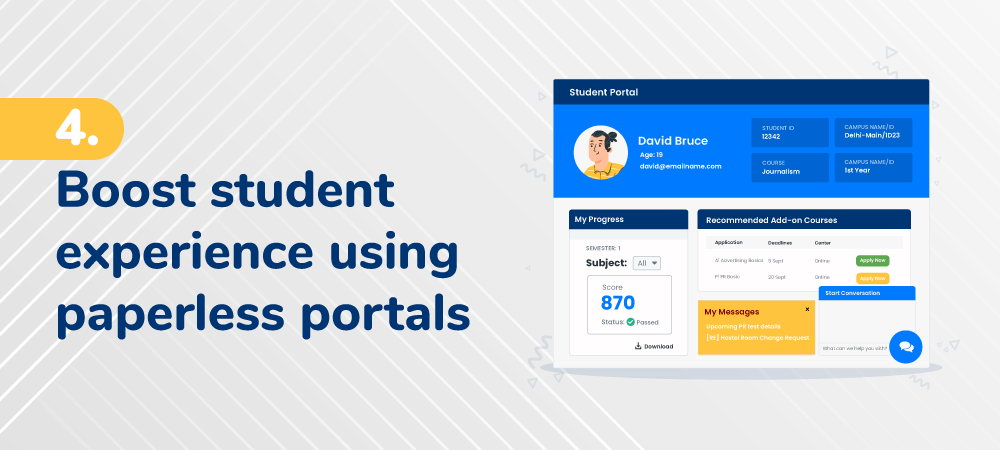
Paperless applicant portals help make the application journey easier for students. For instance, a student-friendly form will always have a higher completion rate.
Paperless application portals have two-fold benefits. It lets students apply online – without having to wait in queues just for submitting the application form. And it makes it easy for the counselor to fetch the student information in the correct format. Moreover, you can access the data for multiple purposes – from checking eligibility to enrollment and placements. It eliminates the need for a separate data entry operator. And students don’t need to share their details repeatedly with the administrators.
Also check out: LeadSquared’s Smart Student Management System For Schools & Universities
All of this will ensure that your digital native students can complete their applications with ease. Counselors can jump in to aid them only when needed. This can go a long way in enhancing the student experience.
Response timing significantly impacts conversion. While exact multipliers vary by industry, higher education student experience data consistently shows response speed correlation.
Research from education technology providers and enrollment management
associations suggests:
Delayed response (>24 hours): 40-60% drop in engagement
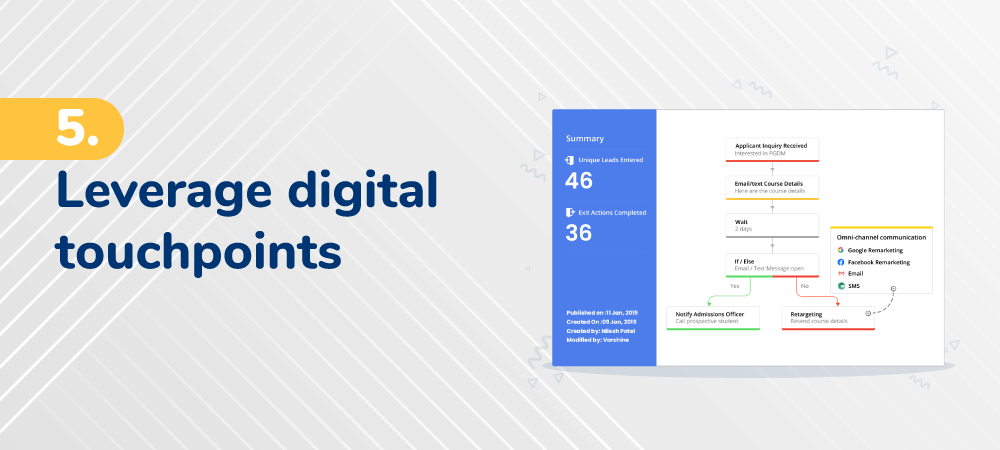
Use automation to build an engaging digital student journey – with minimum human intervention. So no matter how or when a student fills out a form, the system automatically engages with the applicant till a relevant student counselor reaches out to them.
For example, if a student signs up on your website, the admission management system can automatically send out relevant messages, such as welcome emails, brochures, and more. You can initiate this communication via WhatsApp messages, emails, or SMS. If the student does not respond, the system can send a notification to the admission team to follow-up. The point is – once you have identified different touchpoints along the student journey, you can create automated workflows for the admission process.
Every interaction—from social media and your website to applications and student portals—is part of one continuous digital journey.
When these touchpoints are connected, students move naturally from discovery to enrollment and beyond, with personalized guidance, timely reminders, and easy access to resources. The result is less friction, lower frustration, and stronger engagement.
By unifying digital touchpoints into a single experience, institutions create a smoother, more intuitive journey that supports both prospective and current students.
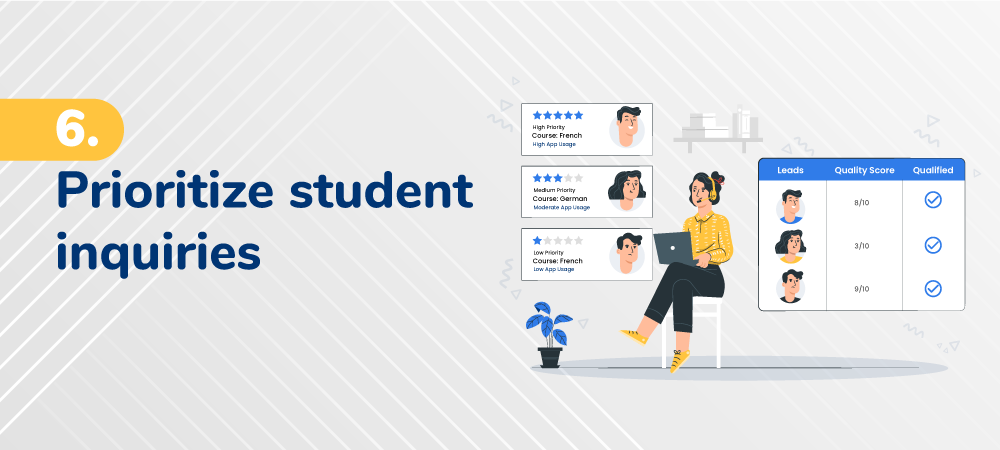
One of the biggest concerns for educational institutions is to figure out whom to approach first. How to prioritize student inquiries that have a higher chance of conversion? It is common for educational institutions to receive hundreds of inquiries daily during the admission season. And it is practically impossible to call every lead.
Short answer: Use tech tools.
LeadSquared Education CRM has a lead scoring mechanism. It lets you assign scores automatically to inquiries based on the courses explored, enrollment applications, and so on. For instance, a student who has downloaded the brochure will have a higher lead score than the student who just browsed your home page.
Thus, lead scoring helps you identify students who are more interested in admission. This way, you can prioritize follow-ups with them.
Also, you can segment the inquiries into specific buckets based on their stage in the application process (for example, inquiries, applications, opportunities, students, etc.). The CRM system automatically moves them in the respective buckets based on your interactions with them. This way, the admission counselors know how to assist the students and move them forward in the admission cycle.
Digital tools may streamline enrollment and engagement, but student feedback is what truly drives how to improve student experience on campus.
Real-time feedback helps institutions understand why issues occur—not just what happened—revealing gaps in support, learning experiences, or campus services. When faculty and staff can act on this input immediately, problems are resolved before they escalate.
By treating feedback as a continuous, actionable input rather than a formality, institutions create a more responsive, supportive, and engaging campus experience where student voices drive meaningful change.
The shift to digital-first education isn’t slowing down—it’s accelerating. Universities that master seamless onboarding and personalized engagement aren’t just improving their reputation; they’re directly boosting enrollment numbers in an increasingly competitive market.
The education sector may look saturated, but the gap between institutions that truly understand student experience in higher education and those that don’t is wider than ever. The right strategy and tools don’t just level the playing field—they win it.
LeadSquared’s Education CRM addresses your challenges through omnichannel lead capture, automated engagement workflows, predictive lead scoring, and more.
See workflow automation specific to your institutionhttps://www.leadsquared.com/higher-education-demo/ size and admission volume.
Improve student experience by focusing on three key areas: streamline administrative processes with digital portals and automation, respond to inquiries within 2 hours to maintain engagement, and personalize communication at every touchpoint from application to enrollment. Use CRM tools like LeadSquared to capture leads from all channels, prioritize high-intent students through lead scoring, and create automated workflows that guide students through the admission journey without friction. The goal is to make every interaction feel effortless and genuinely supportive.
Focus on two things: speed and experience. Students abandon applications when processes drag on or feel impersonal. With LeadSquared’s sales and marketing automation, you can respond faster, personalize communication at scale, and eliminate friction points in your enrollment funnel.
The institutions converting best aren’t necessarily the most prestigious—they’re the ones that make applying feel effortless.
Artificial intelligence helps institutions move beyond automation to proactively support students by anticipating their needs in real time.
AI enables:
Personalized guidance through tailored course and pathway recommendations.
Instant support with chatbots that answer questions anytime.
Early intervention by flagging students who may need help before issues escalate.
Stronger engagement by unifying data across digital touchpoints for deeper insight.
By working behind the scenes, AI removes friction, surfaces actionable insights, and allows staff to focus on meaningful student support—making the academic journey faster, smarter, and more personal.
Student feedback is abundant, but real value comes from understanding what drives enrollment, satisfaction, and retention.
With LeadSquared, institutions can use AI-driven analytics to analyze open-text feedback, detect sentiment, group recurring themes, and track trends in real time. By combining feedback with behavioral data across applications, portals, and communications, teams gain a clear view of where students struggle and where to act.
The result is actionable insights that help institutions respond faster, prioritize improvements, and continuously enhance student experience.
 18 min read
  16 min read
  9 min read



 10 Student Engagement Strategies for Enrollment Counselors in Higher Educa...