





- Home

- Learn
- Healthcare
- The benefits of AI automation in healthcare
HEALTHCARE
The benefits of AI automation in healthcare
Contents

 19 min read


AI automation in healthcare is the result of two trends meeting at the same time: advances in artificial intelligence and the large-scale digitization of healthcare operations. Hospitals and clinics now run on interconnected software systems, and those systems increasingly include AI components that automate specific types of work.
Public discussion often presents AI in healthcare as a breakthrough technology, but most real-world usage today is task-oriented. AI tools are applied to structured problems such as document processing, image analysis support, scheduling optimization, coding assistance, and automated communication workflows. These are targeted implementations inside broader software environments.
The shift toward AI-enabled automation has been gradual. Healthcare organizations are adopting them where they fit operationally and technically.
This article provides a clear explanation of what AI automation in healthcare is, where it is used today, how it works at a practical level, and what readers should understand about its scope and limitations.

When people talk about “AI automation” in healthcare, they are referring to a combination of two ideas: artificial intelligence and automation.
In healthcare contexts, “AI” means software that can analyze information, recognize patterns, make predictions, and so on. These abilities come from techniques such as machine learning, predictive analytics, natural language processing, and computer vision. For example, AI can analyze thousands of medical images to notice subtle signs of disease, or it can read clinical notes and extract important details from them.
By contrast, “automation” means tasks being carried out by a system instead of being done manually by a person. Traditional automation follows fixed instructions. If a task always follows the same steps, automation tools can execute it consistently without human effort. Examples include sending appointment reminders automatically or transferring data between systems without someone having to type it all in.
AI automation is a combination of these ideas. It means systems that not only do tasks automatically but also use data to decide how to do them, interpret information, and refine their behavior based on what they learn. Unlike simple rule-based systems that follow if-then instructions, AI automation can adapt to new patterns and make context-informed choices.
This is one of the most common forms of AI used in healthcare. A machine learning system looks at large amounts of medical data (such as patient records, lab results, or biological measurements) and learns patterns from them. Once trained, these systems can recognize similarities or trends in new data, estimate likely outcomes, or flag unusual results that might need human review. For example, machine learning can help forecast which patients are at higher risk of certain conditions based on their history.
Often called NLP, this technology focuses on human language. Much of healthcare information exists as written or spoken text (including doctor’s notes, clinical reports, and patient messages). NLP helps computers interpret and extract meaning from this text so that it can be used in electronic systems. It is widely used to automate documentation, summarize clinical notes, and power chatbots that respond to patient questions.
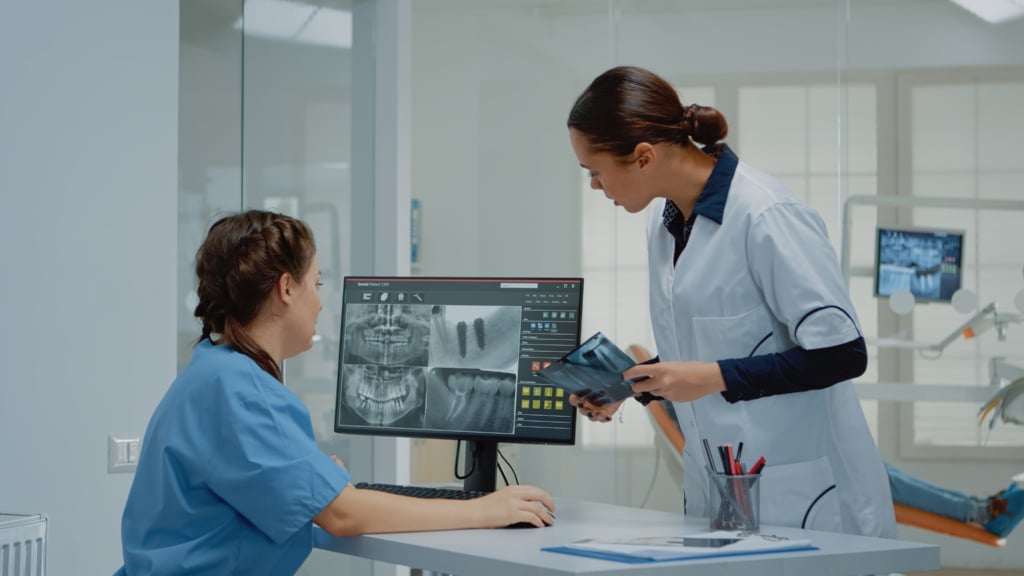
This is the part of AI that interprets visual information. In healthcare, computer vision systems analyze images like X-rays, CT scans, and MRIs to identify features of interest or abnormalities. These tools do not replace radiologists but provide another layer of analysis to highlight areas that need closer inspection.
This refers to AI systems that use patterns in past data to estimate future outcomes. In healthcare automation, predictive analytics can forecast things like patient admission rates, likely complications, or resource needs, so organizations can plan ahead more accurately.
This refers to software tools that automate repetitive administrative tasks. These tools can move data, trigger actions, or complete structured processes automatically based on predefined rules and intelligent data interpretation. In healthcare, this is often used for billing, appointment scheduling, insurance verification, or document processing.
One of the core areas where AI automation is actively used today is clinical care support. These are tools and systems that help medical professionals process clinical information and identify patterns that might not be obvious immediately.
A well-known use of AI in clinical care is medical imaging support. AI models trained on large sets of X-rays, CT scans, mammograms, and other imaging types can detect features such as small tumors, fractures, or signs of stroke with great accuracy. In recent trials, AI-assisted breast cancer screening tools have been shown to detect more significant cancers and reduce false positives in large populations.
Another application is risk prediction models. These systems examine a patient’s history, lab results, heart rate, blood pressure, and other measurements to estimate the likelihood of outcomes like hospital readmission, deterioration in the intensive care unit, or complications after surgery. These models generate risk scores that clinicians can include in their assessment and planning.
Early warning systems operate continuously on patient data and trigger alerts when patterns suggest a patient’s condition may be worsening. Research has shown that well-implemented warning models can improve prognosis by prompting earlier clinical action.
There are also treatment recommendation support tools. These use clinical guidelines and historical data to suggest therapies or diagnostic pathways that clinicians might consider. These suggestions are intended to inform clinicians, not to make decisions autonomously. Finally, clinical documentation automation uses AI to transcribe doctor-patient conversations into structured records and extract key points from notes, reducing manual data entry. Services from companies like Heidi Health and Twofold Health are examples of this trend.
Across these cases, AI helps analyze data and highlight relevant insights, while clinicians retain responsibility for interpretation and care decisions.
Beyond clinical support, a large portion of AI automation in healthcare is focused on administrative and operational tasks. These are the processes that keep healthcare facilities running but often involve high volumes of repetitive work. AI automation can handle many of these tasks faster and with fewer errors than manual methods.
Appointment scheduling and rescheduling is a common example. Many systems now let patients book, cancel, or change appointments online, but AI goes a step further. It can automatically find available time slots, minimize overlaps, and adjust schedules based on provider availability and patient preferences, cutting down the need for front-desk intervention.
Reminder systems use automation to send notifications by text, email, or phone. These reminders reduce missed appointments and prompt patients to complete forms or attend follow-ups.
Insurance verification and prior authorization processes are often time-intensive. AI systems can check coverage details, confirm benefits, and even pre-fill authorization forms based on patient data, reducing back-and-forth between clinics and insurers.
Medical coding, billing, and claims processing are other areas where AI is being applied. AI tools can read clinical documentation, assign appropriate billing codes, flag inconsistencies, and route claims automatically. These functions help reduce manual errors and speed up reimbursements.
Records management automation includes everything from processing intake forms automatically into electronic health records to organizing scanned documents and routing lab results to the correct care team. By automating these high-volume, repetitive tasks, healthcare organizations can free staff time for more complex work.
In addition to clinical and administrative functions, AI automation plays a growing role in patient communication and engagement. A common use is AI chat systems that answer questions and guide patients at scale. These systems use natural language processing to understand what a person types or says and respond with information about symptoms, appointment times, medications, and basic healthcare topics. Some AI assistants can perform initial triage by asking structured questions about symptoms and then suggesting the next step, such as self-care guidance, a telehealth visit, or a referral to a clinician.
Automated follow-up and medication reminders are also widely used. These systems can send scheduled notifications to encourage patients to take medications, complete recommended activities, or attend follow-up appointments. They help manage ongoing care and maintain continuous contact, especially when patients are responsible for tasks at home.
Remote patient monitoring uses sensors, wearable devices, or home monitoring equipment to gather health data such as heart rate, blood pressure, glucose levels, or oxygen saturation in real time. AI tools analyze this continuous stream of data to detect unusual patterns or early signs of problems and generate alerts for clinicians or care teams. This allows providers to intervene earlier and manage chronic conditions more effectively without waiting for in-person visits.
With wearables and connected devices, automated risk alerts and trend analysis help keep care teams informed on patients’ condition changes and support long-term condition management. This approach can reduce hospital readmissions and improve the consistency of care for patients who are not physically in a healthcare facility.
AI automation in healthcare mainly improves how quickly and consistently routine work gets done. Its value shows up in practical ways across patient services, clinical work, and healthcare operations. The gains usually come from faster processing, fewer manual steps, and better use of existing data, not from replacing professionals.
From a patient’s point of view, the biggest difference is often speed and consistency in everyday interactions with healthcare systems. When routine processes are automated, fewer requests get stuck in manual queues.
Common patient-facing benefits include:
Use of AI chat systems and automated reminders has risen sharply, with some providers reporting AI-driven scheduling and communication tools reducing no-shows by 35 percent and boosting patient throughput by 30 percent.
These tools improve responsiveness and continuity, but medical conclusions still come from clinicians.
For clinicians, the main benefit is reduced friction around documentation and data review. Many AI tools are designed to handle background tasks that normally consume time and attention.
Typical clinician benefits include:
Clinician use of AI is growing. Surveys show that about 66 percent of U.S. physicians have adopted AI tools for at least one workflow-related use case, including documentation support.
At the operational level, AI automation helps stabilize and streamline high-volume workflows. It is most effective where tasks are repetitive and rules-driven.
Common organizational benefits include:
Also, in revenue cycle and billing workflows, AI document processing tools have been shown to reduce resolution times by around 30 percent.
As we saw, AI automation in healthcare drastically improves many workflows, but so does it generate its share of technical and operational risks. Understanding these limits is important, considering the sensitive, high-stakes environment that the healthcare domain is.
AI systems learn from historical data. If the training data is incomplete, inconsistent, or poorly labeled, the system’s output will also be unreliable. Healthcare data is often spread across multiple systems and formats, which increases the chance of gaps and noise. This directly affects model accuracy.
Medical datasets are not always representative of all populations. Some demographic groups are historically under-documented or under-studied. When AI models learn from skewed data, their predictions may be less accurate for certain patient groups. This creates uneven performance and fairness concerns that researchers are actively working to measure and correct.
AI systems can also produce false positives (flagging a problem that is not real) and false negatives (failing to detect a real problem). In clinical settings, either type of error can have consequences, from unnecessary follow-ups to missed conditions. AI outputs always require human review because they are statistical predictions, not judgments.
There is a known risk that users may trust automated outputs too quickly, especially when systems appear accurate. If human oversight weakens, errors can pass through unchecked. Current best practice keeps clinicians and administrators responsible for final decisions.
AI systems require large volumes of patient data. This raises security and privacy exposure. Healthcare data breaches already occur, and AI platforms increase the number of systems handling sensitive information. Strong data governance and access controls are necessary to handle AI-powered technologies.
Regulatory frameworks for AI in healthcare are still developing. Many approval systems were designed for static medical devices, not adaptive algorithms. Rules around validation, monitoring, and accountability are still evolving.
Many healthcare organizations run on legacy software. Integrating AI tools with older record systems and workflows can be technically complex and expensive. Integration challenges often slow real-world deployment.

AI automation in healthcare works most effectively when it is integrated into the software systems that already support clinical work, administrative processes, patient communication, and care workflows. To understand this, it helps to know what these systems are and how AI enhances them.
EHRs are digital repositories that store medical information about patients, including medical history, diagnoses, medications, lab results, and imaging reports. They replace paper files and help clinicians access up-to-date patient information quickly. AI is being added to EHR systems to go beyond storage and retrieval. For example, AI can summarize long clinical notes so clinicians can review key points faster. It can extract structured data from unstructured text, reducing the need for manual typing. Some advanced systems use natural language processing (NLP) to translate spoken clinical conversations into draft records during a visit. AI can also highlight potential drug interactions or flag relevant prior findings, helping clinicians without making decisions for them.
Healthcare CRMs (Customer Relationship Management systems) manage administrative and engagement workflows for practices. In healthcare, these systems track and help handle patient inquiries, appointments, reminders, follow-ups, and communication history across channels.
Traditional CRM features are rule-based and can schedule reminders or update records when certain actions happen. When AI is added, these systems can interpret unstructured data, recognize patterns, and support proactive engagement. For example, AI can analyze communication histories to suggest likely reasons for a missed appointment or predict which patients are more likely to cancel, and then trigger targeted outreach. AI can also help consolidate incomplete or duplicate records, so staff do not have to clean data manually. These AI enhancements help reduce administrative burden and improve continuity of patient interactions.
Several modern healthcare CRM platforms now include built-in AI assistants for communication workflows.
One example is LeadSquared’s healthcare CRM, which includes an AI layer called Lexi AI that focuses on language-driven service and support tasks. In healthcare operations, these AI features are used to:
These are AI functions because the system is interpreting and generating language, not just executing preset rules.
Patient communication systems
These tools once integrated with AI can interpret patient messages and route them to the appropriate workflow or responder. For example, AI systems may classify an incoming message as a prescription refill request versus a billing question and organize them accordingly. AI agents connected with EHR and CRM systems can automate common interactions such as appointment confirmations or questions about lab results, reducing wait times, and manual handling.
Telehealth and workflow management tools
Telehealth and workflow management tools use AI to support clinicians during virtual consultations, such as generating draft visit summaries from spoken interactions or suggesting relevant clinical information based on the current encounter. These AI functions help keep records updated and reduce the time clinicians spend on administrative follow-up tasks after a virtual visit.
AI automation in healthcare is a growing layer of intelligence added across clinical, administrative, and patient engagement workflows. As we saw, it helps interpret healthcare data, streamline repetitive healthcare workflows, and support better communication. At the same time, its proper functioning still hinges on good data, human oversight, and thoughtful implementation.
For many organizations, the most immediate impact appears in patient communication and service workflows. This includes reading incoming patient messages, identifying what the patient is asking about, and sending the request to the correct team, such as scheduling, billing, or clinical support. It also includes drafting replies to common patient questions like appointment requests, document requirements, or follow-up instructions, which staff can review and send quickly instead of writing from scratch.
Healthcare CRM platforms are increasingly central to managing these interactions because they track patient journeys, inquiries, and follow-ups in one place. Platforms such as LeadSquared’s healthcare CRM include AI features that summarize long message threads, suggest response drafts, and automatically handle simple support queries when appropriate.
If you want to see how this works in real patient engagement workflows, a short product demo can make it easier to evaluate in context.
AI chatbots used within healthcare systems are typically trained on organization-approved content and workflows, and are designed only for administrative or informational tasks. They provide instant answers about appointments, insurance policies, clinic hours, or preparation steps for visits based on defined knowledge bases. These bots do not provide medical diagnoses or treatment advice and are not substitutes for a clinician’s judgment. In contrast, general AI tools like ChatGPT are broader language models that may offer health information but are not tied to clinical approval, patient records, or regulatory compliance and are not HIPAA-compliant for clinical use
No. Current AI automation tools are designed to support and assist staff, not replace them. They automate routine, repetitive, or time-consuming tasks such as drafting template responses, summarizing notes, answering common questions, or processing administrative data. These tools free human workers to focus on complex, non-routine work. Clinical decisions, oversight of patient care, and nuanced judgment remain the responsibility of trained professionals.
No. Even when AI systems generate insights, summaries, or automated replies, human supervision remains essential. AI models interpret patterns and language, but they lack contextual understanding, empathy, ethical judgment, and full access to a patient’s medical history. Without human oversight, automated outputs can be incorrect or misleading, especially in clinical or nuanced operational cases.
There are emerging guidelines and consensus frameworks that define principles like fairness, explainability, traceability, and robustness for trustworthy AI in healthcare. These guidelines recommend structured evaluation, transparency in how models make decisions, and ongoing monitoring to detect bias or performance drift. Adhering to such frameworks helps ensure AI automation tools remain reliable and aligned with clinical standards.
One common concern is trust and interpretability. Clinicians want to understand why AI tools produce certain outputs. Studies show that clinicians sometimes accept, ignore, or modify AI suggestions depending on clarity, perceived reliability, and context. Because AI outputs are based on patterns and probabilities, clinicians prioritize critical thinking and may negotiate between AI suggestions and their own expertise.
Yes, but its use is very controlled. Certain devices integrate AI to assist surgeons or help analyze complex intra-operative data. However, recent reports show that when AI tools are used in high-risk areas like surgical navigation or specialized imaging, safety monitoring and oversight are vital, as errors or malfunctions have occurred. These are closely regulated, and clinicians maintain ultimate control.
AI automation tools can process and analyze patient information when properly integrated with secure systems, but reputable platforms are designed to comply with privacy regulations (e.g., HIPAA in the U.S.). Tools that handle protected health information (PHI) must meet strict data governance, consent, and security requirements. General consumer AI tools not built for healthcare should never be used with PHI.

 15 min read
  13 min read 14 min read


 Achieve Better Results with Patient Outreach