





EDUCATION
Why CRM for Colleges is Key to Student Success and Institutional Growth
Contents

 8 min read


The National Student Clearinghouse Research Center reported a 3.1% drop in undergraduate enrollment. Today’s students expect personalized, digitally supported educational experiences that mirror the service levels of big tech companies
Customer Relationship Management (CRM) systems are the answer to this. CRMs help institutions grow enrollment, cut costs and connect with students and alumni.
This article looks at CRMs for colleges, the benefits they bring to institutions and how they are changing student engagement, enrollment and retention.
A Customer Relationship Management (CRM) system is a software that helps organizations manage interactions with their customers or clients in a structured, data-driven way.

A Customer Relationship Management (CRM) system when applied to education acts as a central platform to manage all interactions across the student lifecycle from recruitment to graduation and even alumni engagement.
Unlike general business CRMs, education specific CRMs like LeadSquared’s Higher Education CRM are designed to meet the needs of academic institutions.
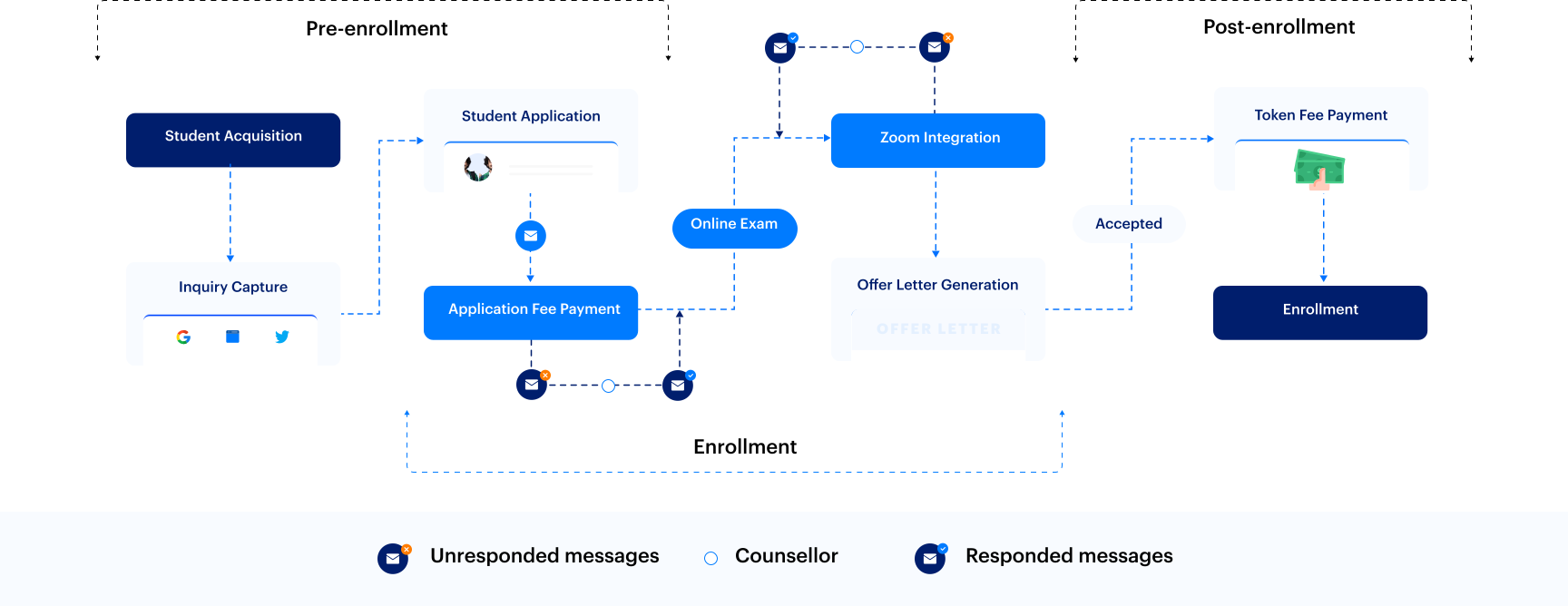
Education CRMs do more than basic contact management, simplifying complex processes, improving communication and driving student engagement through features designed for colleges and universities:
By centralizing these services, CRMs help institutions in the education sector deliver data driven experiences to modern students, simplify operations and improve overall student satisfaction.
Institutions with a CRM benefit from optimized sales and marketing processes and data-driven recruitment strategies. By collecting and analyzing data on prospective students, CRMs allow colleges to create highly targeted recruitment campaigns and reach and engage more. This helps improve enrollment rates by-
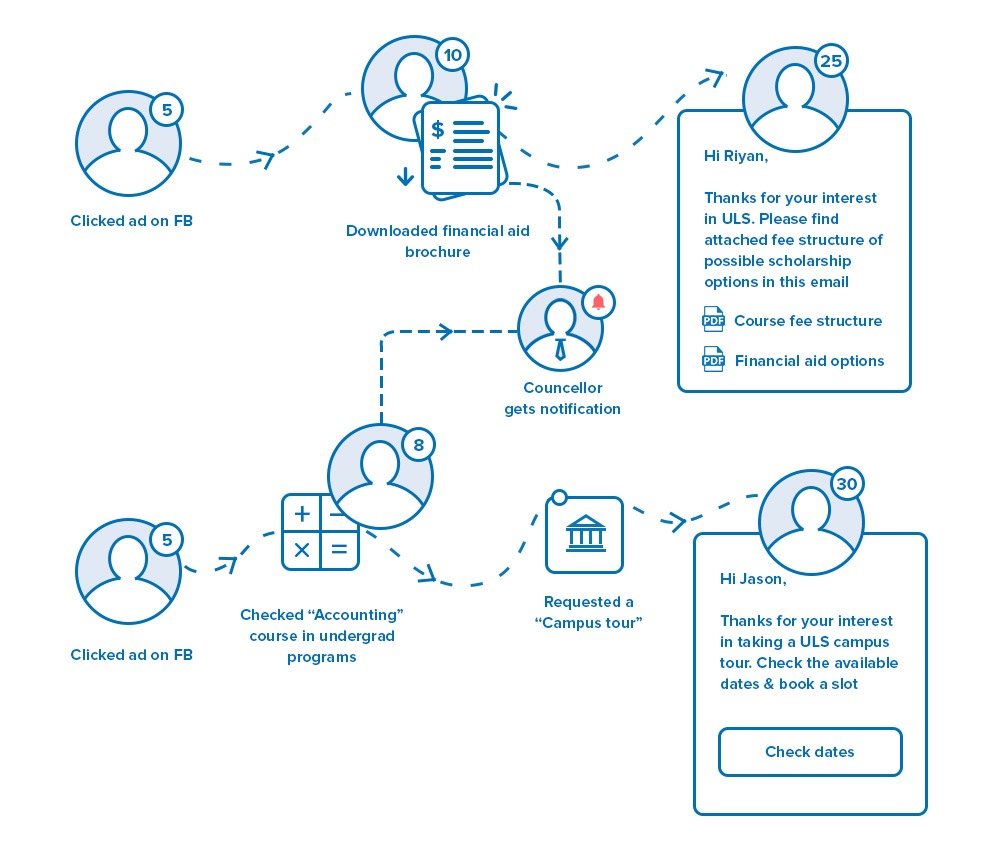
As institutions compete for students in a tougher market, these features make CRMs a valuable tool to reach and convert students.
CRMs not only improve recruitment outcomes but also help institutions reduce operational costs through an integrated CRM platform. According to a report by Tribal group, adopting a CRM can reduce student acquisition costs by 30%.

This combination of cost savings and efficiency helps institutions get more from their recruitment budget and achieve their enrollment targets without unnecessary spend. These benefits are particularly significant in the education sector, where financial challenges are often more pronounced.
Retention is a big challenge in the education sector as students expect more personalized support. A higher education CRM system helps institutions monitor student engagement, track academic progress, and implement timely interventions which all contribute to higher retention rates.
This is critical for colleges to provide a supportive environment for long-term student success.
One of the biggest benefits of CRM in the education sector is the ability to enhance the student journey and increase student engagement through personalized communication. CRMs use data on student preferences and behavior to create meaningful and customized interactions.
Salesforce Education Cloud data shows CRMs in institutions see 25% increase in engagement rates and 30% improvement in response times, creating stronger early connections that build trust and increase conversion.
The admissions process is resource heavy, institutions receive thousands of applications each cycle. CRMs integrated with student information systems help manage these volumes by automating key steps and increasing transparency so both applicants and admissions teams can see what’s happening. The education sector benefits greatly from these systems, ensuring better alignment with institutional goals and enhanced student engagement.


LeadSquared CRM users see a big reduction in application processing time and a boost in application completion rates. This means admissions staff can focus on building relationships with top candidates rather than paperwork.
Data driven decision making
Data analytics is another big feature of CRMs in the education sector, allowing institutions to make data-driven decisions based on real-time information. By analyzing enrollment, engagement, and academic performance trends, institutions can refine their strategy to improve student outcomes and operational efficiency.

Educause research shows colleges using CRM analytics see a 15% increase in retention and 20% better resource utilization, creating a more sustainable and student-centric learning environment.
CRMs are not just for current students; they are also key to building long term relationships with alumni. Strong alumni engagement benefits institutions through fundraising, mentorship and brand reputation and CRMs enable this engagement through:
CRMs simplify the planning and promotion of alumni events like networking gatherings, lectures and reunions which strengthen alumni connections.
By tracking alumni profiles and preferences CRMs make it easier to create mentorship opportunities, connect alumni with current students to support career development.
With detailed alumni profiles institutions can tailor their outreach to increase donation rates and build long term relationships.
Institutions with strong alumni engagement programs see higher fundraising success, CRMs help maintain active and ongoing relationships that benefit both alumni and the college. CRM systems are specifically designed to meet the needs and requirements unique to the education sector, ensuring better alignment with institutional goals and enhanced student engagement.
Implementing a CRM in higher education requires planning and collaboration across departments. Here are the steps to follow to ensure a successful CRM rollout:
Start by identifying the specific challenges and goals the CRM will address, align with institutional goals.
Involve admissions, marketing, student services and IT departments to ensure the CRM meets all departmental needs.
A training plan is crucial for adoption. Change management should highlight the benefits of the system and have clear communication to get user buy in.
Regular audits and user feedback sessions to ensure the CRM continues to meet evolving needs and maximize its impact.
Implementing these best practices ensures that the CRM system is tailored to the unique requirements of the education sector.
LeadSquared provides customized onboarding and training support to help institutions migrate to their CRM smoothly, so staff are ready to use the system to support student engagement and institutional goals.
With declining enrollment and rising student expectations, CRMs are the solution for higher education institutions to increase engagement, streamline processes, and make data-driven decisions in the education sector.
By investing in a CRM, colleges and universities can improve their ability to attract, retain, and engage students and thrive in a competitive education landscape.
For institutions committed to delivering personalized, high-quality education, investing in a CRM like LeadSquared higher education CRM goes beyond just a technological upgrade. It’s an essential step toward ensuring long-term success and resilience in an evolving educational landscape.
Enter your details and we'll send you a quick confirmation email to verify your address.

 8 min read
  12 min read
  16 min read



 A Comprehensive Guide to School Admission Software: Benefits, Features, and...
