





EDUCATION
How to re-engage and re-enroll stopped-out students at scale: Strategies that work
Contents

 19 min read


Only 43% of students who enter bachelor’s programs graduate within the expected timeframe. (Source).
This represents a significant global challenge and an unprecedented opportunity for higher education institutions worldwide.
Stopped-out students aren’t failures; they are adults who faced barriers, made hard choices, and left college with earned credits that can still lead to completed credentials and meaningful life change. For enrollment leaders, registrars, and student success teams, re-engaging them goes beyond filling seats—it supports completion goals, advances equity, and builds a sustainable enrollment strategy that isn’t reliant only on traditional first-time freshmen.
This comprehensive guide provides actionable, scalable strategies to re-engage and re-enroll stopped-out students—complete with data-driven frameworks, proven messaging scripts, and workflow templates.
Stop-out isn’t randomly distributed across student populations. According to a November 2025 report from the Community College Research Center (CCRC), nearly 40% of community college students do not return for their second year, with disproportionate impact on students of color, adult learners over 25, parents, and those balancing full-time employment.
The reasons students leave are equally complex. Financial pressures, family caregiving responsibilities, health crises, employment demands, and lack of academic support all contribute—but notably, academic failure is rarely the primary cause. Most stopped-out students leave with good academic standing, which means they’re eligible to return and are positioned to succeed with the right support.
For colleges and universities facing demographic headwinds and enrollment volatility, stopped-out students represent a strategic asset:
Yet despite these compelling reasons, most institutions lack systematic, scalable strategies to re-engage stopped-out students. Ad-hoc outreach, generic messaging, policy barriers, and insufficient tracking leave thousands of potential completers on the sidelines.
Before launching any outreach campaign, you must understand who stopped out, why they left, when they departed, and what barriers stand between them and re-enrollment.
Poor segmentation leads to generic messaging that fails; precise diagnosis enables personalized, effective engagement.
Start by extracting data from all students who left your institution in the past 1–5 years without completing a credential. Then segment this population across multiple dimensions:
Credits earned:
Students with 60+ credits should be your highest priority—they’re closest to completion and most likely to respond positively.
Time away:
Prioritize students who left within the past 1-2 years, as recency significantly impacts re-enrollment likelihood. Then expand to longer-term populations.
Last enrollment term:
Timing matters. Outreach should begin 4–6 months before your target enrollment term.
Stop-out reason (if documented):
If reasons aren’t systematically captured in your CRM, consider adding exit surveys or post-withdrawal check-ins to future processes.
Demographics and equity markers:
Tracking these markers ensures your strategies to re-engage stopped-out students advance equity rather than perpetuate disparities.
Program and major:
Students in discontinued programs need pathway counseling before re-enrolling; students in high-demand fields benefit from messaging that emphasizes career ROI.
The best outreach strategy fails if you can’t reach students. Before launching campaigns, audit your contact data quality:
If your overall contactability rate is below 60%, invest in data hygiene before launching large-scale campaigns. You’ll waste your budget and erode morale by sending messages into the void.
Before you begin outreach, document:
These baselines enable you to measure impact accurately and calculate ROI.
Effective strategies to re-engage stopped-out students require more than good intentions. You need cross-functional collaboration, technology infrastructure, clear accountability, and disciplined execution. Here’s how to build your re-engagement engine.
Re-enrolling stopped-out students touches every part of your institution. A successful initiative requires coordinated effort across multiple departments. Use this RACI framework (Responsible, Accountable, Consulted, Informed) to clarify roles:
Campaign lead (typically VP of Enrollment or Marketing):
Data and analytics (Institutional Research or CRM Manager):
Outreach execution (Enrollment counselors, advisors, call center):
Policy and process (Registrar, Financial Aid):
Meet weekly during campaign launch, then bi-weekly during execution. Clear communication prevents the “someone else’s job” trap that kills initiatives.
Your technology needs and costs scale with campaign ambition:
Low budget ($5,000–$15,000):
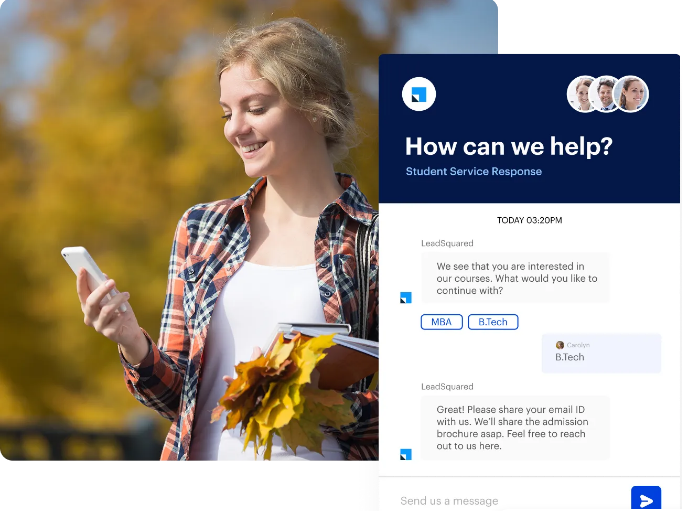
Medium budget ($15,000–$50,000):
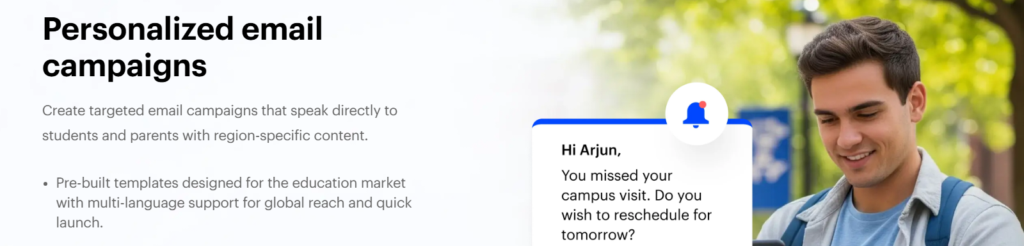
High budget ($50,000–$150,000):
Start with a low- or medium-budget pilot targeting 500–1,000 students. Scale investment based on proven ROI.
This proven sequence combines multi-channel persistence with strategic timing to maximize response and conversion rates. Implement it over 60–90 days before your target enrollment term:
Day 0: Segment and load
Day 1: SMS #1 – The opening
Check out LeadSquared’s Higher Education Text Messaging Platform
Day 3: Email #1 – The invitation
Helpful resources:
Using CRM To Power Highly Personalized Marketing Campaigns
Personalizing Higher Education Marketing Campaigns At Scale
Day 7: Phone call #1 – The human connection
Day 14: SMS #2 – The incentive
Day 21: Email #2 – The social proof
Day 30–35: Direct mail (optional but powerful)
Day 45–60: SMS #3 and Phone call #2 – The final push
Throughout this sequence, any student who responds immediately exits the automated cadence and enters a personalized, one-on-one nurture track with an assigned advisor. Speed to response matters—aim to contact responsive students within 2 hours during business hours.
When students respond, your team needs clear protocols for next steps:
Interested and ready to apply:
Interested but has barriers:
Maybe later / need more time:
Not interested / do not contact again:
Adult learners are motivated by different factors than traditional 18-year-olds. Your messaging must reflect their lived realities, speak to their aspirations, and remove psychological barriers that make re-enrollment feel impossible.
SMS #1 (160 characters): “Hi [Name], you earned [X] credits toward your degree at [Institution]. We’d love to help you finish. Reply YES to learn about flexible options.
SMS #2 (time-sensitive): “[Name], we’ve waived your $50 application fee—just for you. Re-enroll by [date] and get priority registration for fall classes. Questions? Text or call [number].”
SMS #3 (final outreach): “[Name], fall classes start [date]. You have everything you need to succeed—and we’re here to help. One quick call: [number]. Hope to see you in class.”
Email #1 body:
Hi [Name],
Life took you in a different direction a few years ago—but your [X] credits at [Institution] are still here, waiting to work for you.
Since you left, we’ve helped hundreds of students just like you finish their degrees with flexible schedules, one-on-one advising, and financial support. Many were surprised to learn they were just [Y] credits away from graduating.
Here’s what happens next if you’re interested:
1. Reply to this email, call me at [phone number], or schedule a 15-minute call here: [calendar link] 2. We’ll review your transcript together and create a personalized completion plan 3. You can apply for free (we’ve waived the application fee) by [date]
You’ve already done the hard part—starting. Finishing is closer than you think.
I’m here to help,
[Advisor name]
[Title]
[Email] | [Phone]P.S. Check out [Student name]’s story—she came back after 3 years and graduated in 18 months while working full-time: [link to video or written story]
Email #2 subject line: “How [Alumna Name] finished her degree while raising two kids”
Email #2 body:
Hi [Name],
I wanted to share a story I think you’ll relate to.
[Alumna name] left [Institution] in 2019 with 54 credits. She had a full-time job, two young kids, and $800 in unpaid balances. She thought finishing was impossible.
But in 2022, she came back. We cleared her balance, she took evening classes online, and she graduated last spring with her [degree name]. Today she’s [new job title] earning [X% salary increase].
Here’s what she said: “[Quote about how returning was the best decision and how the support made it possible].”
You can read her full story here: [link]
If you’re wondering whether you can do it too, the answer is yes. Let’s talk about your path.
[Advisor name]
[Contact information]
Voicemail script (30 seconds):
“Hi [Name], this is [Advisor name] from [Institution]. I see you earned [X] credits with us back in 2026—you’re more than halfway to a degree. I’d love to help you explore flexible options to finish, whether that’s online, evenings, or a custom schedule. No pressure, just possibilities. Call me back at [number] or text YES to [shortcode]. Thanks, and I really hope to hear from you soon.”
Don’t assume you know what resonates. Test:
Even perfect messaging fails if policy barriers block re-enrollment. Audit and fix these friction points before launching outreach.
Eliminate or waive re-application fees: Charging stopped-out students to reapply sends the message that you don’t really want them back. Waive fees for all stopped-out students, or at minimum for those who left in good academic standing.
Simplify re-admission applications: If a student was making satisfactory academic progress when they left, allow immediate re-enrollment with minimal paperwork—ideally a one-click “I’m ready to return” form that confirms contact information and intended major.
Grant automatic good standing: Unless a student was dismissed for academic or conduct reasons, presume they’re eligible to re-enroll without petitions, committee reviews, or waiting periods.
Clarify academic forgiveness policies: Publish clear, accessible information about:
Auto-package preliminary financial aid: Generate an estimated financial aid offer in your first outreach email. Even a rough estimate (“You may be eligible for up to $X in grants and $Y in loans”) reduces financial uncertainty that prevents students from engaging.
Offer emergency grants and balance clearance: Small debts create massive barriers. Consider:
Lumina Foundation research found that emergency grants of $1,000 can resolve outstanding balances for 60% of stopped-out students, removing their primary barrier to return.
Create flexible payment plans: Partner with third-party providers (Nelnet, Flywire, Sallie Mae) to offer:
Create a downloadable “Your Return Checklist” that students can reference:
Make this checklist prominent in all outreach materials and on your re-enrollment landing page.
Allow students to earn meaningful credentials on the path to a degree:
Market these milestones in outreach: “Earn a career-ready certificate in just one semester, then keep going toward your degree.”
This approach:
Work with community colleges to retroactively award associate degrees to students who transferred to your institution before completing 60 credits at their original school. This:
If you’re a community college, partner with universities to ensure your stopped-out students receive their associate degrees after transferring, creating momentum for bachelor’s completion.
Stopped-out students aren’t lost to higher education—they’re waiting for an institution that will meet them where they are, honor their prior learning, remove barriers, and provide real support for completion.
With proven strategies to re-enroll stopped-out students at scale, your institution can:
The data is clear: institutions that invest systematically in re-engagement see measurable results within a single term. What’s missing is institutional will and strategic execution. Start with a focused pilot. Measure rigorously. Scale what works.
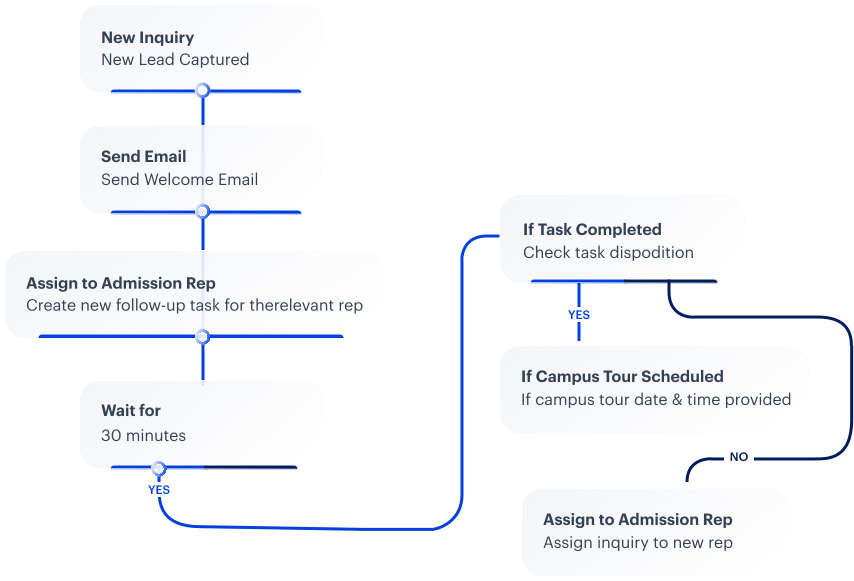
LeadSquared’s higher education CRM gives you the tools to do exactly that: automated multi-channel campaigns, real-time student tracking, customizable workflows for the 8-step cadence outlined in this guide, and dashboards that measure every KPI that matters. From segmentation to re-enrollment, LeadSquared helps enrollment teams turn stopped-out students into graduates.
Three factors drive higher re-enrollment: recency (students who left within 1-2 years are more likely to return), credits earned (students with 60+ credits have higher completion probability), and persistence of outreach (multi-channel campaigns with 8-12 touches over 60-90 days outperform single-touch efforts). Measure your baseline in your pilot campaign.
A focused pilot can launch in 4-6 weeks.
Weeks 1-2: data audit and team assembly.
Weeks 3-4: build workflows and messaging.
Weeks 5+: launch outreach to 500-1,000 students.
LeadSquared’s higher education CRM can accelerate this timeline with pre-built templates for multi-channel campaigns and automated segmentation tools.
Re-engaging stopped-out students typically delivers strong ROI because acquisition costs are significantly lower than recruiting new students ($200-$800 vs. $2,000-$5,000 per enrollment). Calculate your specific ROI as: (Net tuition revenue from re-enrollments – Campaign cost) ÷ Campaign cost. Track this metric from your pilot to build your business case.
You need a CRM that handles multi-channel sequences (SMS, email, phone), tracks every touchpoint, and reports on key metrics. LeadSquared’s higher education CRM is purpose-built for complex enrollment campaigns, with automated workflows for the 8-step cadence, real-time dashboards for measuring contactability and response rates, and integrations with your SIS for seamless data flow.

 8 min read 18 min read
  8 min read


 How to Improve Student Experience in Higher Education