





- Home

- Learn
- Process Automation
- Understand Onboarding Automation
PROCESS AUTOMATION
Understand Onboarding Automation
Contents

 6 min read


In this article, we will discuss the prevailing onboarding challenges. We will also look at how simple onboarding automation tools like self-serve portals can speed up your operations.
Not very long ago, onboarding used to be a manual process. It required many human interactions. But it has now become simpler with digital technologies and tools.
Onboarding started as a smaller segment in the vast expanse of technological implementations. It was a small backend application to collect the company employee information. Earlier implementation of automation revolved only around onboarding new employees.
Soon, businesses realized the amount of time and effort they spend on onboarding tasks. To simplify the process, they started adopting automation tools.
Today, the employee onboarding process has evolved into automated onboarding across all industries.
The growth of the onboarding software industry is indicative of the values it brings to the plate.
The onboarding workflow in any industry involves some/all the following stakeholders:
For ease of operations, companies want to know everything about their stakeholders. Availability and access to data from thousands of interconnected sources can give a competitive edge to a company. While the data is here, so are the obstacles. The need to learn, adapt, and grow with the massive amount of data requires a strategic approach. Onboarding automation, data, and technology form a perpetual cycle.
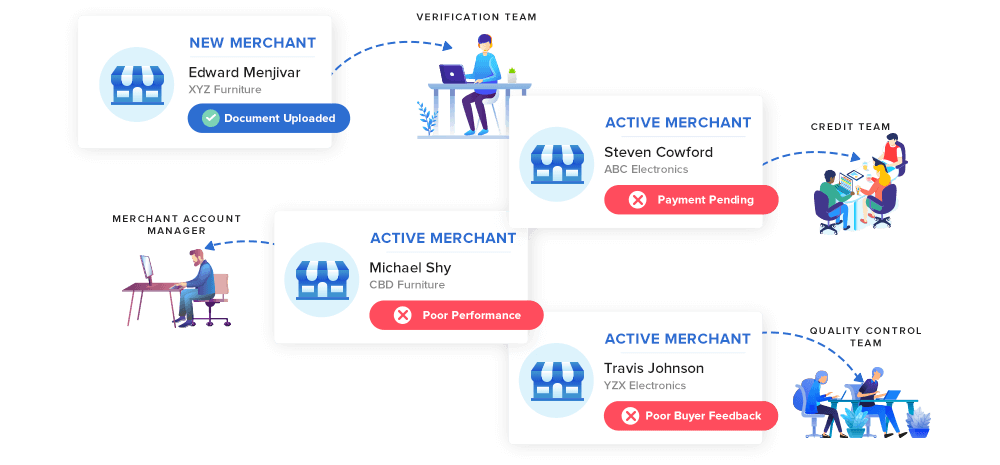
What most companies fail to realize is that onboarding is not a one-time exercise. The process is continuous, time taking, and stressful. Acquiring new customers is 5 to 25 times more expensive than retaining existing ones. (Source: Invesp)
It involves assessing and reassessing the ever-evolving client’s situation and needs. That is, only after a thorough review, offer the best possible solution to your clients.
A continuous onboarding process helps manage any changes in the circumstances of the customer. For example, you can easily manage KYC, legal checks, product & service configurations, etc., on the go.
The prevailing pandemic has added further complexities to the onboarding paradigm. Lockdowns have stalled onboarding and have created bottlenecks in the business processes.
To resolve these challenges, organizations must invest in digital onboarding solutions. For example, Video KYC to onboard customers and partners from a remote location is one of the solutions.
Automation is about digitizing manual and repetitive processes. Some of these processes include monotonous tasks such as:
Contrary to popular belief, automation is not a one-time project. It is an unending development process.
Automating a small part of your business is not enough. When companies look at the bigger picture, they realize that it is not a single piece of software. But automation is a practice of streamlining and stabilizing the whole business process.
The initial deployment is an arduous learning experience. When the first piece fits right, you will start using the next automation opportunity. It will help you grow and improve your system as you learn what works.
An onboarding solution can transform the whole experience into a rewarding initiative. The following are its key features:
In any organization, onboarding involves the following four crucial phases:
Today, manual processes are a barrier to good customer experiences. It includes the client onboarding phase. Companies that engage more with clients motivates them to buy 90% more frequently. They also spend 60% more per transaction and have almost three times the annual value than other customers.
The following are the proven benefits of onboarding automation:
Automation solutions can give a competitive edge to your organization. It will not only speed up the operations but also deliver better customer experiences. Successful companies are miles ahead of their competitors with the implementation of automation.
Therefore, the time is ripe to invest in onboarding tools to avoid the repercussions of late adoption.
Try LeadSquared Onboarding Automation Software for Free!
Also read:
Onboarding in recruitment refers to the process of bringing a new member/employee to work. Recruitment involves finding a candidate, interviews, etc., while onboarding comes after securing the candidate.
It depends on the industry and individual business processes. For example, employee onboarding may take days, whereas digital vendor onboarding happens instantly. u003ca target=u0022_blanku0022 href=u0022https://www.leadsquared.com/vendor-onboarding-software/u0022 rel=u0022noreferrer noopeneru0022u003eDetailsu003c/au003e.
Orientation is a part of the onboarding process. It involves making the new team member familiar with the organization, teams, processes, and systems. On the other hand, onboarding involves document collection and verification, orientation, and training.

 9 min read
  13 min read
  15 min read


 Why is online onboarding system necessary for field sales agents?