




EDUCATION
Lead generation strategies for higher education: AI, CRM, and global best practices
Contents

 16 min read


The enrollment landscape has fundamentally transformed over the past few years.
What once worked no longer delivers the same results. Think broad demographic targeting, simple email campaigns, and traditional open house events.
Prospective students now expect instant responses, personalized interactions, and seamless experiences across every channel they use, from Instagram to WhatsApp to your website chatbot.
For enrollment and marketing leaders, this shift presents both challenges and unprecedented opportunities. Early adopters are discovering that modern lead generation strategies for higher education can generate more applications with fewer resources—but only when strategy, technology, and execution align.
Cost per inquiry in higher education has climbed significantly, with institutions spending anywhere from $100 to over $1,000 per lead last year, depending on channel and program type.
International recruitment adds further complexity—regional privacy laws, social platforms, and academic calendars—while rising costs and demographic shifts intensify competition.
Yet some institutions are thriving in this environment. They’re not necessarily outspending their peers. Instead, they’re deploying AI lead generation strategies for higher education that combine artificial intelligence for predicting which prospects will enroll, CRM systems that coordinate personalized engagement across email, SMS, and chat, and global-first thinking that adapts tactics to local markets.
This guide offers tactical implementation steps and proven strategies for any institution—from regional colleges to flagship universities to online programs—ready to modernize their lead generation.
Generic “prospective student” personas are obsolete. Build ICPs at the program level:
Layer in behavioral signals: content consumption patterns, device type, time-to-inquiry from first touch, and engagement velocity.
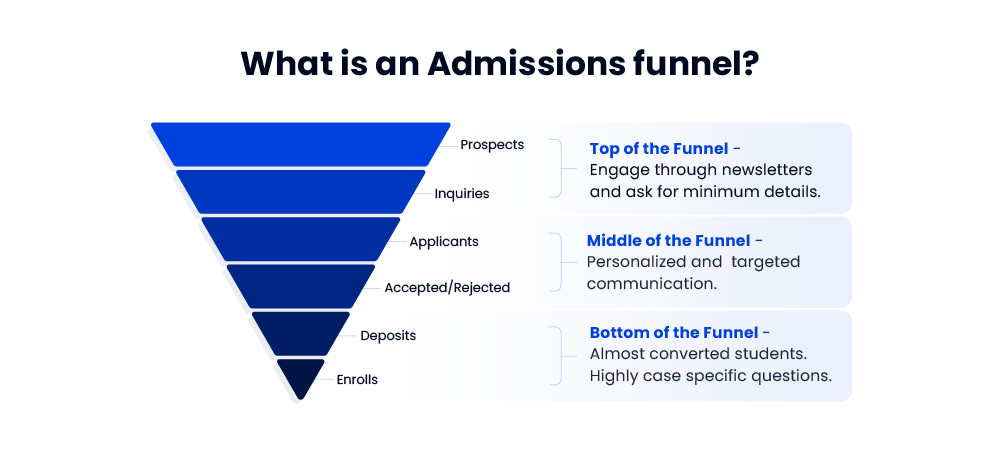
The modern funnel isn’t linear, but you still need defined stages:
Define clear milestones and set target conversion rates for each stage of the funnel. While specific benchmarks vary by institution type and acceptance rate, establish baseline conversion targets at each stage and measure performance consistently to identify improvement opportunities.
In a LeadSquared webinar, experts discussed the best practices to set up and grow a student engagement engine. They discussed how to connect with students at the appropriate time, channel, and message to increase enrollment.
Watch the recording here:
Standardize lead types with scoring and ownership:
Build routing logic in your CRM: Round-robin by counselor capacity, geo-based assignment for regional expertise, program-specific specialists for graduate/professional programs.
With AI lead scoring, move beyond demographic scoring to machine learning models that predict application and enrollment likelihood.
Deploy AI chatbots for 24/7 inquiry capture, qualification, and routing—critical for global recruitment across time zones.
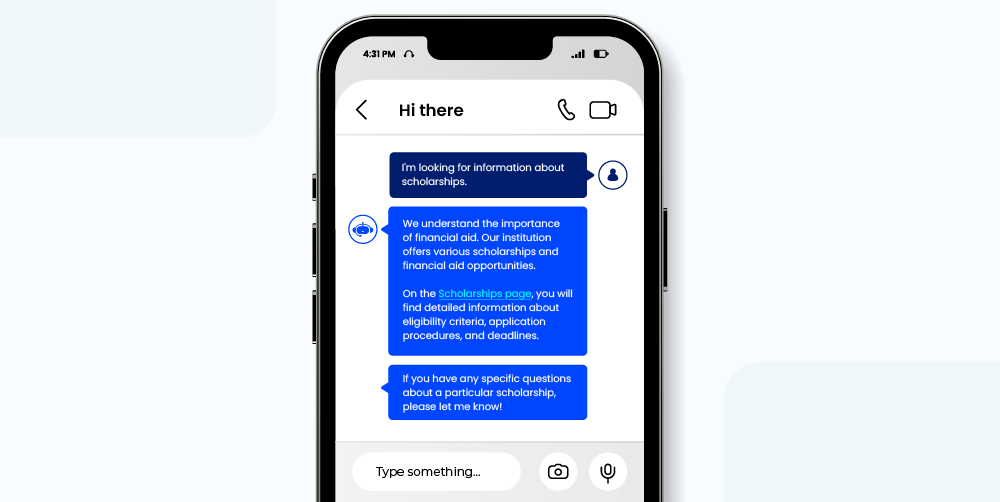
Best practices:
Tools: LeadSquared, Drift, Intercom, MobileMonkey, or custom builds on Dialogflow/Rasa.
Use AI to personalize website content, email sequences, and ad creatives based on individual behavior.
Tactics:
Generate program-specific blog posts, email copy variations, and ad headlines using GPT-4/Claude, but always human-review for accuracy, tone, and compliance.
Workflow:
Helpful resource: 50+ ChatGPT Prompts For Marketing [Free Examples & Expert Tips
Optimize every academic program page for search:
Target keywords: “[program name] degree,” “best [program] programs,” “[program] online degree,” “[career] degree requirements.”
Helpful resource: SEO For Educational Institutions: Boost Visibility
Embed calculators on program pages that estimate net cost after aid and post-graduation salary:
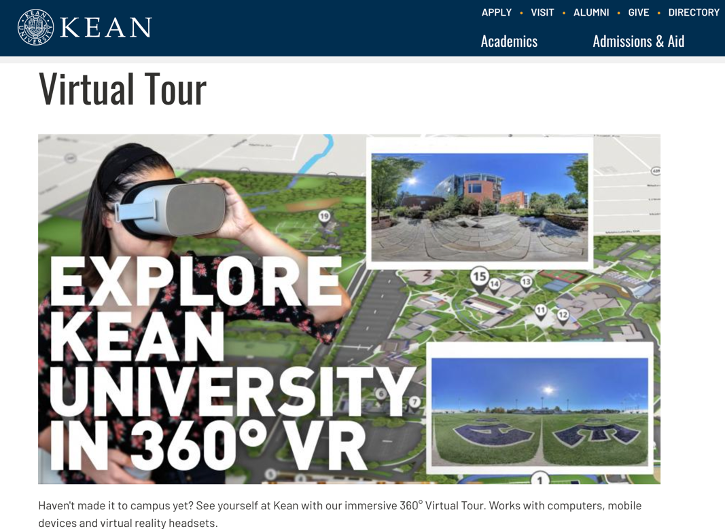
Host program-specific webinars (admissions Q&A, faculty panels, student panels) with targeted promotion:
Build formal agreements with community colleges and pathway providers:
Incentivize alumni to refer qualified prospects:
Helpful resources:
The Ultimate Guide To Higher Education Marketing In 2025
5 Education Marketing Channels & 8 Strategies: Boost Conversions
Asia-Pacific (APAC)
| Regulation | Scope | Key Requirements |
| GDPR | EU/EEA residents | Explicit consent, right to erasure, data portability, DPO if processing large scale |
| FERPA | US student education records | Parental consent for <18; student consent for college/university students |
| PECR | UK electronic marketing | Opt-in for email/SMS marketing; cookie consent |
| CAN-SPAM | US commercial email | Clear unsubscribe, accurate sender info |
| CASL | Canada commercial email | Express or implied consent; unsubscribe in every message |
| LGPD | Brazil | Similar to GDPR; consent, data minimization, DPO |
| PDPA | Singapore, Thailand | Consent, purpose limitation, data protection officer |
Lead generation efficiency:
- Cost per Lead (CPL): Media spend ÷ leads generated (target: $40–$120 depending on program)
- Cost per Application (CPA): Media spend ÷ applications received (target: $300–$1,500)
- Customer Acquisition Cost (CAC): Total marketing spend ÷ enrolled students (target: <10% of first-year tuition revenue)
- Inquiry → MQL: 40–60%
- MQL → SQL: 35–50%
- SQL → Application: 40–55%
- Application → Enrollment: 60–75%
- Time to first response: <60 seconds for hot leads, <24 hours for warm
- Engagement velocity: Days from inquiry to 3rd meaningful interaction (target: <14 days)
- Nurture touch count: Average touches before application (benchmark: 8–12)
Build role-based dashboards in your CRM or BI tool (LeadSquared, Tableau, Power BI, Looker):
CMO/VP dashboard:
Enrollment manager dashboard:
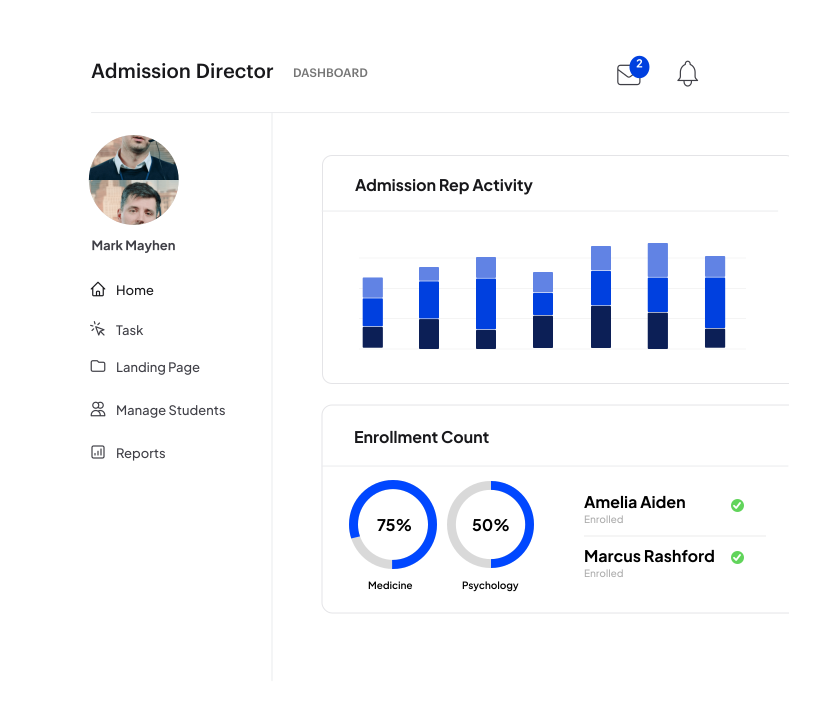
Digital marketing dashboard:
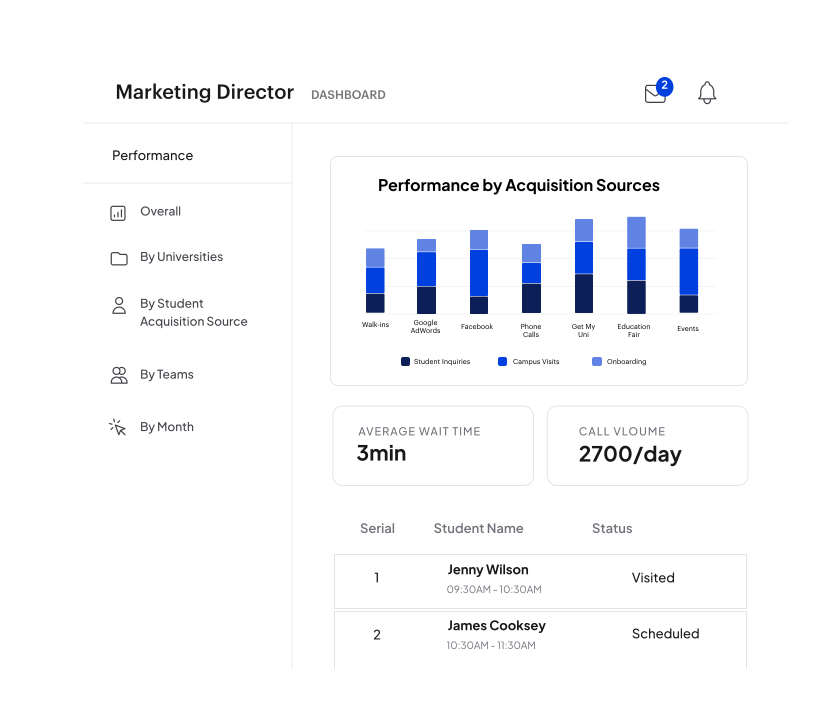
Prioritize A/B tests by expected impact and ease of implementation:
Q1 tests:
Q2 tests:
Q3 tests:
Q4 tests:
Effective AI lead generation strategies for higher education aren’t about replacing human counselors with robots—they’re about equipping your team with tools that identify the right prospects, deliver personalized experiences at scale, and free up staff for high-impact relationship-building.
The institutions thriving share common traits:
Remember—lead generation is only valuable if those leads convert to enrollment. Align marketing and admissions under shared KPIs, unified data, and a commitment to the prospective student experience.
The right CRM foundation makes all the difference. Platforms like LeadSquared’s Higher Education CRM provide purpose-built tools for student recruitment—from automated lead capture across all channels and intelligent lead scoring to omnichannel engagement orchestration and speed-to-lead automation. When your technology stack is designed specifically for enrollment management rather than generic sales, your team can focus on building relationships instead of managing spreadsheets.
Take the next step: Conduct a lead generation audit to benchmark your current performance against the strategies outlined here. Identify your top 3 quick wins and your transformational initiative (likely AI scoring or CRM overhaul). Then build your business case with projected ROI and resource requirements.
The enrollment funnel of the future is here. Will your institution lead or follow?
Move beyond basic demographics to behavioral and predictive segmentation. Segment by:
Engagement level: High-intent (multiple touchpoints, program page visits) vs. exploratory (single landing page view)
Program interest: Group by specific majors, degree levels, or study modes (online vs. on-campus)
Geographic location: Domestic vs. international; regional preferences for campus proximity
Application readiness: Hot leads (downloaded application, requested info session) vs. cold leads (early awareness stage)
Source channel: Organic search, paid ads, referrals, education fairs—each requires different nurture approaches
Financial profile: Scholarship seekers, aid-dependent, or full-pay prospects
Use a purpose-built higher education CRM like LeadSquared to automate this segmentation with intelligent lead scoring that updates in real-time based on behavior. The platform’s automated workflows can then trigger personalized nurture campaigns for each segment—ensuring counselors focus on high-propensity leads while marketing nurtures those still in consideration.
Focus on quality over quantity by refining your targeting and qualification criteria:
Improve lead quality at the source –
Target lookalike audiences: Upload your enrolled student data to Meta/Google to find prospects with similar profiles
Use program-specific landing pages: Create dedicated pages for each program with clear admission requirements—this pre-qualifies visitors
Deploy lead scoring: Assign points based on engagement signals (program page visits, brochure downloads, event attendance) to identify high-intent prospects
Add qualification questions: Include fields like “intended start term,” “program of interest,” and “education level” in inquiry forms
Leverage AI and automation –
Conversational chatbots: Use AI chatbots to ask qualifying questions (budget, timeline, program fit) before passing leads to counselors
Predictive scoring models: Implement machine learning that predicts application likelihood based on historical data
Optimize channels –
SEO for high-intent keywords: Target bottom-of-funnel searches like “apply to [program]” or “[program] admission requirements”
Retarget engaged visitors: Show ads to people who spent 2+ minutes on program pages or visited multiple times
Partner strategically: Build relationships with community colleges, pathway providers, or education agents who deliver pre-qualified transfer students
Automate qualification workflows –
A CRM like LeadSquared can automatically score and segment leads in real-time, routing only qualified prospects to counselors while nurturing lower-scoring leads until they’re ready. The platform’s intelligent lead distribution ensures your team spends time on prospects who match your ideal candidate profile—improving both conversion rates and counselor efficiency.
Result: Fewer junk inquiries, higher inquiry-to-application rates, and better ROI on marketing spend.
Don’t discard them. Tag with “future term interest” and enter long-term nurture: quarterly program updates, new scholarship announcements, curriculum changes. Re-activate 6–9 months before the next intake with refreshed messaging. Recycled leads convert at 15–25% in subsequent cycles.
Three levers with immediate impact:
(1) Speed-to-lead—respond within 5 minutes;
(2) Personalization—reference prospect’s specific program interest and source in first outreach;
(3) Remove friction—simplify application, provide document checklists.
Use automation for efficiency (lead routing, reminders, FAQs), not relationship-building. Reserve human counselor time for high-value interactions: campus visit planning, financial aid consultations, program fit discussions. Train staff to reference CRM data in calls (“I see you visited our engineering page 5 times—let’s discuss what excites you about that program”).
Run campaigns through regional instances with geo-specific consent workflows. Example: EU prospects see GDPR-compliant forms with granular opt-ins; US prospects see CAN-SPAM-compliant forms with simpler unsubscribe. Use CRM custom fields to track consent by region and channel. Consult legal counsel for complex scenarios (e.g., EU citizens studying abroad).
You can increase student lead volume without increasing cost by improving conversion and re-engagement. LeadSquared helps capture more leads from existing channels, nurture incomplete or cold inquiries with automated follow-ups, retarget high-intent prospects, and optimize campaigns using conversion and ROI insights—so you generate more leads from the same budget.

 16 min read
  9 min read 17 min read



 Top 12 Education KPIs To Drive More Enrollments in 2026