





LENDING
Loan origination automation system: Smarter, faster, AI-powered
Contents

 13 min read


Lenders are no longer competing on interest rates alone. They are competing on experience, reliability, and speed. In India, that pressure is even intense because borrowers have more options than ever, and switching costs are close to zero.
Let’s start with a scenario you may find relatable.
A customer applies for a two-wheeler loan from their phone while standing at the dealership. The dealer says, “Approval will take 10 minutes.” The customer uploads PAN and Aadhaar, shares basic details, and expects a clear next step. Ten minutes pass. Then twenty. Nobody calls. The customer is not angry yet, but they begin to wonder if they should walk next door to another NBFC.
From the borrower’s side, it feels like silence. From the lender’s side, the file is moving, just not in a way the borrower can see.
The application might be sitting with an operations team that is handling a festival-season spike. One document is readable, but slightly unclear, and the agent hesitates because they do not want to trigger a duplicate request. A verification request has been initiated, but the result is sitting in a different system, and no one has refreshed that screen yet. A credit officer has flagged a small clarification and assumed someone else will pick it up. No one is being careless. No policy has been ignored. Yet the experience feels stalled.
That gap between internal activity and external silence is where trust takes a hit. It is also where this system becomes a strategic lever, not just a tech upgrade.
In this article, we will walk you through what loan origination automation really means in the context of today’s Indian lending sector, what leading NBFCs are doing differently, where AI genuinely helps, and how to evaluate a solution without falling for buzzwords.
Indian lenders are scaling across channels: branches, DSAs, marketplaces, embedded finance partnerships, and D2C avenues. At the same time, regulators are tightening expectations around transparency, consent, and governance in digital journeys. The RBI’s Digital Lending Directions, 2025 consolidate and build on prior guidance, including requirements for regulated entity and lending service provider arrangements.
So, the challenge is not only “process faster.” It is “process faster, with control.”
That combination is hard to pull off when origination is spread across email threads, spreadsheets, multiple point solutions, and tribal knowledge. What breaks first is consistency. What breaks next is visibility. And then costs rise quietly, because teams end up doing the same work twice.
This is why a loan origination automation system is no longer just a growth tool. It is operational risk management.
You will hear several terms used interchangeably: loan automation software, loan processing automation, an automated loan processing system, even a lending automation processing system.
The simplest way to define it is this: A loan origination automation system is the operating layer that makes sure every application moves through intake, documentation, verification, credit decisioning support, and disbursal workflows in a predictable way, with audit trails and borrower communication baked in.
It does not mean you remove underwriting. It means you remove avoidable delays, manual handoffs, and “who owns this file” confusion.
Many NBFCs handle both assisted and digital journeys; this matters because the borrower does not care which channel they used. They care that it works.
Borrower experience in India is often shaped by three emotions: urgency, anxiety, and trust. Urgency is obvious. People apply for credit because they need something now. Medical expenses. School fees. A working capital gap. Purchase at the point of sale.
Anxiety shows up quickly when communication is unclear. If a borrower uploads documents and hears nothing, they assume something is wrong. If they are asked for the same item twice, they assume the lender is disorganized. If they are told “verification pending” for a day, they assume the lender is not serious.
Trust is what decides whether they continue, and whether they come back.
A well-designed automated loan origination system reduces anxiety by making the process visible and structured. The borrower receives an acknowledgement immediately. They know what happens next. If something is missing, the request is precise. If there is a delay, they get an update before they have to chase.
This is not about fancy UX. It is about operational truth showing up on the borrower’s screen.
And that is exactly what many high-growth NBFCs are optimizing for right now.
In India, intake is messy because distribution is diverse. A single lender may get leads from DSAs, branches, call centres, websites, apps, and platform partnerships. When each source runs its own mini-process, consistency collapses.
A loan automation system centralizes intake, so every application becomes a trackable object with a clear owner, SLA, and next step.
This is where lenders remove two silent killers: duplicates and misrouting.
For example, a borrower might apply through a partner platform and also through your website because they did not get confirmation the first time. Without automation, two teams work the same file. With a structured intake flow, you dedupe early and route correctly.
That is not just efficiency. It prevents poor borrower experience and internal friction.
This is also where India’s lending rails are evolving. The RBI Governor addressed the potential of the Account Aggregator framework and the Unified Lending Interface (ULI) to streamline and standardize lending processes as part of digital public infrastructure. If your intake layer is chaotic, you will not be able to fully leverage these rails. Don’t you think?
Document collection is where borrowers lose patience, and where lenders lose time.
In India, documentation varies widely by product and borrower type. A salaried borrower looks different from a self-employed professional. A local shop owner’s cash flows look different from a mid-sized distributor. MSME underwriting often involves bank statements, GST data, and business proofs, while consumer lending may rely on a different set of signals.
When documentation is treated as a one-size-fits-all checklist, two things happen:
Loan origination automation software helps by making document requirements dynamic. The borrower sees only what is relevant. The lender sees what is complete, what is unclear, and what needs follow-up. Requests are specific, not generic.
This is where your tone matters. “Upload KYC docs” is vague. “Your PAN image is unclear, please re-upload a sharper photo,” is respectful and actionable. Automation lets you standardize that clarity.
Verification is essential. The problem is orchestration.
Many NBFCs have separate systems for bureau pulls, KYC checks, bank statement analysis, fraud checks, and internal policy validations. The checks may be fast, but the coordination is manual.
An automated loan origination system orchestrates verification like a relay race where the baton is never dropped. When prerequisites are met, checks are triggered. Results are logged. Exceptions are flagged early. Files move to the right queue without someone needing to nudge them.
This is also where India’s Account Aggregator (AA) ecosystem is changing the equation for income and cash-flow visibility through consent-based data sharing. Sahamati’s FY25 impact reporting estimates meaningful scale in AA-enabled disbursals and loan counts, signaling real adoption across lenders and products.
If you are using AA flows, automation becomes even more valuable because consent journeys, data pulls, and exception handling must be consistent and auditable.
This is the part people get wrong. They assume automation means “auto-approve.”
In reality, most mature lenders in India use automation to support credit discipline, not bypass it.
An automated loan origination system helps you do three things well:
That last point matters more each year. Governance expectations are rising, and the RBI’s Digital Lending Directions emphasize responsibilities and oversight in regulated entity and service provider arrangements.
Automation, done well, gives you traceability. It reduces “decisioning by WhatsApp” and replaces it with documented workflows.
AI is useful in origination when it handles scale, not judgment.
In Indian lending environments, AI tends to add value in some core aspects where humans get slowed down:
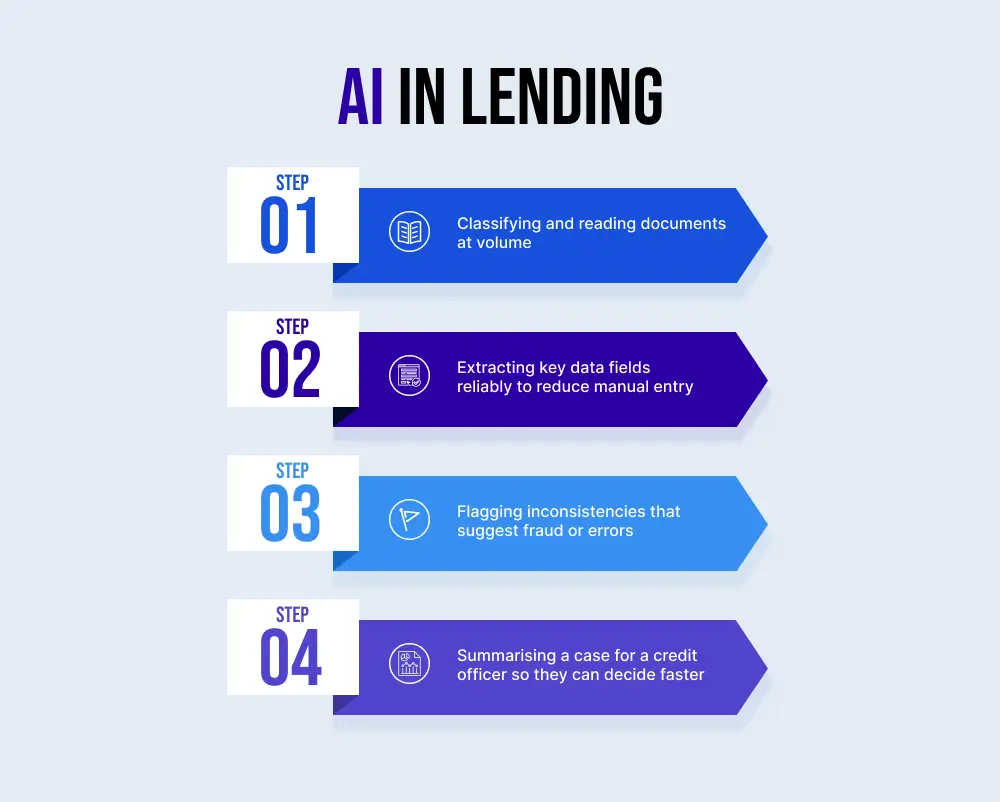
AI can also improve responsiveness in borrower communication, but it must be controlled. A borrower does not want a chatbot that sounds confident and wrong. They want clarity, status, and the ability to reach a human when it matters.
The rule of thumb is simple: use AI to reduce repetitive tasks and use humans for exceptions and judgment.
When a loan automation system is implemented, these are some benefits that eventually show up:
Turnaround times become predictable; teams spend less time chasing and more time deciding on matters of importance. Drop-offs are reduced because borrowers get clarity. Compliance teams get better audit trails. Operations leaders also get better visibility into bottlenecks by stage, channel, and geography.
There is also another specific benefit lenders increasingly focus on: repayment setup reliability.
Mandate-based repayments are a major lever for portfolio health. UPI AutoPay adoption has been growing, and recurring payment rails have become a bigger part of how lenders design collections and repayment experiences.
A system that connects origination to repayment setup smoothly, without handoffs, reduces all the back and forth during collections later on.
A credible conversation about loan automation must include risks.
Automation scales whatever you build. If you build a clean workflow, you scale discipline. If you build a messy workflow, you scale mistakes. The foundation has to be set right.
The main risks lenders should plan for are:
The RBI’s Digital Lending Directions, 2025 exist largely because guardrails matter in digital journeys.
Treat compliance as a design input, not a final checklist.
This is where many projects go off track, not because technology fails, but because expectations are unrealistic.
Implementation usually requires:
In the Indian context, add one more layer: partner distribution realities. DSAs and field teams need workflows that work on mobile, in low-connectivity environments, and with regional operational patterns. If your automation assumes perfect conditions, adoption will fail.
Also consider strategic shifts like co-lending. RBI’s co-lending framework that took effect from Jan 1, 2026, is expected to shape how some lenders think about origination, funding commitments, and operational timelines.
If your origination is not structured, co-lending complexity becomes hard to manage.
When evaluating such software, we think it’s important to ask questions that reveal operational truth:
Can you configure workflows without rebuilding everything each time a policy changes? Can you see where every file is stuck and why? Do you have audit trails that are easy to retrieve? Can you integrate cleanly with bureaus, KYC, AA flows, and your internal systems? Can you support both assisted and digital origination?
Also ask about resilience. What happens during outages? What is the incident response process? How is data access controlled?
Such solutions aren’t defined by features alone. It is defined by how reliably it performs under pressure.
LeadSquared is one option in the broader category of loan origination automation software. It is commonly used to structure intake, automate workflows, orchestrate follow-ups, and improve visibility across origination journeys.
As with any platform, outcomes depend on implementation discipline, integration choices, and governance. The best results come when lenders treat automation as infrastructure and align it tightly with policy and compliance requirements.

The strategic story here is not “technology is the future.” The strategic story is that Indian lending is scaling, distribution is diversifying, and governance expectations are rising.
A well-designed loan origination automation system helps NBFCs grow without losing control. Borrowers experience clarity and momentum. Leadership gets visibility and predictability.
That combination, speed with discipline, is what separates lenders that scale sustainably from lenders that simply grow busy.
A loan origination automation system helps lenders manage the entire loan journey from application to disbursal. It automates tasks like application intake, document collection, verification checks, and workflow routing so teams can process loans faster.
Loan origination automation helps lenders handle growing application volumes without increasing operational load. It reduces manual work, speeds up turnaround time, and ensures applications move through verification and credit checks in a structured way.
Many NBFCs use loan automation to manage applications coming from multiple channels such as digital platforms, DSAs, and branch teams. Automation helps them coordinate verification checks, documentation, and credit workflows while keeping the borrower’s journey consistent.
It’s essential to consider software that supports flexible workflows, integrates with verification services and data providers, and provides strong audit trails. The system should also adapt easily as regulations, products, and lending strategies evolve.

 11 min read
  9 min read 9 min read