




EDUCATION
Personalizing higher education marketing campaigns at scale: Best practices, frameworks, and use-cases
Contents

 20 min read


Picture this: It’s Tuesday morning, and your enrollment team hits “send” on 47,000 emails promoting “world-class education” to every prospect in the database. An aspiring nurse gets the same message as a computer science major. A parent researching costs sees identical content to a student comparing athletic programs. Open rate: 8%.
Now imagine instead: That nursing student who spent five minutes on your healthcare page receives an email highlighting clinical placements. The computer science inquiry who downloaded your engineering brochure gets a video tour of your innovation lab. The parent viewing financial aid pages triggers scholarship calculators and payment options. Three months into this behavioral approach, open rates hit 34% and inquiry-to-application conversion jumps 22%.
The difference wasn’t budget—it was personalization at scale.
Today’s prospective students expect the same level of relevance they get from Netflix and Spotify. According to Accenture’s 2024 Personalization Pulse Check, 91% of consumers are more likely to shop with brands that provide personalized offers and recommendations—and higher education is no exception. Yet most institutions still treat personalizing higher education marketing campaigns as mail-merge first names in email subject lines.
If you’re wondering, “How can I personalize education marketing at scale?”, this guide shows enrollment and marketing leaders how to build truly personalized campaigns across the entire student lifecycle—from first website visit through graduation—without burning out your team or violating compliance guardrails.
Scalable personalization in higher education marketing campaigns means delivering the right message, to the right student, at the right time, through the right channel—automatically and consistently across thousands of prospects.
It’s not about manually crafting individual emails. It’s about building systems that use data, segmentation, and automation to make each touchpoint feel individually relevant while operating across your entire funnel.
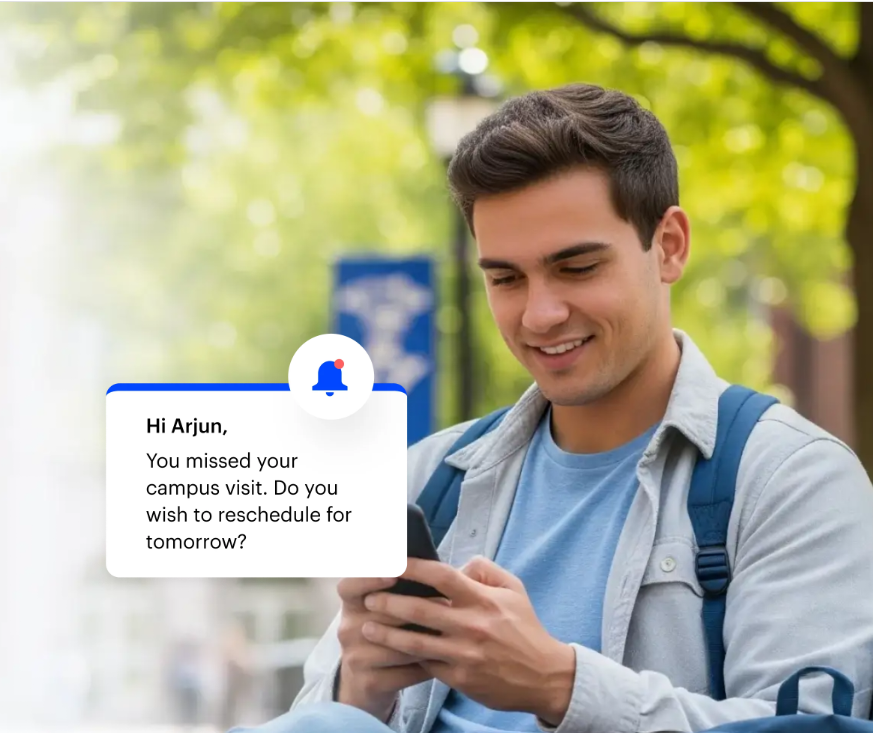
Real personalization in higher ed includes:
The key word is scale. You’re not creating 10,000 unique campaigns. You’re building intelligent frameworks that personalize automatically based on student behavior, attributes, and engagement patterns.
Personalization at scale is impossible without clean, integrated data. Before you craft a single segmented email, you need three foundational elements working together.
Your CRM, Student Information System (SIS), and Customer Data Platform (CDP) must talk to each other. This creates a unified student record that tracks someone from anonymous website visits through enrollment.
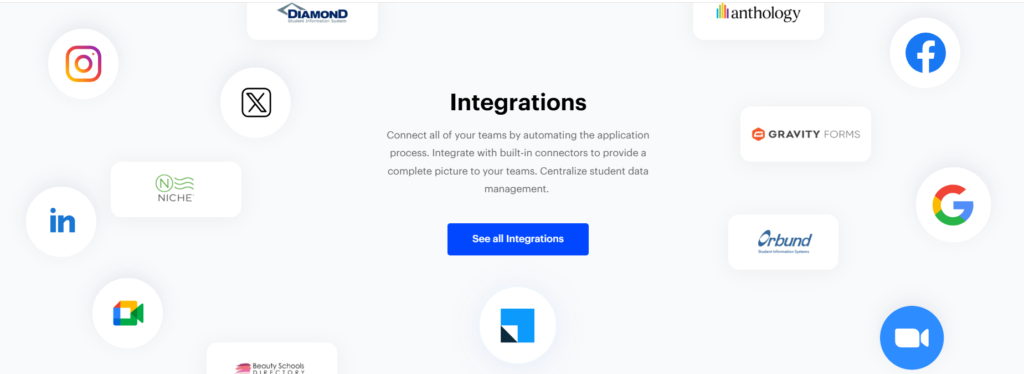
The minimum viable setup includes:
Most institutions already have these systems but run them in silos. Connecting them is the key—and it doesn’t always require expensive middleware. Many modern higher ed specialized education platforms like LeadSquared include native connectors and pre-built integrations that reduce implementation time.
LeadSquared offers out-of-the-box integrations with major SIS platforms and provides unified tracking across website visits, email engagement, call logs, and application progress—all within a single student record view that enrollment teams can action immediately.
Also read: Using CRM To Power Highly Personalized Marketing Campaigns
You need to connect anonymous sessions to known individuals while respecting privacy. This means:
According to the 2024 EDUCAUSE Analytics Landscape Study, while 79% of institutional leaders express interest in analytics, significant gaps remain in data integration and infrastructure—making unified prospect and student data systems a critical priority. Closing this gap is your first 90-day priority.
Raw demographic data tells you who someone is. Behavioral data tells you what they care about and when they’re ready to act.
High-value signals to track:
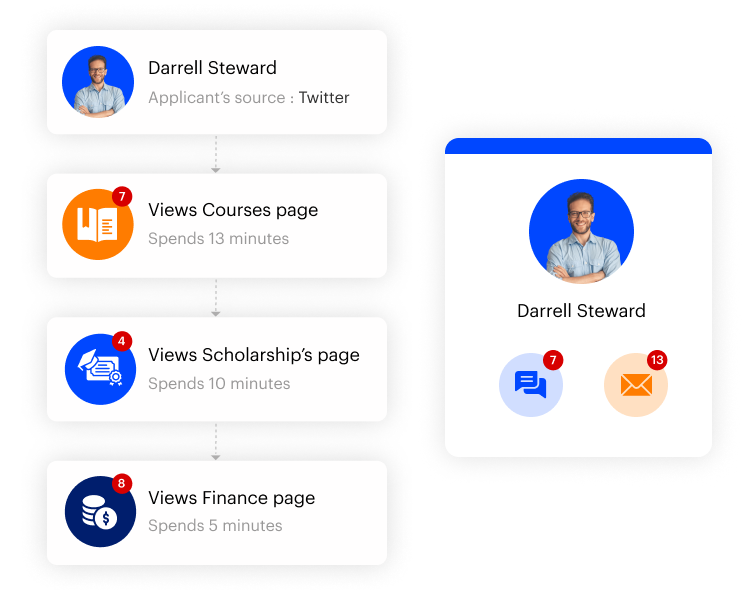
Each signal should update the contact record in real time and trigger appropriate follow-up sequences. A student who’s viewed your engineering program page four times in a week is fundamentally different from someone who clicked one email and never returned.
Modern CRM platforms designed for education—like LeadSquared—automatically capture these behavioral signals without requiring custom development. The platform tracks website activity, content downloads, email engagement, and application progress, then makes this data immediately available for segmentation and automation triggers.
Effective segmentation for higher education marketing campaigns combines attributes you know with behaviors you observe and outcomes you predict.
1. Program interest and academic fit: Segment by intended major, academic preparation level, and program-specific behaviors. A student researching data science needs different content than someone exploring social work.
2. Enrollment stage and readiness: An inquiry in October of senior year is very different from an inquiry in February. Create stage-specific journeys that match decision timelines.
3. Geographic and demographic context: In-state vs. out-of-state, domestic vs. international, traditional vs. non-traditional age, first-generation status—all influence messaging and offer strategies.
4. Engagement propensity and channel preference: Some students devour email. Others only respond to SMS. Model engagement likelihood and honor channel preferences.
Institutions using predictive analytics—including AI lead scoring, or machine learning lead scoring, enrollment propensity models, and behavioral forecasting—see up to 75% higher conversion rates compared to basic scoring methods, while generating 50% more enrollment-ready prospects at 33% lower cost.
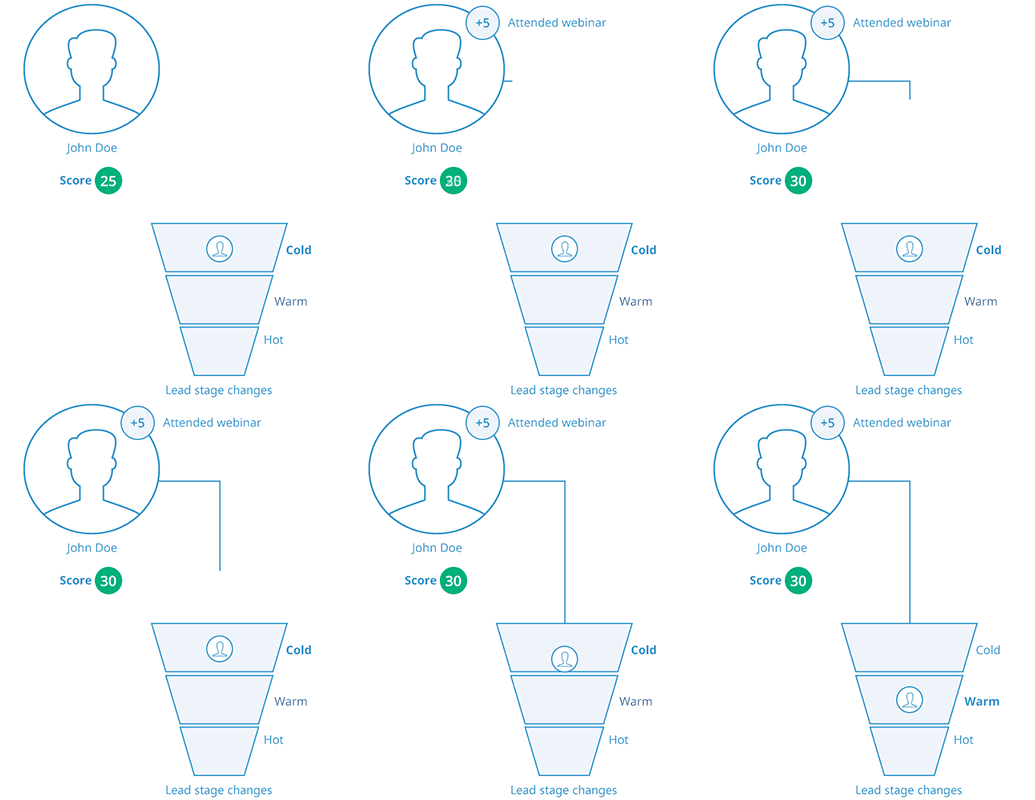
Build scoring models that predict:
Start simple. Even a basic model that assigns points for email opens, website visits, and form submissions will dramatically improve your targeting efficiency compared to batch-and-blast approaches.
LeadSquared’s intelligent lead scoring automatically weights activities based on conversion correlation—website visits, email clicks, form submissions, and call connections are scored dynamically. Admissions counselors can prioritize their daily follow-up based on real-time engagement scores, ensuring high-intent prospects get immediate attention.
Beyond traditional demographics, consider why students are choosing your institution. Students select colleges to fulfill specific goals and motivations.
Common JTBD in higher ed:
Map your content and messaging to these underlying motivations. A working adult seeking an online MBA to accelerate their career needs very different proof points than an 18-year-old looking for the traditional college experience.
Great personalization requires a matrix of messages that address different needs at different stages through different channels.
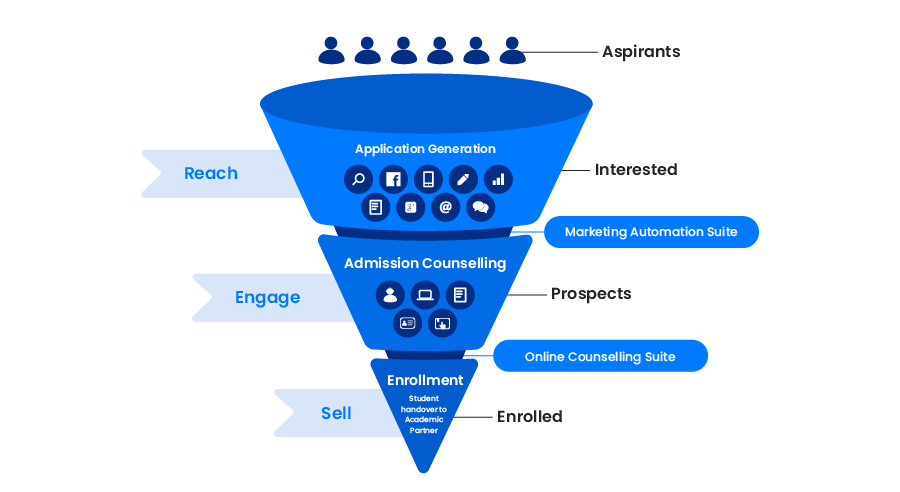
LeadSquared enables true omnichannel orchestration by managing email, SMS, WhatsApp, and voice communications from a unified platform. Campaigns can automatically switch channels based on engagement—if a student doesn’t open emails, the system can trigger SMS outreach. All interactions are logged in one timeline, giving counselors complete context for every conversation.
Also read: 5 Education Marketing Channels & 8 Strategies: Boost Conversions
Students don’t think in channels—they experience your brand as one continuous conversation. Your systems should too.
Modern marketing automation platforms let you orchestrate journeys that span email, SMS, website, paid media, and even direct mail from a single workflow.
Example journey: Application completion campaign
Day 0 (Application started, not submitted):
Day 2 (If not completed):
Day 5 (If not completed):
Day 7 (If not completed):
Day 10 (If not completed):
This journey uses five channels in a coordinated fashion. Each touchpoint is tracked, and completion at any point stops the sequence.
With LeadSquared’s workflow automation, institutions can build these complex, multi-channel journeys with visual drag-and-drop builders. The platform automatically manages wait times, channel switches, and completion triggers—no coding required. When a student completes their application at any stage, they’re immediately removed from the recovery sequence and enrolled in the next appropriate journey.
AI isn’t replacing enrollment marketers—it’s letting them work on an institutional scale with boutique-level personalization.
Machine learning models analyze historical data to predict which actions drive progression. They can recommend:
These models improve continuously as they observe outcomes.
AI can help scale personalized content creation:
Critical safeguard: Always implement human review loops. AI should draft, suggest, and optimize—but enrollment professionals must approve messaging, especially anything related to financial aid, academic requirements, or policy information. FERPA and institutional liability demand this oversight.
AI-powered chatbots on your website can handle initial questions 24/7, qualify leads, and route high-intent prospects to human counselors.
Best implementation practices:
Chatbots shouldn’t replace counselors—they should free counselors from repetitive questions so they can focus on high-touch, complex needs.
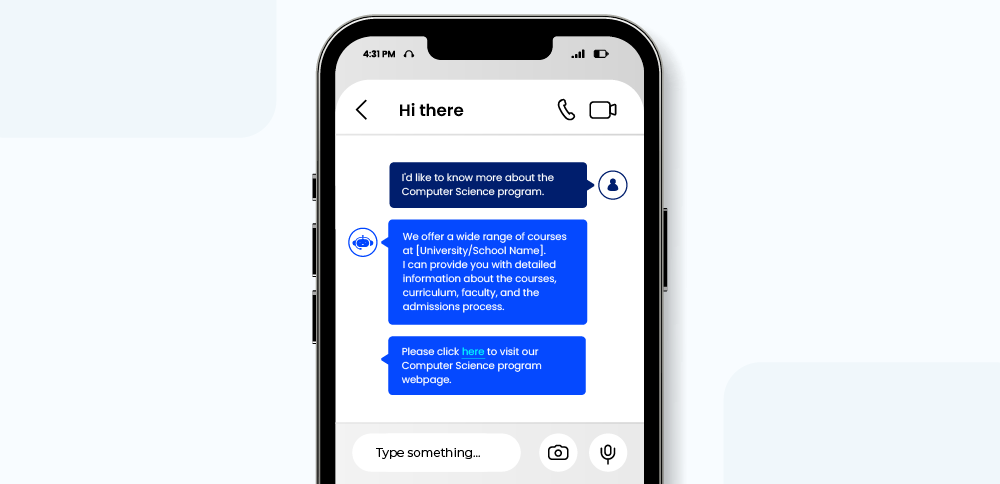
LeadSquared integrates with chatbot platforms and automatically captures conversation data into student records. When a chatbot conversation identifies a high-intent prospect—someone asking about application deadlines or financial aid—the system can immediately notify the assigned counselor and queue the lead for follow-up with full conversation context.
Personalization without guardrails creates legal, ethical, and reputational risk.
Practical compliance steps:
When in doubt, consult your institution’s legal counsel. Privacy law is evolving rapidly, and stakes are high.
Personalized content must be accessible to everyone. Follow WCAG 2.1 AA standards:
Personalization can actually improve accessibility when done thoughtfully. For example, allowing users to select their preferred content format (video, text, audio) makes your content more universally usable.
Challenge: Fragmented systems prevented personalized, timely responses. Generic outreach led to inquiry drop-offs in a competitive market.
Solution: LeadSquared’s behavioral lead scoring identified each prospect’s engagement level and program interests. A 21-touchpoint strategy adapted messaging based on student actions—website visits triggered relevant program information, application starts prompted personalized assistance. Each message came from the student’s assigned counselor’s personal contact, creating authentic connections at scale.
Results: Speed-to-lead improved 12x with contextually relevant messages. Contact rates increased by 13% through behavioral prioritization. Campus appointments rose by 5%. Personalized automated acknowledgments achieved a 100% response rate, with communications tailored to each student’s specific program of nterest and enrollment stage. \
Challenge: With 100,000+ monthly inquiries across 75 colleges, counselors couldn’t personalize guidance at scale. Students received generic information regardless of their interests or behavior.
Solution: Website tracking captured which programs students explored, time on cost pages, and learning format preferences. This powered personalized omnichannel campaigns: nursing prospects received evening tour invitations, budget-conscious students got EMI options upfront, working adults saw flexible schedules. Lead scoring prioritized high-intent students, while automated campaigns sent program-specific content based on browsing patterns.
Results: Platform delivers 1 million personalized emails monthly, dynamically adapted to each student’s college preferences, budget, and interests. Counselors access complete behavioral profiles—every program viewed, every document downloaded—enabling highly relevant conversations. Real-time tracking shows which colleges students explore most, allowing proactive outreach before students even ask.
Personalizing higher education marketing campaigns at scale isn’t about sending more messages—it’s about sending better ones. The institutions winning enrollment are those that use data, segmentation, and automation to make every touchpoint relevant.
Start with your biggest pain point. If it’s converting inquiries to applications, build a behavioral nurture campaign for engaged prospects. If it’s yield, focus on admitted student journeys. Prove ROI in one area, then expand.
The students you’re recruiting have grown up with algorithmic personalization everywhere else in their digital lives. Meeting their expectations isn’t optional anymore—it’s table stakes. The future of enrollment isn’t louder marketing—it’s smarter, more relevant, more human-feeling communication at an institutional scale. The tools and frameworks exist today. The question is whether your institution will use them to stand out or blend in.
LeadSquared is a comprehensive CRM and marketing automation platform purpose-built for education institutions. With unified student journey tracking, omnichannel engagement capabilities, and intuitive automation tools, LeadSquared helps colleges and universities personalize at scale—from first inquiry through graduation. Learn more about how LeadSquared can transform your enrollment marketing.
Personalizing higher education marketing campaigns at scale means delivering relevant, individualized messages to thousands of prospective students automatically based on their behaviors, interests, and stage in the enrollment journey. Instead of sending generic emails to everyone, institutions use data, segmentation, and automation to tailor content—so a nursing prospect sees clinical placement rates while an engineering inquiry receives lab tour invitations. This approach dramatically improves engagement and conversion rates without requiring counselors to manually customize every interaction.
Start by implementing marketing automation platforms like LeadSquared that track student behavior (website visits, content downloads, application progress) and trigger personalized messages automatically. Build 3-5 core audience segments based on program interest and engagement level, then create message frameworks for each lifecycle stage. Use behavioral triggers—not manual effort—to send relevant content. For example, when a student views your financial aid page three times, the system automatically sends scholarship information. This lets small teams deliver personalized experiences to thousands of prospects simultaneously.
Institutions implementing personalized campaigns typically see 15-40% increases in email click-through rates, 10-25% improvement in inquiry-to-application conversion, and significant gains in yield rates.
For example, as we discussed in this article, Asher College improved speed-to-lead by 12x and increased contact rates by 13% after implementing behavioral personalization with LeadSquared. College Vidya scaled from handling 10 to 100,000+ monthly inquiries while delivering 1 million personalized emails through automated, behavior-driven campaigns. The key is starting with one pain point, proving ROI, then expanding.
Most institutions can launch initial personalized campaigns within 90 days following a phased approach. Weeks 1-4 focus on data infrastructure and baseline measurement. Weeks 5-8 involve building segments and content frameworks. Weeks 9-12 activate automated journeys and begin testing. The investment typically includes 200-400 staff hours and $15-45K in budget depending on current technology maturity. Start with high-impact use cases like application abandonment recovery or admitted student nurture, prove effectiveness, then scale to additional segments and channels.
 18 min read
  8 min read
  8 min read


 Digital intake forms in healthcare: A practical guide