





- Home

- Learn
- Healthcare
- How to implement an AI patient intake agent in your clinic
HEALTHCARE
How to implement an AI patient intake agent in your clinic
Contents

 16 min read


As AI rapidly proliferates into the world of healthcare, every step of the patient journey is undergoing digital transformation. AI patient intake agents are emerging as widely adopted solutions for improved intakes, reduced wait times and enhanced patient experiences.
| Metric | Traditional Intake | With Tech or AI-enabled intake automations |
| Patient wait time | 60-100 min average wait time for manual processing. | Up to 57% reduction in patient wait time. |
| Form completion rate (before visit) | Can be low, with many patients completing forms on-site or not at all. | 64-74% completion rate with electronic pre-visit forms. |
| Staff data entry errors | Manual entries are highly prone to mistakes. | Error rates in patient forms can fall by 40-50%. |
| No-show rate | Last-minute no-shows are common and lead to revenue leakage. | Digital and AI-powered patient intake models can reduce no-shows by upto 70%. |
| 24*7 accessibility | Limited, as intake occurs only during defined office hours. | 24*7, always-on intake possible via phone or portal |
| Multi-language support | Varies – some locations may offer English-only forms. | Agents can be configured in multiple languages. |
| Compliance & Privacy | Manual processes risk compliance lapses. | Built in HIPAA and GDPR compliant controls for audit-trails, end-to-end encryption. |
| Staff workload | Heavy workload, with most of the staff time dedicated to repetitive calls & paperwork. | Low workload, with AI patient intake agent automating repetitive tasks and paperwork. |
| Integration capabilities | Staff members have to manually re-enter data into CRM/EHR/HIS. | Data flows between systems automatically. |
In most clinics, “patient intake” refers to print-out forms, repetitive questions and staff fluttering between insurance calls and front-desk check ins. But walking into a clinic shouldn’t feel like walking into an auction, with everyone vying to be noticed first. That’s where AI patient intake agents come in: to help clinic visits feel like boarding a plane with an e-boarding pass, quick and hassle-free.
AI patient intake agents are virtual bots that digitally automate every step of the patient intake journey, from information collection to updating records. They can converse with patients via phone calls, chat, or website portals. Some processes an AI patient intake agent can help automate include appointment scheduling, insurance & patient record verification, FAQ handling, and consent form capture.
In this article, we will take you through the fundamentals of implementing a patient intake AI agent, covering technological, compliance, and specialty-specific aspects.
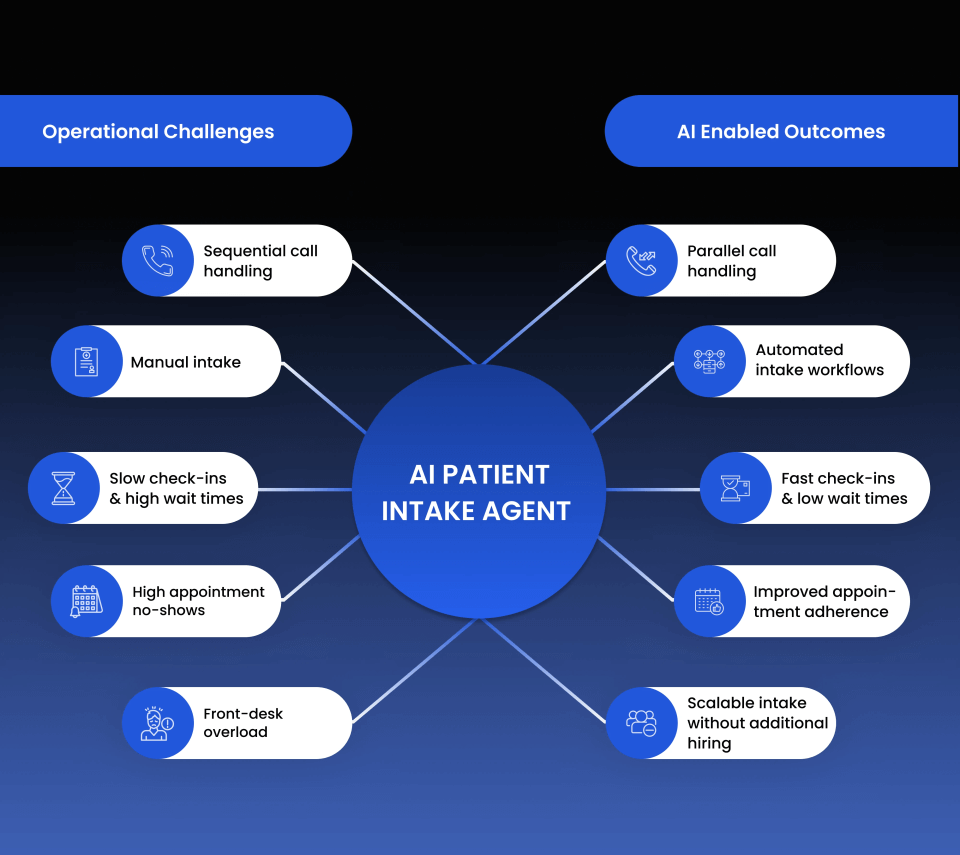
As patient volumes grow, traditional intake struggles to keep up. Phones ring non-stop, forms pile up, and small delays compound into longer waits and patient drop-off. This leads to missed appointments, loss of information, and burnt-out staff.
An AI patient intake agent, on the other hand, can help streamline this complex and sensitive process. This is especially critical in ABA clinics,where a poorly designed patient intake process can frustrate families, delay care, and create confusion around client-provider fit. By guiding families through intake smoothly, an AI patient intake agent can play a central role in collecting the right information early and setting the patient up for success.
A centralized process or agent helps manage the intake process by:
As a result, registration workflows become consistent and proactive, with the patient being actively involved in every step through regular communication. This ensures complete patient data capture and engagement, 24×7 operational support, and a smoother patient experience — all without extra headcount.
AI patient intake agents enable patients to complete the registration process digitally, either through a short voice interaction or pre-guided chatbot workflows. Studies across outpatient settings show check-in times drop by 60% when intake is completed pre-visit, meaning patients can spend less time in the lobby and more time with the clinician.
Automated reminders, self-scheduling, and instant rescheduling help keep patients on track. Clinics that send automated reminders report up to 50% fewer no-shows, leading to more optimized schedules. AI capabilities like Scheduling Agents enable automatic appointment booking.
Patient intake agents can handle incoming calls, intake forms and appointment confirmations simultaneously, helping free up time for human staff. Research shows clinics can reduce intake call handling costs by up to 40% with AI-enabled patient intake solutions. Moreover, AI intake agents are always on and operate 24*7 – meaning late-night appointment requests, weekend form submissions and after-hour questions are handled immediately.
Rushed conversations and manual form entries can lead to transcription errors. With AI handling information collection in the patients’ preferred language at the patients’ convenience, forms are completed, and inconsistencies are flagged early. This translates to fewer billing issues, lower claim denial risk, and improved trust and compliance.
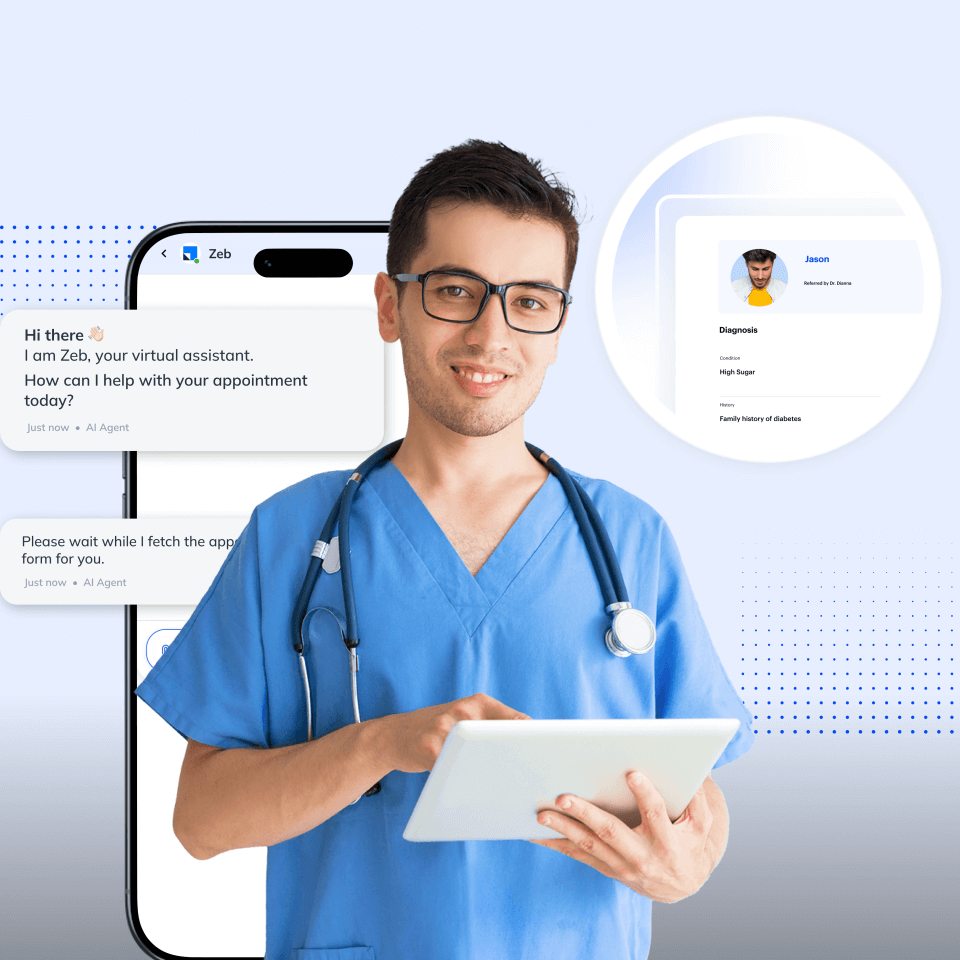
An AI patient intake agent combines conversational AI, workflows, and system integrations to guide patients through the intake process smoothly.
The agent follows a pre-configured intake flow that ensures it captures the patient’s contact details, medical history, consent, appointment preferences, and visit-specific questions in a logical order. Some AI agents can be configured to include specialty-specific questionnaires and screening forms as well.
AI intake agents can interact with patients via phone (voice), SMS, WhatsApp, web chat or portals, depending on patients’ preference. Upon data capture, the agent can route it to appropriate systems for various uses – even coordinating cross-system communication.
Once the information has been captured via the intake flow, the AI patient intake agent sends automated confirmation messages, pre-visit instructions, and reminders via the patients’ preferred channel of communication. Some AI agents can also provide simple one-click (“Yes”/”No”/”Reschedule”) replies to reduce no-shows.
AI intake agents use natural language processing (NLP) to understand dynamic input. This enables the agent to ask relevant follow-up questions.
Agents can be configured to automatically verify patient data and insurance eligibility using standards like FHIR or HL7, which also enable it to push the verified data directly into the EHR or HIS. Every interaction between the agent and patient can be logged with relevant insights for audit and quality checks.

Step 1: Assess your current patient intake workflow
Step 2: Align users and stakeholders
Step 3: Scour and choose the right AI intake platform
Step 4: Integrate your systems and go live
Step 5: Conduct pilots of phase-wise rollouts
Starting small is the key to successful rollouts. This is especially important if you’re implementing your AI patient intake agent across multiple locations or specialties.
Step 6: Introduce system to patients
Step 7: Measure results and scale
Most users of AI patient intake agents see ROI in 6-9 months, depending on the areas automated. Platforms like LeadSquared simplify this journey with real-time intake dashboards, no-code workflow automations and built-in support for multi-location clinics.
Given the sensitive nature of the data the AI patient intake agent will handle, you must choose a vendor that is thoroughly regulatory-compliant. Here are region-wise compliance guidelines to keep in mind:
Apart from region-specific privacy compliance guardrails, the following points are essential to keep in mind:
AI works best when it’s built for the operations and systems you use. While the core workflow may remain the same across clinics, certain aspects such as follow-up questions, tone and routine rules may change by specialty, visit type and patient profile. Here are a few examples of how different clinics may implement AI clinic intake agents:
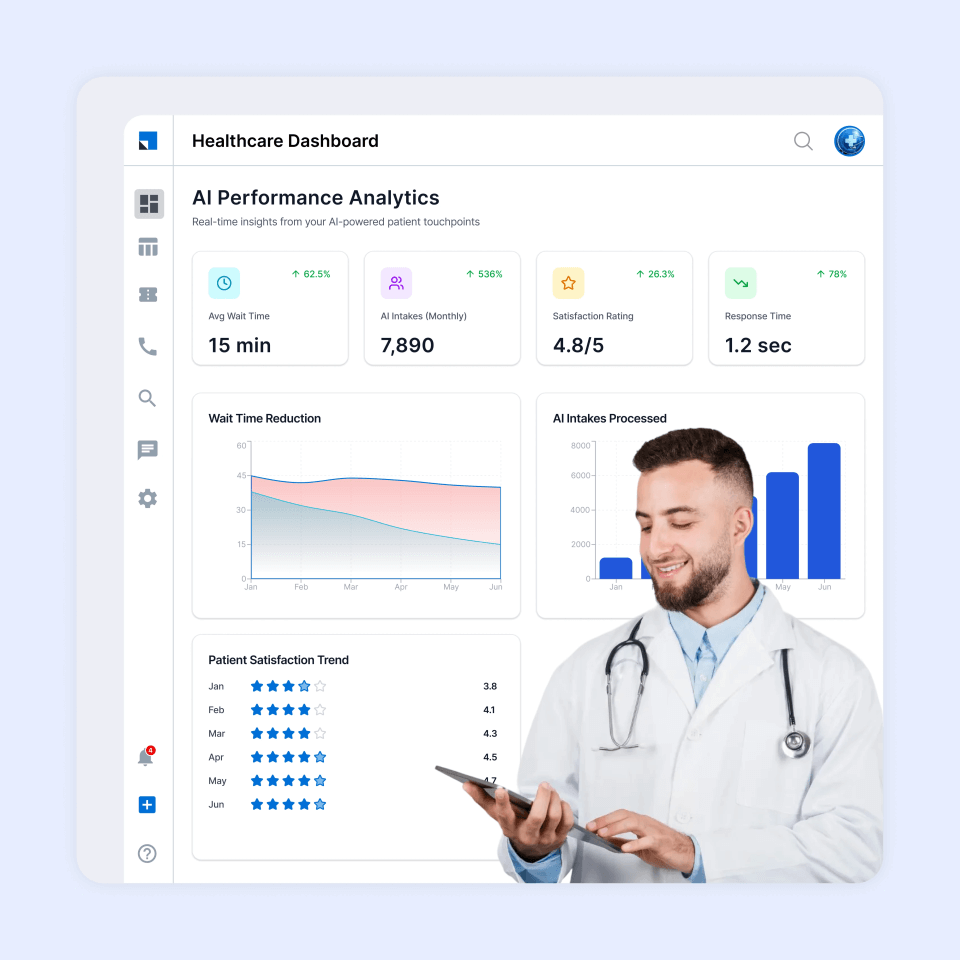
After 6-9 months, calculate your ROI by comparing investment costs to savings gained from reduced overtime, avoided hires, patients gained and recovered appointments. If results are strong, consider expanding your AI agent to handle other tasks and departments.
AI patient intake agents are simplifying the way patients interact with clinics and staff. With routine intake handled consistently at scale, clinics are experiencing shorter wait times, cleaner data, smarter workflows, and more engaged staff. As healthcare operations shift toward digital models, AI intake platforms and agents will begin to take center stage. If you’re considering adopting an AI-based patient intake and engagement platform, this article gives you the roadmap. With a healthcare-optimized platform with LeadSquared, getting started is easy.
Clinics can automate patient intake and onboarding by implementing AI patient intake agents to collect the patient’s details such as medical history, documents and consent before their visit. The AI agent guides patients through intake via their preferred channel of communication, validates required fields, and pushes structured data directly onto the clinic’s CRM or EHR.
With AI patient intake agents helping patients check-in via digital means before they even arrive at the front desk, form filling exercises are reduced. This significantly reduces lobby wait times and improves patient flow, especially during peak hours.
Clinics can automate appointment booking, rescheduling, and cancellations by implementing an AI patient intake agent. The AI agent can integrate with the clinic’s scheduling system to check provider availability in real time and book appointments instantly. Patients can also reschedule or cancel via interacting with the AI agent without having to call the front desk.
Clinics can streamline the collection of patient documents and forms by implementing an AI patient intake agent. The agent can prompt patients to upload necessary documents such as ID proofs, insurance cards, referrals, or consent forms during the digital intake flow. By using OCR and validation rules, the system can ensure documents are complete and readable before submissions, hence reducing follow up calls and delays at the clinic.
While choosing AI-based intake systems, clinics should ensure that the vendor supports encryption, role-based access, audit trails and compliance with regulations such as HIPAA, GDPR and India’s DPDP Act. AI workflows can improve compliance by enforcing digital consent, logging every interaction, and preventing unauthorized access to patient data.
For clinics to move from manual patient management to automated systems safely, they should start with pilot phases by automating high-impact areas like intake and scheduling. AI patient intake agents can be implemented to help automate intake and scheduling-related processes.

 15 min read 15 min read 13 min read


 What Should Be in Your Sales Toolkit in 2026