
EDUCATION
Higher education lead nurturing: The complete guide to converting more students 
Contents

    For most prospective students, choosing a college or university is one of the biggest decisions of their lives. 

    True lead nurturing in higher education means walking alongside a prospect through that decision. 

    Higher education lead nurturing is not about blasting personalized emails to every prospective student who lands on your website. It is about building meaningful relationships between your institution and the people who matter most — students who are actively searching for the right place to invest their future. 

    It involves a sequence of targeted, well-timed communications that acknowledge where a student is in their journey, address their specific concerns, and position your institution as the answer they’ve been looking for. Done right, it doesn’t feel like marketing at all. It feels like guidance. 

    And in this guide, we’ll tell you how to give that guidance in the best way you can! Read on.  

    What is education lead nurturing? 

    The student journey begins long before an application is submitted — usually with a search query. From that first click, prospective students are evaluating institutions, consuming content, and forming impressions. This is where lead nurturing begins: capturing attention, earning trust, and exchanging valuable content for the information that lets you start a real conversation. 

    From there, nurturing is about staying one step ahead. It means anticipating what a prospective student needs at each stage of their decision-making process and delivering the right information before they even think to ask for it. When done well, it creates a steady rhythm of relevance that keeps your institution top of mind — and keeps students coming back. 

    4 Effective education lead nurturing tactics 

    1. Build a data-driven lead scoring system

    Understanding education lead scoring

    Not every prospective student who visits your website is ready to enroll. And when measuring applicant-to-enrollment conversion specifically (students who have already submitted applications), the average rate is approximately 20%. However, the full inquiry-to-enrollment funnel shows significantly lower conversion at 3-5%.
    Education Leads
    Higher education lead nurturing: The complete guide to converting more students  6

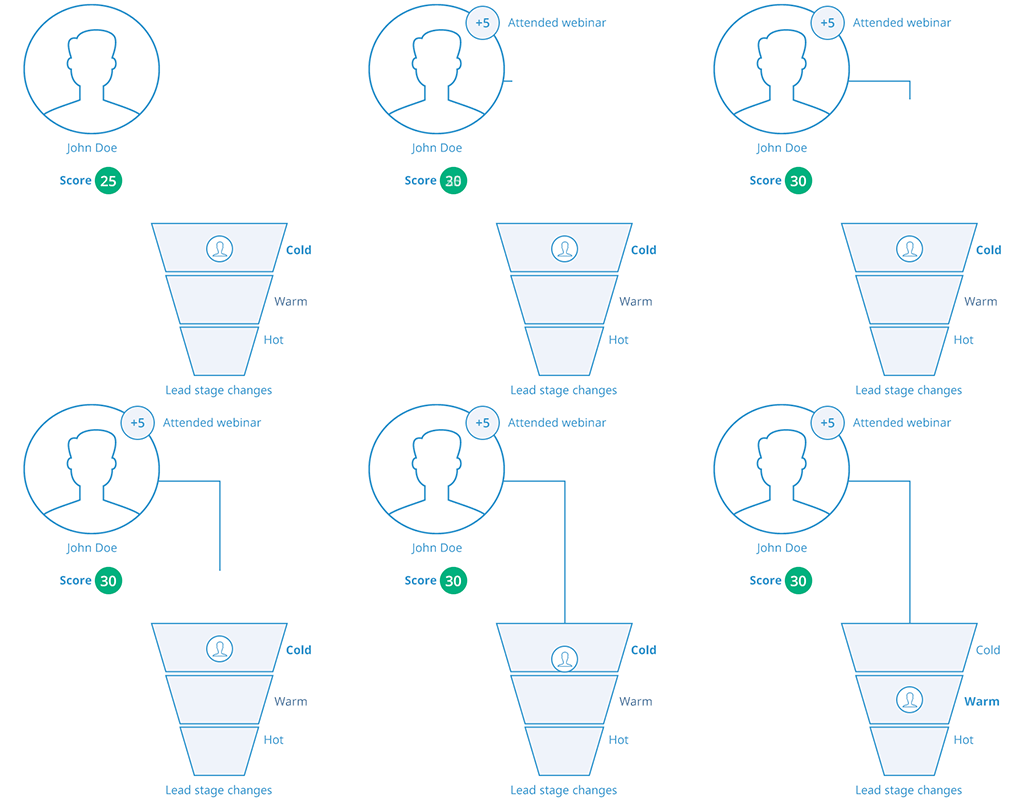
    Lead scoring assigns point values to prospect behaviors and characteristics, helping enrollment teams prioritize follow-up. Here’s how to build an effective scoring model:
    Demographic Scoring (30% weight):

    • Program match: +25 points (interested in programs you offer)
    • Geographic fit: +15 points (in serviceable region)
    • Financial indicators: +10 points (income level matches tuition)
    • Age/career stage: +10 points (matches typical student profile)

    Behavioral Scoring (50% weight):

    • Visited website 5+ times: +20 points
    • Downloaded program guide: +30 points
    • Attended virtual info session or webinar: +40 points
    • Started application: +50 points
    • Opened 3+ nurturing emails: +15 points
    • Visited pricing page: +25 points
    • Watched program video to completion: +20 points
    Education lead stage changes
    Higher education lead nurturing: The complete guide to converting more students  7

    Engagement Timing (20% weight):

    • Active in past 7 days: +20 points
    • Active in past 30 days: +10 points
    • No activity in 60+ days: -10 points

    Scoring Thresholds:

    • Hot Lead (80+ points): Contact within 2 hours, assign to senior counselor
    • Warm Lead (50-79 points): Enter standard nurture sequence, contact within 24 hours
    • Cold Lead (20-49 points): Long-term nurture campaign, monthly touchpoints
    • Unqualified (<20 points): Quarterly newsletter only

    Tools for Lead Scoring:

    • Native scoring in: LeadSquared, and other Education CRM platforms like Slate, HubSpot Education, Salesforce Education Cloud
    • Standalone tools: Leadfeeder, Madkudu, Infer
    • Custom solutions: Google Analytics 4 + CRM integration

    Building your scoring model: A step-by-step framework

    Step 1: Define your ideal student profile

    Before scoring behaviors, identify demographic characteristics of students who typically enroll and succeed:

    • Geographic location (serviceable region)
    • Age range and career stage
    • Educational background
    • Financial indicators
    • Program interest alignment

    Step 2: Build demographic scoring framework

    Assign point values to profile characteristics:

    • Program match: +25 points (interested in programs you offer)
    • Geographic fit: +15 points (in serviceable region)
    • Financial indicators: +10 points (income level matches tuition)
    • Age/career stage: +10 points (matches typical student profile)
    • Referral source quality: +5 points (alumni/employee referrals)

    Step 3: Define behavioral scoring criteria

    Score engagement actions based on intent signals:
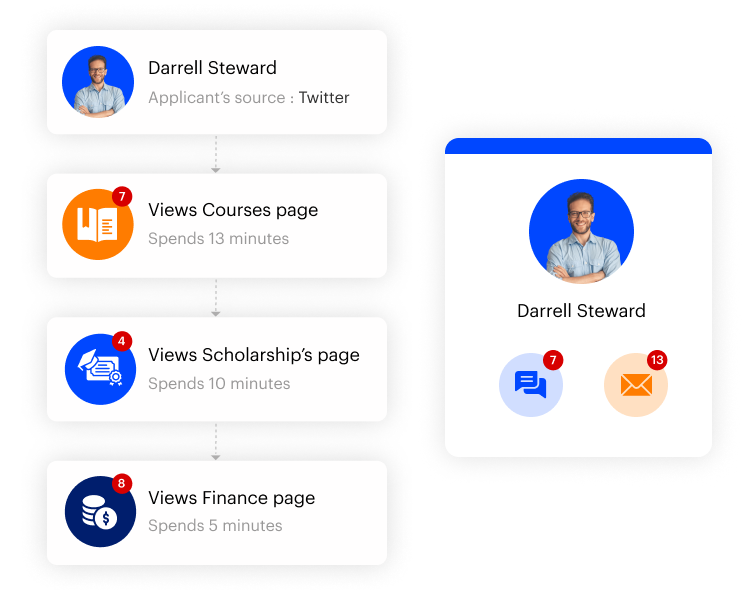
    • Started application: +50 points (highest intent)
    • Attended virtual info session: +40 points
    • Downloaded program guide: +30 points
    • Visited pricing page: +25 points
    • Watched program video (>50%): +20 points
    • Visited website 5+ times: +20 points
    • Opened 3+ nurturing emails: +15 points
    • Submitted inquiry form: +10 points
    Score engagement actions based on intent signals
    Higher education lead nurturing: The complete guide to converting more students  8

    Step 4: Add engagement timing weights

    Recency matters for conversion likelihood:

    • Active in past 7 days: +20 points
    • Active in past 30 days: +10 points
    • No activity in 60+ days: −10 points
    • No activity in 90+ days: −20 points

    Step 5: Establish scoring thresholds

    Define lead categories with clear action triggers:

    • Hot Lead (80+ points): Contact within 2 hours, assign to senior counselor
    • Warm Lead (50–79 points): Enter standard nurture, contact within 24 hours
    • Cold Lead (20–49 points): Long-term nurture campaign, monthly touchpoints
    • Unqualified (<20 points): Quarterly newsletter only

    Step 6: Test and Calibrate

    Validate scoring against historical conversion data:

    • Pull 3–6 months of past conversions
    • Apply scoring model retroactively
    • Compare predicted scores vs. actual enrollments
    • Adjust point values if <70% accuracy
    • Retest until threshold accuracy reaches 75%+

    Step 7: Implement in CRM

    Configure automation and alerts:

    • Build custom fields for each scoring criterion
    • Set up automated score calculations
    • Create alerts when leads cross thresholds
    • Configure lead assignment rules
    • Test with 10–20 sample leads before full rollout

    2. Check for leakages in your sales funnel

    Not every prospective student who enters your pipeline will enroll — and that’s expected.

    What institutions need to avoid is losing students due to gaps in their own process. A slow follow-up, irrelevant communication, or a broken touchpoint in the application journey can quietly push a motivated prospect toward a competitor.

    This is why regularly auditing your lead nurturing process matters. Tracking where students drop off — whether it’s after an inquiry, a campus visit, or an application start — helps your admissions and marketing teams spot weak points before they become patterns. Fixing these gaps early saves time, reduces recruitment costs, and ultimately improves enrollment outcomes. Do your higher education lead nurturing analysis, and course-correct wherever needed.

    3. Define a set protocol for interacting with your leads

    There is a fine line between staying on a prospective student’s radar and overwhelming them. Too many emails, too many calls, and too little relevance will push even genuinely interested students away. A structured communication cadence — one that respects their time and mirrors where they are in the enrollment journey — is far more effective than high-volume outreach.

    This is where drip campaigns prove their worth in higher education. A well-sequenced drip starts with higher-frequency touchpoints when interest is fresh, then gradually shifts to periodic, value-driven communication as the student moves closer to a decision. Each message feels timely rather than intrusive, keeping your institution present in their mind without crowding their inbox.

    On that note…

    4. Develop a content strategy for education lead nurturing

    Education buyers have unique content needs at each funnel stage. Here’s what works for different education segments:

    A. Higher education (Undergraduate programs):

    Awareness Stage (Months 9-12 before enrollment):

    • Virtual campus tours (8-12 minute videos)
    • Student day-in-the-life blogs
    • Major exploration guides
    • Career outcome data by program
    • Financial aid calculators

    Consideration Stage (Months 4-8):

    • Department-specific webinars with faculty
    • Admitted student Meta (Facebook) groups Parent information sessions
    • Housing and campus life details
    • Scholarship opportunity alerts

    Decision Stage (Months 1-3):

    Deposit deadline reminders with incentives

    • Course registration previews
    • Roommate matching information
    • New student orientation details
    • Committed student ambassador connections

    B. K-12 Private Schools:

    Awareness Stage:

    • Teacher credential highlights
    • Curriculum differentiation guides
    • College acceptance track records
    • Parent testimonial videos

    Consideration Stage:

    • Shadow day invitations
    • Sample class recordings
    • Student work portfolios
    • Extracurricular program tours
    • Tuition assistance calculators

    Decision Stage:

    • Enrollment contract with FAQs
    • New family orientation schedule
    • Supply list and uniform information
    • Carpool/transportation coordination
    • Parent association introduction

    C. Test Prep & Professional Training:

    Unique characteristics:

    • Extremely short decision cycles (2-8 weeks vs. months)
    • 100% self-directed adult learners
    • Test dates create natural urgency deadlines
    • High price sensitivity (direct out-of-pocket payment)
    • Results-driven decision making (past performance data is #1 factor)
    • Mobile-first behavior (75%+ of engagement on smartphones)

    Awareness Stage (Weeks 8-12 before test):

    •  Free full-length diagnostic test with instant scoring
    • “Ultimate [Test Name] Study Guide” comprehensive PDF
    • Score improvement calculator showing ROI
    • Test format overview and common mistakes videos
    • “Can you score [Target] without a course?” Quiz
    • Study timeline templates by test date
    • Sample lesson videos (15-minute format)

    Consideration Stage (Weeks 4-8 before test):

    • Before/after score improvement case studies with timelines
    • Student success video testimonials from similar backgrounds
    • Comparison guides (Self-study vs. Course vs. Private tutor)
    • Meet the instructors video series
    • Free 1-on-1 strategy consultation calls
    • ROI calculator (score improvement → scholarship value)
    • Payment plan options and pricing transparency

    Decision Stage (Weeks 1-4 before test):

    • Money-back score improvement guarantees
    • Limited enrollment spots messaging for upcoming cohorts
    • 7-day free trial or risk-free cancellation offers
    • “What happens on Day 1” orientation preview
    • Direct instructor outreach via phone/SMS
    • Enrollment deadline countdown timers
    • Last-minute bonuses (extra practice tests, extended access)

    Lead scoring adjustments:

    • Registered for test with date set: +40 points
    • Test date within 60 days: +30 points
    • Completed diagnostic test: +50 points
    • Watched sample lesson to completion: +25 points
    • Visited pricing page: +30 points
    • Attended live webinar: +40 points

    Key metrics:

    • Response time target: <5 minutes (leads go cold fastest in this segment)
    • Inquiry-to-enrollment conversion: 15-25%
    • Average days to conversion: 14-21 days (standard timing)
    • Cost per enrollment: $80-250
    • Primary objection: “I can study on my own” (counter with data showing guided prep = 2-3x better results)

    Some helpful resources:

    10 Student Engagement Strategies For Higher Education

    A Detailed Guide On Student Recruitment Strategies For Colleges In 2026

    The Ultimate Guide To Higher Education Marketing In 2026

    Week-by-week implementation roadmap

    Phase 1: Foundation (Weeks 1-4)

    Week 1: Audit & Planning

    • Export last 12 months of lead data from current systems
    • Calculate current conversion rates by source and stage
    • Identify top 5 lead sources (website, referrals, ads, events, etc.)
    • Map existing content to funnel stages (awareness/consideration/decision)
    • Document current follow-up processes and response times

    Deliverable: Current State Assessment Document

    Week 2: Segmentation Strategy

    • Define segments (by program, geography, demographics, behavior)
    • Create student personas (3-5 detailed profiles)
    • Map typical decision timeline for each segment
    • Identify key decision criteria by segment
    • Set conversion benchmarks by segment

     Deliverable: Segmentation Framework Document

    Week 3: Content Inventory & Gap Analysis

    • Catalog all existing content (blogs, videos, guides, webinars)
    • Tag content by funnel stage and segment
    • Identify content gaps (stages/segments with <3 pieces)
    • Prioritize content creation based on highest-value segments
    • Create content production schedule (next 90 days)

    Deliverable: Content Gap Analysis & Production Calendar

    Week 4: Technology Setup

    • Configure CRM fields for lead scoring
    • Set up segmentation tags in email system
    • Connect Google Analytics to CRM for behavior tracking
    • Create dashboard for monitoring key metrics
    • Test integrations between systems

    Deliverable: Configured Technology Stack

    Phase 2: Program Build (Weeks 5-8)

    Week 5: Lead Scoring Model

    • Define scoring criteria (demographic + behavioral)
    • Set point values for each criterion
    • Establish scoring thresholds (hot/warm/cold)
    • Build scoring automation in CRM
    • Train team on how to interpret scores

    Time Investment: 12-15 hours

    Week 6: Email Sequence Development

    • Write welcome sequence (5 emails over 14 days)
    • Create nurture sequences by segment (8-12 emails over 90 days)
    • Develop re-engagement campaign (4 emails for dormant leads)
    • Design decision-stage push sequence (3 emails over 7 days)
    • A/B test subject lines and CTAs

    Time Investment: 20-25 hours

    email sequence deployment
    Higher education lead nurturing: The complete guide to converting more students  9

    Week 7: Automation Workflows

    • Build trigger-based workflows (download, page visit, video watch)
    • Set up lead assignment rules to enrollment counselors
    • Create notification alerts for hot leads
    • Configure lead routing by geography/program
    • Test all workflows with sample leads

    Time Investment: 10-12 hours

    Budget: $0-500 (depending on CRM capabilities)

    Week 8: Sales Enablement

    • Create lead handoff protocol document
    • Develop talk tracks for each lead score category
    • Build library of responses to common questions
    • Set service level agreements (response times by priority)
    • Train enrollment team on new processes

    Time Investment: 8-10 hours

    Phase 3: Launch & Optimization (Weeks 9-12)

    Week 9: Soft Launch & Testing

    • Launch nurture sequences to small test group (50-100 leads)
    • Monitor email deliverability rates and spam scores
    • Test all automation triggers with live leads
    • Conduct QA on lead scoring calculations
    • Review initial engagement metrics (open rates, click rates)
    • Fix any broken links or workflow errors
    • Gather feedback from enrollment team on lead quality

    Time Investment: 10-12 hours

    higher education lead nurturing - launch and testing
    Higher education lead nurturing: The complete guide to converting more students  10

    Week 10: Full Launch & Monitoring

    • Roll out to entire lead database
    • Set up daily monitoring dashboard (key metrics)
    • Schedule daily check-ins with enrollment team (first week)
    • Document issues and quick wins
    • Begin A/B testing email subject lines
    • Monitor response time compliance
    • Track conversion rates by segment

    Time Investment: 12-15 hours

    Week 11: Initial Optimization

    • Analyze first 2 weeks of performance data
    • Adjust lead scoring thresholds based on actual conversions
    • Refine email sequences (pause low performers, amplify winners)
    • Update automation workflows based on bottlenecks
    • Revise talk tracks based on enrollment team feedback
    • Test new CTAs on underperforming emails
    • Create report of early wins and learnings

    Time Investment: 15-18 hours

    Week 12: Documentation & Handoff

    • Create comprehensive playbook document
    • Document all workflows with screenshots
    • Build training videos for new team members
    • Establish ongoing optimization schedule (monthly reviews)
    • Set up automated reporting (weekly/monthly)
    • Conduct final team training session
    • Create 90-day roadmap for continued improvements

    Time Investment: 10-12 hours

    Measuring Lead Nurturing Effectiveness

    Primary KPIs (Track Weekly)

    1. Conversion rate by stage

    Formula:

     (Leads advancing to next stage ÷ Total leads in current stage) × 100

    Benchmarks:

    Inquiry → Application

    • 15–25% (higher ed)
    • 35–45% (test prep)

    Application → Enrollment

    • 30–45% (higher ed)
    • 50–70% (test prep)

    Overall Inquiry → Enrollment

    • 3–8% (higher ed)
    • 15–25% (test prep)

    Tracking Method:

    • Create Google Analytics funnel visualization
    • Set up CRM stage change reports (run every Monday)
    • Compare to same period last year

    2. Lead Velocity Rate

    Formula:

     [(Leads this month − Leads last month) ÷ Leads last month] × 100

    • Target: 10–15% month-over-month growth
    • Segment by source to identify highest-performing channels

    3. Time-to-Conversion

    Formula:

    Average days from first touch to enrollment

    Benchmarks:

    Undergraduate

    • 6–12 months

    Graduate Programs

    • 3–6 months

    Certificate Programs

    • 1–3 months

    Test Prep Courses

    • 2–4 weeks

    4. Email Engagement Metrics

    • Open rate: Target 25–35% (education average: 28%)
    • Click rate: Target 3–5% (education average: 3.8%)
    • Unsubscribe rate: Keep below 0.5%

    Analysis Approach:

    • Segment by student type (traditional, adult learner, international)
    • Test send times (Tuesday 10am vs Thursday 2pm vs Sunday 6pm)
    • A/B test subject line personalization

    Secondary KPIs (Track monthly)

    6. Content Engagement Score

    Calculate weighted score:

    • Blog read: 1 point
    • Video watched >50%: 3 points
    • Guide downloaded: 5 points
    • Webinar attended: 10 points
    • Campus visit: 20 points

    Use Case:
    Leads with 25+ points convert at 3.2x rate vs. <10 points

    7. Lead Score Distribution

    Track percentage of leads in each category:

    • Hot (80+ points): Target 5–10%
    • Warm (50–79 points): Target 20–30%
    • Cold (20–49 points): Target 40–50%
    • Unqualified (<20): Acceptable up to 30%

    Alert Trigger:
    If >40% of leads are “Unqualified,” review lead sources and qualification criteria

    8. Nurture Email Performance

    Track by sequence:

    • Welcome series: 45% open rate, 8% click rate (higher engagement expected)
    • Monthly newsletter: 22% open rate, 2.5% click rate
    • Re-engagement: 15% open rate, 1.5% click rate

    Optimization Rule:
    If sequence drops below 20% open rate for 2 consecutive months, pause and redesign.

    CRM Dashboard Requirements:

    • Lead source performance table
    • Stage conversion rate trends
    • Average time in each stage
    • Counselor performance metrics
    • Enrollment forecast based on pipeline

    Mini case studies

    Case study 1

    upGrad, a leading B2C EdTech provider, aimed to scale its student enrollment and outreach efficiency across its various business verticals.

    Challenge:

    • High turnaround time (TAT) for responding to student inquiries.

    • Risk of lead leakage due to fragmented acquisition sources.

    • Need for improved productivity within B2C sales and engagement teams.

    • Manual processes slowing down the student conversion funnel.

    Implementation (12-week rollout):

    (While the results are verified, the specific project phases here are a creative interpretation)

    Weeks 1-4: Foundation & Integration

    Marketplace Integration: Connected diverse lead acquisition marketplaces directly into LeadSquared to centralize data.

    Data Consolidation: Audited existing student data to eliminate silos across B2C verticals.

    Weeks 5-8: Automation

    Response Automation: Implemented automated workflows to trigger immediate responses to new student inquiries.

    Workflow Optimization: Built no-code workflows to handle lead distribution and student engagement.

    Weeks 9-12: Optimization

    Productivity Monitoring: Leveraged LeadSquared as a tracking tool to monitor team performance and response metrics.

    Process Refinement: Adjusted automated triggers to hit the target response time of under 30 minutes.

    Results (Post-implementation):

    Response Time: Student response times reduced to under 30 minutes.

    TAT Efficiency: 70% faster turnaround time overall.

    Data Integrity: Achieved Zero Lead leakage.

    Team Output: Improved productivity through automation and marketplace integration.

    Key Success Factors:

    1. Automation of Engagement: Using LeadSquared’s automation to ensure near-instant contact with prospective students.

    2. Centralized Marketplace Integration: Real-time sync of leads from external platforms to prevent data loss.

    3. Comprehensive Tracking: Utilizing the CRM as a central tool to monitor and improve sales performance.

    “upGrad has multiple business verticals, and some of them depended on manual lead distribution. After implementing LeadSquared, lead response times have reduced from 36hr to 30 mins.”

    – Shikhar Singh, Associate Director – Growth Initiatives & Sales Operations, upGrad

    Read more here: UpGrad Reduces TAT To Under 30 Minutes With LeadSquared

    Case study 2

    Yocket, a platform helping students study abroad, sought to improve its engagement with prospective students and optimize its conversion funnel.

    Challenge:

    High lead churn: Potential students were dropping out of the funnel before being contacted.

    Low connectivity: Difficulty in successfully reaching students via phone calls, a common industry struggle.

    Conversion gaps: Need for more efficient outreach to drive student enrollment.

    Implementation (12-week rollout):

    (While the results are verified, the specific project phases here are a creative interpretation)

    Weeks 1-4: Foundation

    Lead Management Integration: Centralized student data within LeadSquared to gain visibility into the entire journey.

    Process Mapping: Identified critical touchpoints where lead churn was highest.

    Weeks 5-8: Automation

    Call Optimization: Deployed LeadSquared’s communication tools to automate and track student outreach.

    Lead Prioritization: Established automated workflows to ensure high-intent students were called during peak connectivity windows.

    Weeks 9-12: Optimization

    Performance Tracking: Used LeadSquared as a tracking tool to monitor call connectivity and agent productivity.

    Churn Reduction: Refined follow-up sequences based on behavioral data to prevent lead drop-off.

    Results:

    Call Connectivity: Achieved 65% connectivity, which is 1.5X higher than industry standards.

    Lead Retention: Significant improvement in lead churn rates.

    Enrollment: Increased student conversions through more effective and timely communication.

    Key Success Factors:

    1. Overcoming Connectivity Barriers: Achieving 1.5x higher connectivity than the industry average through optimized outreach.

    2. Churn Mitigation: Proactively addressing lead loss using integrated tracking and follow-ups.

    3. Data-Driven Engagement: Using CRM insights to bridge the gap between initial inquiry and successful student conversion.

    “LeadSquared makes it easier to set up campaigns or automations as compared to Zoho. The in-house teams stay in constant contact to resolve any issues. LeadSquared’s cloud telephony integration, helped us achieve 65% call connectivity which is 1.5X the industry standards.”

    – Mihir Mehta, Head of Sales, Yocket

    Read more here: Yocket Achieves 65% Call Connectivity (1.5X Higher Than Industry Standards!)

    Common pitfalls & how to avoid

    Pitfall 1: Over-weighting demographics – Many institutions assign too many points to demographic fit and miss high-intent leads from non-traditional backgrounds. A 45-year-old career changer may score low on demographics but could be your most motivated student.

    Prevention: Weight behavioral signals 60-70% vs. demographics 30-40%. Intent beats profile.

    Pitfall 2: Static scoring models – Setting thresholds once and never revisiting them leads to drift as your lead sources and student populations evolve.

    Prevention: Review scoring accuracy quarterly. If hot leads convert <40%, recalibrate thresholds. Markets change—your model should too.

    Pitfall 3: No negative scoring –  Failing to subtract points for disengagement means dead leads stay “warm” forever, wasting counselor time.

    Prevention: Implement decay scoring. Subtract 10-20 points after 60-90 days of inactivity. Archive leads below zero points.

    Pitfall 4: Ignoring lead source quality – Treating all inquiries equally when Google Ads converts at 8% and trade shows at 2% misallocates resources.

    Prevention: Add source multipliers: organic search (+10 points), referrals (+15 points), low quality aggregators (-5 points).

    In conclusion

    Lead nurturing in higher education is not a campaign you run once — it is an ongoing commitment to showing prospective students that your institution understands their goals and has the right environment for them to achieve those goals. Students will always explore their options. Your job is to make sure that through every stage of that exploration, your institution remains the most compelling one.

    About this guide

    This framework has been developed based on implementations across education institutions using various CRM platforms.

    If you are looking for a good enrollment CRM that can help you increase admissions through effective lead nurturing, check out LeadSquared.

    LeadSquared offers education-specific CRM capabilities.

    Schedule a demo.

    FAQs

    What is lead nurturing in higher education?

    Lead nurturing in higher education is the process of building meaningful relationships with prospective students through timely, relevant communication — guiding them from their first inquiry all the way to enrollment.

    Why is lead nurturing important for colleges and universities?

    Most prospective students explore multiple institutions before making a decision. A structured nurturing strategy keeps your institution top of mind, reduces drop-offs in the enrollment funnel, and improves conversion rates without increasing recruitment spending.

    What are the most effective lead nurturing channels for higher education?

    Email drip campaigns, SMS follow-ups, personalized landing pages, and timely calls from admissions counselors are among the most effective channels. The key is coordinating these touchpoints around the student’s journey rather than your institution’s convenience.
    Also read: 5 Education Marketing Channels & 8 Strategies: Boost Conversions
     

    What tools do institutions use for higher education lead nurturing?

    Purpose-built CRM platforms like LeadSquared Higher Education CRM allow institutions to automate communication workflows, track every student interaction across channels, and identify where prospects are dropping off in the funnel — making it easier to nurture leads at scale without losing the personal touch.

    Table of Contents