





SALES
Hottest CRM Trends of 2026
Contents

 8 min read


The CRM landscape is constantly evolving, with new technologies and approaches shaping product development. Here’s a breakdown of some of the hottest CRM trends in 2026, followed by a perspective on what it means for business owners and CRM vendors.
Artificial intelligence (AI) is making a big splash in CRMs. From automating tasks and generating reports to offering predictive analytics and personalized communication, AI is transforming how businesses interact with customers.
CRM companies are developing AI models and integrating their platforms with Generative AI systems like ChatGPT, co-pilot, etc., to catch up with the trend.
Some of the leading examples are:
Conversational interfaces and voice assistants are making their way into CRMs. It allows a more natural and user-friendly experience, letting users interact with the system using spoken language.
For example, Salesforce has integrated with Amazon Alexa to allow hands-free access to certain CRM functionalities. Sales reps can use Alexa to update contact information, log calls, or set reminders, all through voice commands.
With the help of CRM data, businesses are personalizing the customer journey to an unprecedented degree. This means tailoring marketing messages, recommendations, and support interactions to each customer’s needs and preferences.
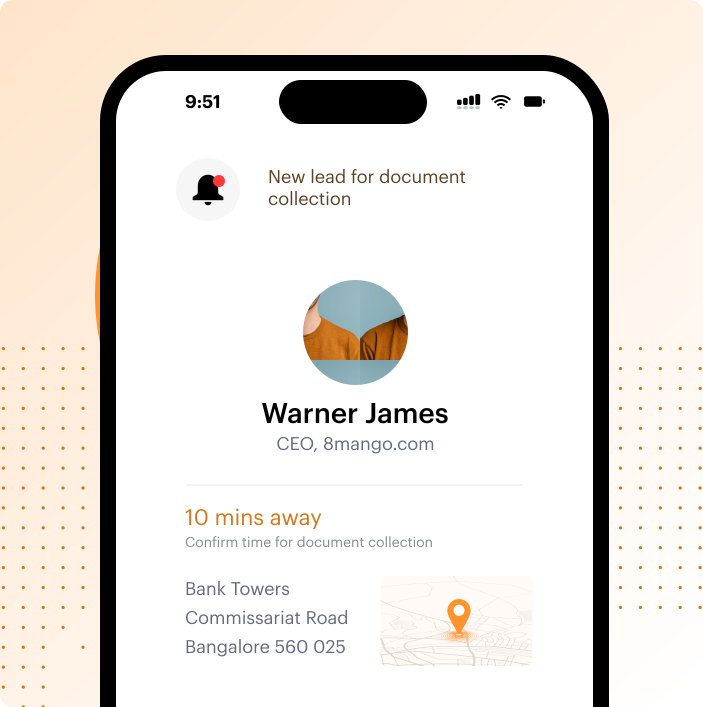
CRM accessibility on mobile devices is crucial in today’s world. The latest CRMs are designed to be mobile-friendly, allowing users to access customer information and complete tasks on the go.
Gone are the days of generic CRM solutions. Today, CRM providers are developing industry-specific CRMs that cater to the unique needs of different businesses.
With the growing importance of customer data security, CRMs are prioritizing robust security measures. This includes data encryption, access controls, and compliance with data privacy regulations.
Some of the ways in which CRM companies are enhancing data security are:
Modern CRMs integrate seamlessly with other business applications, such as marketing automation tools, email platforms, and accounting software. This creates a unified system that streamlines workflows and improves data visibility.
Trends keep evolving. It is up to the business owners to evaluate and prioritize their needs to make the most of their investment in CRM. For this, they need to:
CRM vendors face the challenge of staying ahead of the curve and adapting their offerings to these evolving trends. Here’s how they can navigate this dynamic landscape.
The CRM market is forecast to reach $262.74 billion by 2032, driven by the growing popularity of personalization, digital transformation, and customer experiences.
Players like LeadSquared, Salesforce, Zoho, Oracle, HubSpot, Zendesk, Freshdesk, SugarCRM, and Insightly currently dominate the CRM market. Adapting to the latest trends and investing in robust, industry-relevant CRM solutions will be key to success in this rapidly growing market.
Contact us to learn more about LeadSquared and how it can support your business.
No. Most CRMs today are being designed for non-technical users. AI features like chat-based commands, automated insights, and recommendations are meant to simplify work, not make it more complex. Users can ask questions in plain language, review suggested actions without understanding how the technology works behind the scenes.
Not necessarily. Many CRM vendors now focus heavily on ease of adoption. Interfaces are becoming more intuitive, mobile-friendly, and similar to everyday apps people already use. While some onboarding is required, most teams can start with basic features and gradually adopt advanced ones over time.
AI-powered CRM features are becoming more accessible. Many vendors offer them as part of standard plans or as optional add-ons. Small and mid-sized businesses can start with limited AI capabilities and expand as their needs and budgets grow, rather than making a large upfront investment.
AI predictions are based on historical data and patterns, so they are not perfect. However, they are often more reliable than guesswork. The more data a business feeds into the CRM over time, the better these insights become. AI should be seen as a decision-support tool, not a replacement for human judgment.
AI predictions are based on historical data and patterns, so they are not perfect. However, they are often more reliable than guesswork. The more data a business feeds into the CRM over time, the better these insights become. AI should be seen as a decision-support tool, not a replacement for human judgment.
CRMs can still work, but their effectiveness improves with better data quality. Many modern CRMs include tools to clean, enrich, and organize data automatically. Businesses can also improve results gradually by standardizing data entry and using automation to reduce manual errors.
This depends on the feature and how it’s implemented. Simple improvements like mobile access or better integrations can show results within weeks. More advanced capabilities like AI-driven personalization or analytics usually show meaningful impact over a few months as the system learns from real usage.
Most industry-specific CRMs are built with flexibility in mind. They offer specialized features while still allowing customization and integrations. As businesses grow or diversify, they can often extend the CRM rather than replace it entirely.
When used correctly, modern CRM features improve trust by enabling faster responses, more relevant communication, and better data protection. Customers notice when interactions feel personalized and secure, which directly impacts brand perception and long-term loyalty.
Switching always requires planning, but modern CRMs offer migration tools, onboarding support, and phased rollouts to reduce risk. Many businesses run the new CRM alongside the old one for a short period before fully transitioning, minimizing disruption.
The best approach is choosing a CRM that evolves continuously. Look for vendors that invest in regular updates, open integrations, strong security practices, and scalable architecture. A flexible CRM platform is more future-proof than one built only for current needs.

 27 min read
  20 min read
  17 min read


 17 Powerful Sales Enablement Tools for 2026